


NVIDIA (NVDA) Weekend Outlook: Why the AI Leader Is Down 17% Despite Record Earnings



AI Podcast


NVIDIA’s stock has declined 17.7% from its May 14 all-time high despite record fiscal Q1 2027 earnings. Four headwinds drive this disconnect: a 31% drop in B200 GPU rental rates, zero data center revenue from China, $410.6 million in insider sales, and premium valuation constraints. While technical indicators show the stock is oversold (RSI 28), growth remains supported by the Vera Rubin platform and RTX Spark launch. Investors are closely monitoring upcoming Core PCE data and manufacturing PMIs as catalysts, with a technical entry target at $212.90 and a stop-loss set below $186.20.
TradingKey - NVIDIA (NASDAQ: NVDA) currently trades at $194.74, down 17.7% from its all-time high of $236.54 reached on May 14 following a consolidation that chief executive Jensen Huang has dubbed a “mystery”. The chip maker posted revenue of $81.6 billion in fiscal first quarter 2027, reflecting an 85% year-over-year increase, while delivering a gross margin of 75%. The company also approved an $80 billion buyback authorisation and announced a 25-times dividend hike, arguably marking the most compelling quarter in semiconductor history. But ever since the May 20 results release, NVDA shares have sunk on each successive session.
The 4H chart has NVDA under its EMA200 (206.18) in a declining blue channel, with the RSI at 28.00 (deeply oversold with positive divergence building). This weekend seems like the best opportunity to try to identify the source of this disconnect between the company’s operating performance and its stock price, while also determining if there are any events from June 30 to July 3 that could clear things up.
The Four Forces Keeping NVIDIA Below Its ATH Despite Record Earnings
The first and most measurable factor to watch is the B200 GPU rental price index. The B200’s hourly lease price on some of the largest public cloud networks peaked at $6.11 on May 30, with a decline of 31% in the last three weeks to $4.22 as of June 21. This metric measures AI workload demand against compute capacity in real-time. It’s worth emphasizing that a 31% decline over three weeks doesn’t mean that AI demand is crumbling. It instead suggests that cloud capacity is being built at a rate that is faster than the influx of new AI projects. For a market that has priced NVIDIA as a high-growth franchise with durable pricing power over AI hardware, the trajectory of the rental index was the catalyst for the initial post-earnings selloff.
Another headwind is China. The value of NVDA’s data center revenue from mainland China for fiscal Q1 2027 was effectively zero. For comparison, the segment generated $4.6 billion one year earlier. Early June saw the US Commerce Department close a regulatory loophole to allow Rubin and Blackwell chips to find their way to China into Chinese AI developers via offshore subsidiaries. Jensen Huang admitted to shareholders at May 21’s meeting that the firm had “mostly conceded” China’s cutting-edge chips to Huawei. On top of this, JPMorgan and Bernstein have flagged a $5.5 billion to $16 billion in revenue headwind from China for this coming fiscal year. China remains a structural impairment from which neither NVIDIA’s buyback nor its dividend can fully recover through perception.
The third headwind involves $410.6 million in insider sales over three months. The fourth is the valuation: NVDA began the year at a valuation that was significantly expensive relative to 2023 and 2024’s outstanding returns, limiting the room for the stock price to rerate higher, even as the underlying business continued to outperform.
What Actually Happened at Computex and Why It Matters Going Into Next Week
The only things in Computex, on June 1, I want to focus on, amidst the selloff, were two things:
- Vera Rubin (Blackwell successor) has entered into full mass production and shipments commence in Q3 of 2026. Customers include: OpenAI, Anthropic, xAI, Dell, Oracle, CoreWeave. The Vera Rubin is getting the three full qualified HBM4 memory suppliers Samsung, SK Hynix and Micron shipping into the board.
- RTX Spark, NVIDIA's first System-on-Chip (SoC) designed for Windows-based laptops and compact desktops (including a 20-core, MediaTek-designed CPU (Arm-based) and a Blackwell GPU with 6,144 Cuda cores and 128GB of memory unified (via NVLink) capable of 1 petaflop. Launch customers: Microsoft, Dell, HP, ASUS, Lenovo, and MSI. Expecting 30+ laptop models and 10+ desktop models launching this fall in 2026. RTX Spark stock price impact: Intel -5%, AMD -4%, and Qualcomm -8% on RTX Spark (which means the markets views RTX as a real threat, not just a marketing campaign).
The main catalyst for next week (June 30, July 3) is the Core PCE (May). A weaker Core PCE will ease the multiple compression headwind caused by the Warsh Fed's higher for longer policy and the macro tailwind (from the Warsh Fed) that has compressed tech multiples since May. June manufacturing PMI, for a secondary read of broader AI industrial demand. Any comments from the memory sector about HBM4 pricing and supplies.
NVDA Technical Setup — RSI 28 Extreme Oversold, Descending Channel, Target $212.90
On the 4H timeframe (at $194.74), NVDA is now below the EMA200 ($206.18), inside the descending blue channel (lower highs, lower lows). RSI (28.00) is now strongly oversold with strong buy divergences forming on price. Selling is drying up near the channel. Long wick on recent candles (at least one).
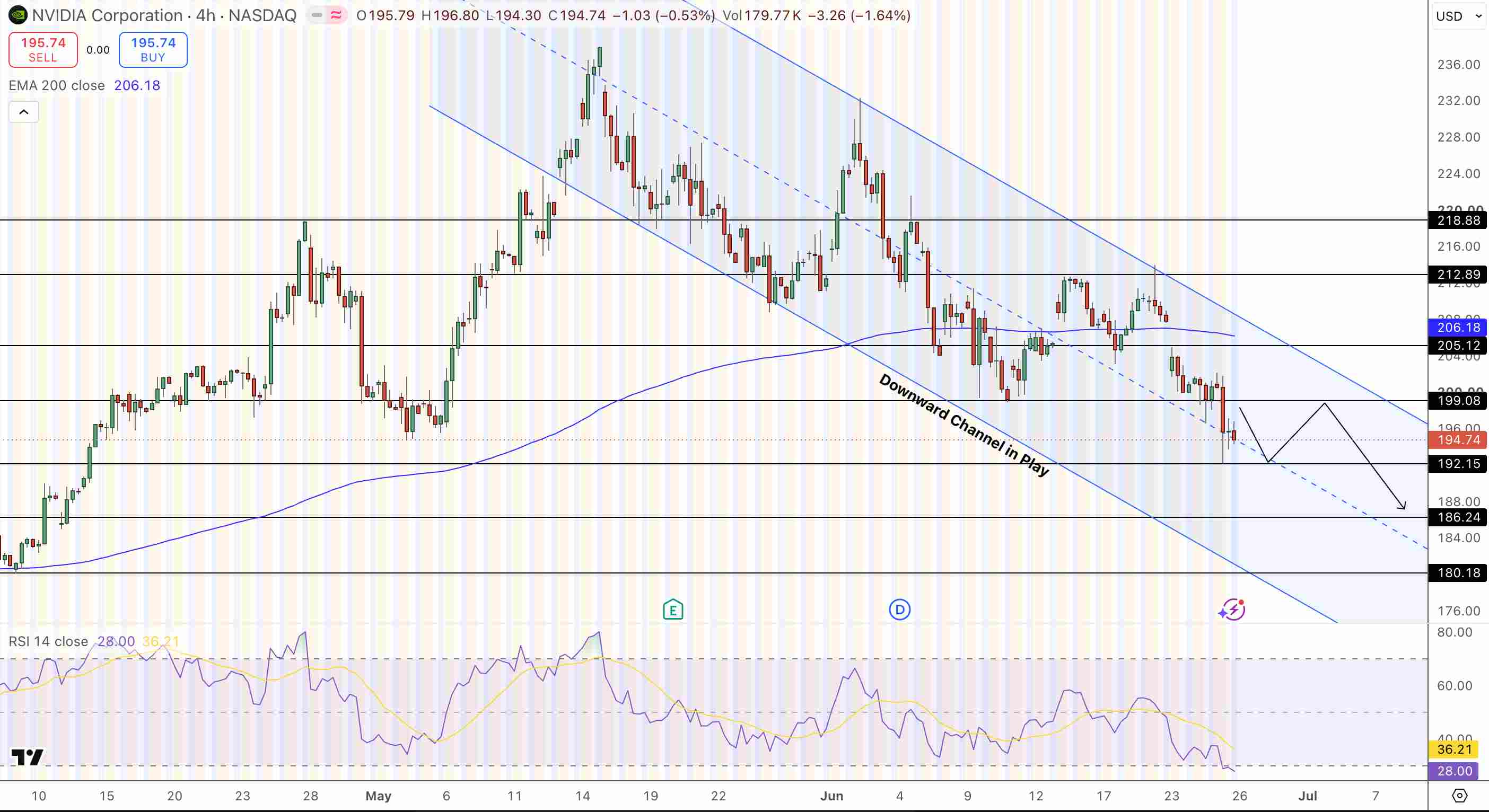
NVIDIA (NVDA) Price Chart - Source: Tradingview
The next line in the sand is $192.15 to $186.24 if this level fails. A clean move over $199.00 would see it retest $212.90 (oversold bounce toward $206.18). The stop is below $186.20.
- Entry: Long above $199.00, clears short term resistance
- Target: $212.90, oversold bounce, toward EMA200
- Stop Loss: Close below $186.20, channel support breaks
- Key macro: Core PCE (May), week of June 30; manufacturing PMI
- ATH: $236.54 (May 14, 2026), Currently $42.16 below (or -17.7%)
- Jensen quote: “Mystery” is Jensen’s public words used to describe NVDA's recent price collapse
Why Is NVIDIA Stock Down 17% From Its All-Time High Despite Record Earnings?
Four specific factors are at play:
- First, the rental rate for the B200 GPU collapsed by 31% to $4.22 a unit in the last three weeks, down from $6.11, signaling that new compute availability is rapidly expanding beyond the rate at which new workloads are emerging, a clear, real-time proxy of oversupply in the market;
- Second, NVIDIA announced that data center revenue from China dropped from $4.6 billion a year ago to effectively zero as U.S. export curbs shut off the country’s data center loophole;
- Third, $410.6 million worth of company insiders sold stock in the last three months, adding to institutional selling, which is why the stock has failed to recover;
- Fourth, NVIDIA opened 2026 in advance of its fiscal year-end 2026 with a premium valuation, which means that even with great news there is limited re-rating upside if not priced down first because the 2023 and 2024 returns were so extraordinary. Jensen Huang even went as far as to publicly describe this pullback as a “mystery”.
What Are Vera Rubin and RTX Spark and Why Do They Matter?
Vera Rubin (VR) is the data center platform successor to Blackwell. It’s now in full production, with early adopters such as OpenAI, Anthropic, xAI, Dell, Oracle, CoreWeave, and all three major HBM4 memory suppliers qualified and shipping.
RTX Spark is NVIDIA’s first AI PC chip designed for a Windows PC. It is a System On Chip (SoC) with an Arm CPU (in a joint development with MediaTek), Blackwell GPU, and up to 128 GB unified memory. It is targeting the Windows laptop and compact desktop market. RTX Spark is coming in late autumn 2026 with over 30 laptop designs and 10 desktops in the works from key partners including Microsoft, Dell, HP, and ASUS. The RTX Spark announcement drove shares down 5% for Intel, 4% for AMD, and 8% for Qualcomm.
Is NVDA a Buy at $195 With RSI at 28?
The setup is deeply oversold with a positive divergence and long lower wicks indicating that buyers are absorbing supply. Buy above $199 to hit $212.90; stop below $186.20. $81.6 billion for Q1 revenue, Vera Rubin is in production, and RTX Spark launching into the PC sector provides multiple avenues for NVIDIA to grow.
All four factors cited above, China revenue near zero, the B200 rental price declining, $410 million in insider selling, and NVIDIA opening 2026 with a premium valuation, explain the lack of recovery following the strong earnings report. Core PCE next week is the macro event most likely to spark a re-rate if prints softer than anticipated.
Bottom Line
NVIDIA delivered the most significant quarter in semiconductor history and the stock is down 17.7% from its all-time high (ATH). Jensen Huang describing the pullback as a “mystery” was accurate from a business perspective, whereas the market’s four-factor thesis (B200 rental price, China revenue, insider sales, valuation) was internally coherent. An RSI of 28 with positive divergence at the channel support level creates a tactically oversold setup for the short term.
The entry above $199 targets $212.90. Stop below $186.20. When markets reopen, Core PCE is the catalyst I will watch for macro reasons and Vera Rubin ramping into production in Q3 is the catalyst I will watch for fundamental reasons to see if the bull narrative can be re-established in the next earnings report.
Recommended Articles











Comments (0)
Click the $ button, enter the symbol, and select to link a stock, ETF, or other ticker.