


GPT-5.2 Debuts as OpenAI Marks 10 Years, Strengthening Its Hold on the AI Frontier



AI Podcast


OpenAI launched its GPT-5.2 series, featuring Instant, Thinking, and Pro versions, achieving significant breakthroughs. The Thinking version reportedly matches human expert levels in software engineering, completing tasks over 11 times faster and at a fraction of the cost. GPT-5.2 excels across various benchmarks, surpassing Google Gemini 3 and Anthropic Claude Opus 4.5 in key reasoning tasks. While market reaction is cautious, with some analysts noting Gemini's integration advantage, GPT-5.2 represents a substantial upgrade. OpenAI also hinted at developing custom AI chips to reduce reliance on Nvidia and celebrated its tenth anniversary, expressing optimism for future superintelligence development.
TradingKey - OpenAI officially launched its latest flagship model, the GPT-5.2 series, on Thursday, just a week after reportedly issuing an internal "red alert."
OpenAI positions GPT-5.2 as "the optimal solution for expert knowledge work," achieving significant breakthroughs across multiple core capabilities.Notably, the GPT-5.2 Thinking version has become the company's first AI model to reach human expert levels in real-world software engineering tasks.
The GPT-5.2 series comprises three versions: Instant, Thinking, and Pro, designed to cover a full spectrum of needs, from everyday office tasks to complex professional assignments.
The Instant version extends GPT-5.1's approachable and natural conversational style, offering quicker responses and clearer explanations for high-frequency tasks such as information retrieval, operational guidance, technical writing, and translation. It directly presents key information, thereby enhancing user efficiency.
The Thinking version, conversely, is engineered for in-depth work. It excels at tasks like coding, summarizing lengthy documents, answering questions based on uploaded files, and performing multi-step mathematical and logical reasoning. Furthermore, it aids users in planning and decision-making through more structured frameworks.
The Pro version targets the most complex and high-risk professional scenarios, demonstrating enhanced accuracy and reliability in demanding tasks like programming, with a significantly reduced rate of critical errors.
Comprehensive Performance Leap
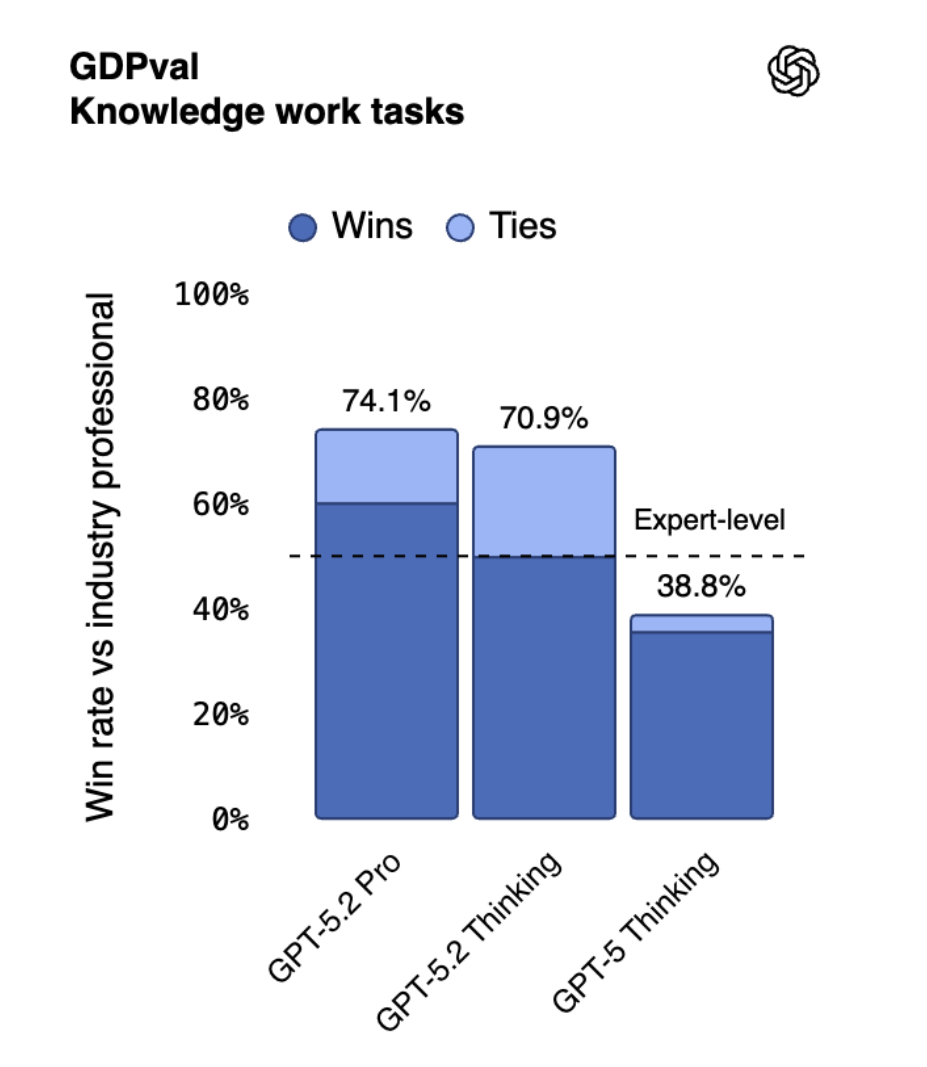
In terms of performance, GPT-5.2 has shattered industry records across numerous authoritative benchmark tests.In the GDPval knowledge work assessment, which covers 44 professions, the model achieved or surpassed human expert levels in 70.9% of tasks. OpenAI highlighted that GPT-5.2 Thinking completes these tasks over 11 times faster than human experts, at less than 1% of the cost.
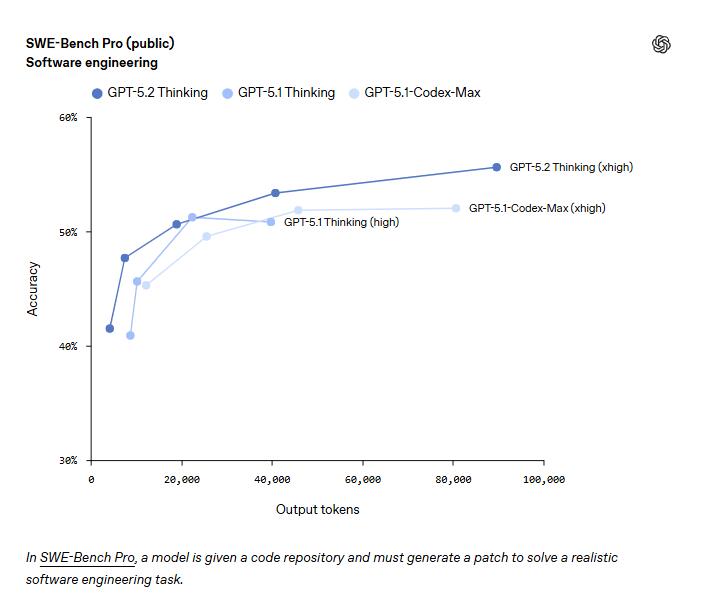
Regarding coding capabilities, the model not only set a new historical high of 80% in the SWE-Bench Verified test but also achieved 55.6% in the more challenging SWE-Bench Pro. These tests encompassed various mainstream languages, including Python, JavaScript, Java, and C++.
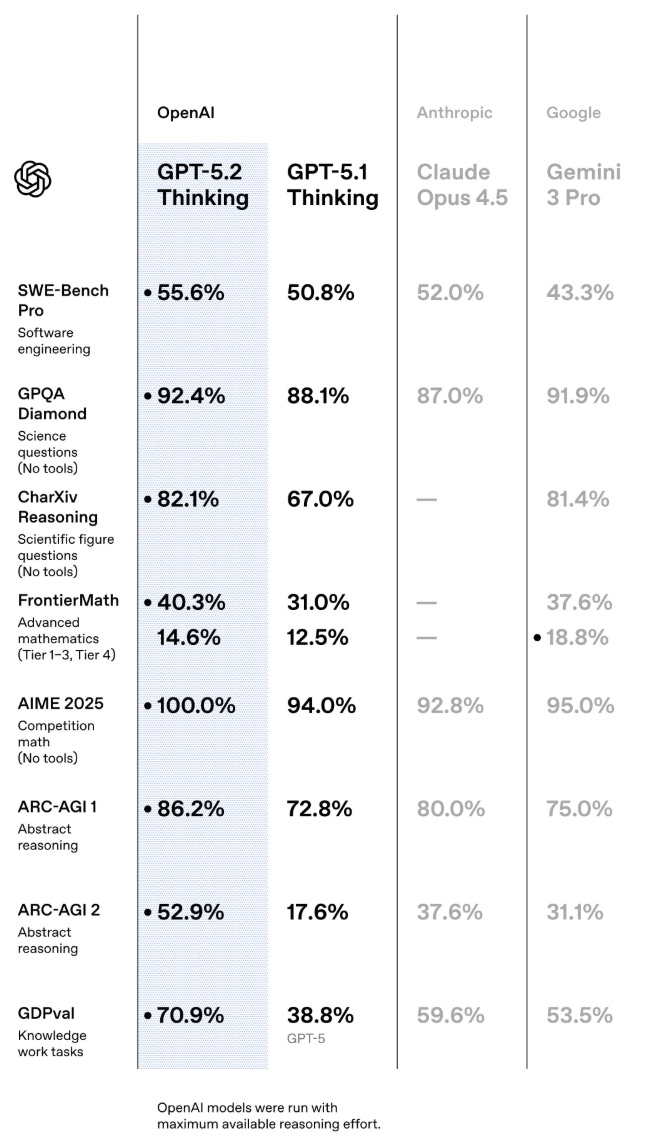
Its scientific and reasoning abilities are equally impressive. GPT-5.2 Pro scored 93.2% on the doctoral-level science Q&A benchmark GPQA Diamond, while the Thinking version achieved 92.4%.
In the general reasoning benchmark ARC-AGI 1, Pro became the first model to break the 90% threshold, marking a significant improvement over last year's o3-preview at 87%. Additionally, the cost to achieve this performance has been reduced to 1/390.
A comparative analysis reveals that GPT-5.2 Thinking slightly outperforms Google Gemini 3 and Anthropic Claude Opus 4.5 across nearly all critical reasoning benchmarks. It maintains an edge in real-world software engineering, advanced scientific Q&A, and abstract pattern discovery tasks.
OpenAI CEO Sam Altman commented, "Even without new features like generating polished documents, GPT-5.2 feels like our biggest upgrade in a long time."
Facing the Competition
Just weeks prior, Gemini 3 had rapidly ascended to the top of LMArena and Humanity’s Last Exam rankings, among others, leveraging its superior reasoning and coding abilities, thereby placing considerable pressure on OpenAI. Earlier this week, media outlets reported that Altman had issued an internal "red alert" memo, urging a concentration of resources to accelerate ChatGPT's iteration.
Responding to this, Fidji Simo, CEO of OpenAI's applications business, stated that the "red alert" was merely an internal priority management tool designed to clarify “Code red, just to put things in perspective, that’s not an uncommon thing,” she said. “We have had an increase in resources focused on ChatGPT in general. I would say that helps with the release of this model, but that’s not the reason it’s coming out this week in particular.”
Altman remarked, "The impact of Gemini 3 on our core metrics may not be as significant as we initially feared." He anticipates OpenAI will exit the red alert status "in a very strong position" before January 2026.
From a technical evolution standpoint, GPT-5.2 appears to be a systematic integration of the past two updates. GPT-5, released in August, underwent an architectural reset, introducing "instant" and "thinking" dual modes. GPT-5.1, in November, optimized conversational abilities and agent collaboration. Building on these, GPT-5.2 comprehensively enhances stability and production-grade reliability.
This release also aims to mend the breach of trust left by the initial GPT-5 version in early August. At that time, the model's elementary errors, such as failing to solve simple math problems and drawing incorrect maps, sparked widespread mockery on social media, exposing OpenAI's challenges in technical stability and product rollout pace.
Notably, despite image generation being an internal priority, this update does not include a new image generator.Since the August launch of Nano Banana, OpenAI has visibly lagged behind Gemini in the visual generation domain. Reports suggest the company plans to unveil a new model with stronger image capabilities in January next year, though this was not confirmed on Thursday.
Market reaction, however, remains cautious. Ray Wang, founder and principal analyst for Constellation Research, said GPT-5.2 is a good response to Google’s Gemini, but not enough to reverse its rival’s momentum. For businesses, “what OpenAI did was make it easier to create office productivity tools,” Wang said. “Gemini is still more integrated.”
Market acceptance for Gemini 3 has been robust, with its Pro preview accumulating 143.5 billion tokens in the five days preceding its launch, significantly higher than Gemini 2.5 Pro's 30.1 billion tokens in its debut week. Furthermore, during its launch week from November 17 to 23, Gemini's weekly visits surpassed 300 million.
Chip Ambitions and Ten-Year Vision
On the same day, in an interview following a deal with Disney (DIS), Altman inadvertently revealed, "We're excited about the upcoming chips." While no details were provided, this slip quickly fueled speculation about OpenAI developing its own AI chips.
Currently, OpenAI has not officially disclosed any chip development plans. However, rumors of collaborations with semiconductor manufacturers like Broadcom (AVGO) have persisted this year, underscoring the company's systematic efforts to reduce its reliance on Nvidia (NVDA), which currently commands approximately 80% of the AI chip market.
Should OpenAI successfully introduce custom chips, it could not only embed its model expertise directly into hardware, enabling software-hardware synergy, but also significantly enhance computing efficiency and cost control.
Thursday also marked OpenAI's tenth anniversary. Altman published a blog post titled "Ten Years," reflecting on the company's journey from a "crazy, unlikely, and unprecedented" starting goal to now "seemingly on the verge of achieving its mission."
He reflected on the early team being "so young, so optimistic, so happy," and despite being "gravely misunderstood," they remained convinced the endeavor was "worth immense effort." He confessed the past three years have been incredibly intense: "Growing from nothing into a massive company is never easy; hundreds of decisions are made every week. I am proud of the team's correct decisions, while most mistakes were my responsibility."
However, he also expressed unprecedented optimism about OpenAI's research trajectory. "In another ten years, it's almost certain we will have built superintelligence. People in 2035 will be able to accomplish things we find unimaginable today."
With the "red alert" seemingly lifted, OpenAI appears to have temporarily regained its footing. However, the battle for AI supremacy is far from over. GPT-5.2's true test will not lie in its laboratory benchmark scores, but rather in its ability to prove itself in the enterprise market.
This content was translated using AI and reviewed for clarity. It is for informational purposes only.
Recommended Articles







Comments (0)
Click the $ button, enter the symbol, and select to link a stock, ETF, or other ticker.