


Japan and South Korea Stocks Slump; Kospi Drops 3.52%, SK Hynix Falls Over 5%, Kioxia Drops Nearly 7%



AI Podcast


On October 22, Japanese and South Korean equities faced a sharp sell-off, with the KOSPI Index dropping 3.52% and the Nikkei 225 falling 2.65%, driven by broad declines in tech leaders like Samsung Electronics, SK Hynix, and SoftBank Group. Amid industry competition and AI demand, Samsung and SK Hynix are upgrading Chinese facilities to produce advanced NAND flash memory, adhering to U.S. export regulations without expanding capacity. Concurrently, the Bank of Korea maintained its benchmark rate at 3.00% on October 22 while upgrading economic growth forecasts, projecting continued momentum from the semiconductor upcycle and potential price increases.

TradingKey - On October 22, Japanese and South Korean stock markets suffered another sell-off. South Korea's KOSPI Index closed down 3.52% at 5,533.78 points, while Japan's Nikkei 225 Index closed down 2.65% at 62,907.84 points, falling below the 63,000-point mark for the first time since September 14.
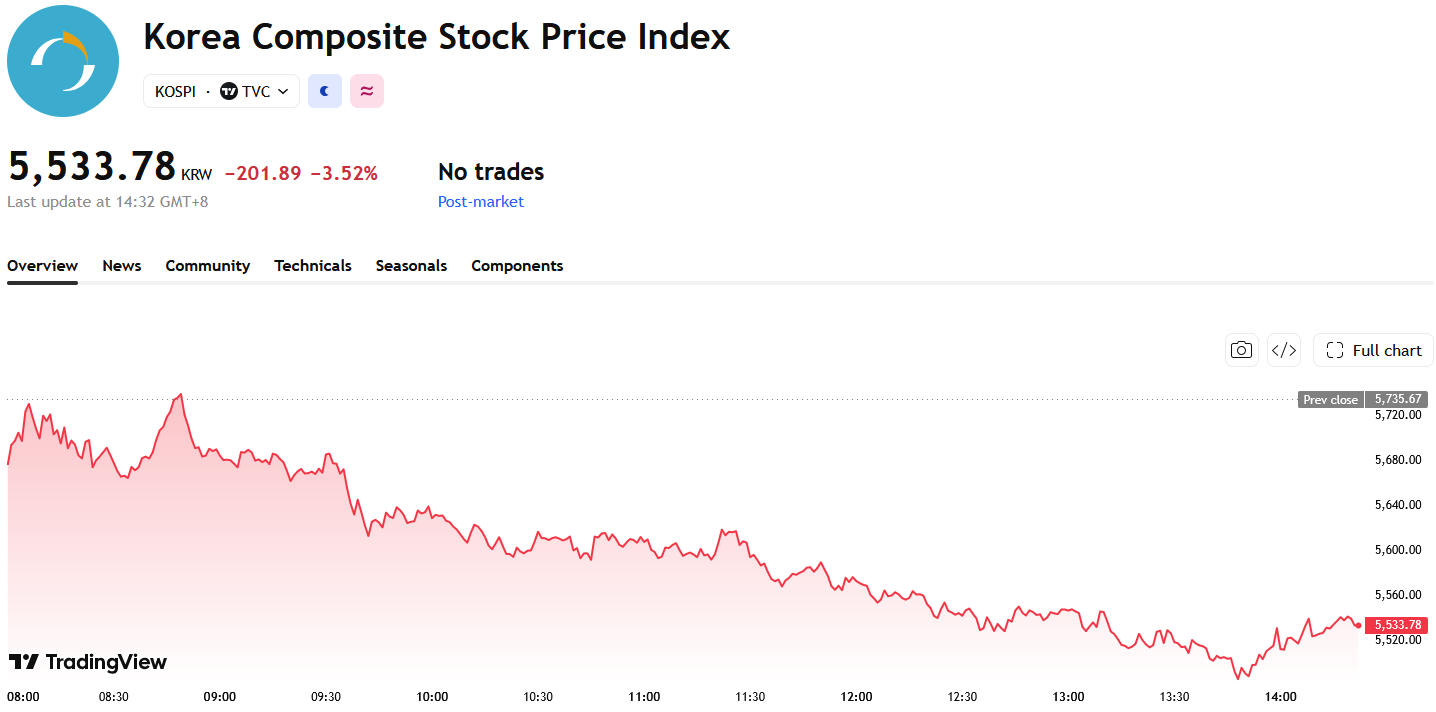
Source: TradingView
South Korean semiconductor leaders tumbled across the board, with Samsung Electronics falling 4.03% to 214,500 won (about $162) and SK Hynix declining 5.49% to 1.223 million won. In the Japanese market, Kioxia fell 6.77% to 12,595 yen (about $80), while SoftBank Group dropped 6.86% to 4,305 yen, placing Japanese and South Korean tech stocks under broad pressure.
Samsung Electronics and SK Hynix are pushing forward with technology upgrades at their plants in China, planning to produce over 200-layer NAND flash memory locally to raise the production technology standard of their Chinese facilities to match their domestic facilities in South Korea, coping with industry competition and meeting growing AI demand. Samsung Electronics stated that the relevant upgrades comply with U.S. export regulations and aim to satisfy global customer demand, including U.S. clients, without expanding production capacity or constructing new manufacturing facilities.
Regarding monetary policy, the Bank of Korea kept its benchmark interest rate unchanged at 3.00% on October 22, meeting market expectations. Previously, the central bank had raised rates in two consecutive meetings in July and August. Meanwhile, the Bank of Korea raised its economic growth forecasts for this year and next, believing that the strong performance of the semiconductor industry will continue to provide key momentum for the South Korean economy. Central bank governor Shin Hyun-song projected that as the semiconductor upcycle persists, chip prices still have room to rise further in the future.
This content was translated using AI and reviewed for clarity. It is for informational purposes only.
Recommended Articles








Comments (0)
Click the $ button, enter the symbol, and select to link a stock, ETF, or other ticker.