


Japan, South Korea Stocks Rebound; Nikkei 225 Up 1.39%, Kospi Up 2.05% But Down 14.46% This Week



AI Podcast


On October 16, Japanese and South Korean stock markets rebounded following sharp recent adjustments, though both posted significant weekly losses. Japan's Nikkei 225 rose 1.39% but dropped 5.37% for the week. South Korea's KOSPI gained 2.05%, yet slumped 14.46% weekly—its largest drop since October 2008—driven by heavy tech sector selling. Despite the bounce, persistent volatility prompted South Korea's Ministry of Economy and Finance to intensify cross-market monitoring. Authorities maintain that robust economic fundamentals, ongoing current account surpluses, and solid corporate earnings continue to provide long-term support for the market.

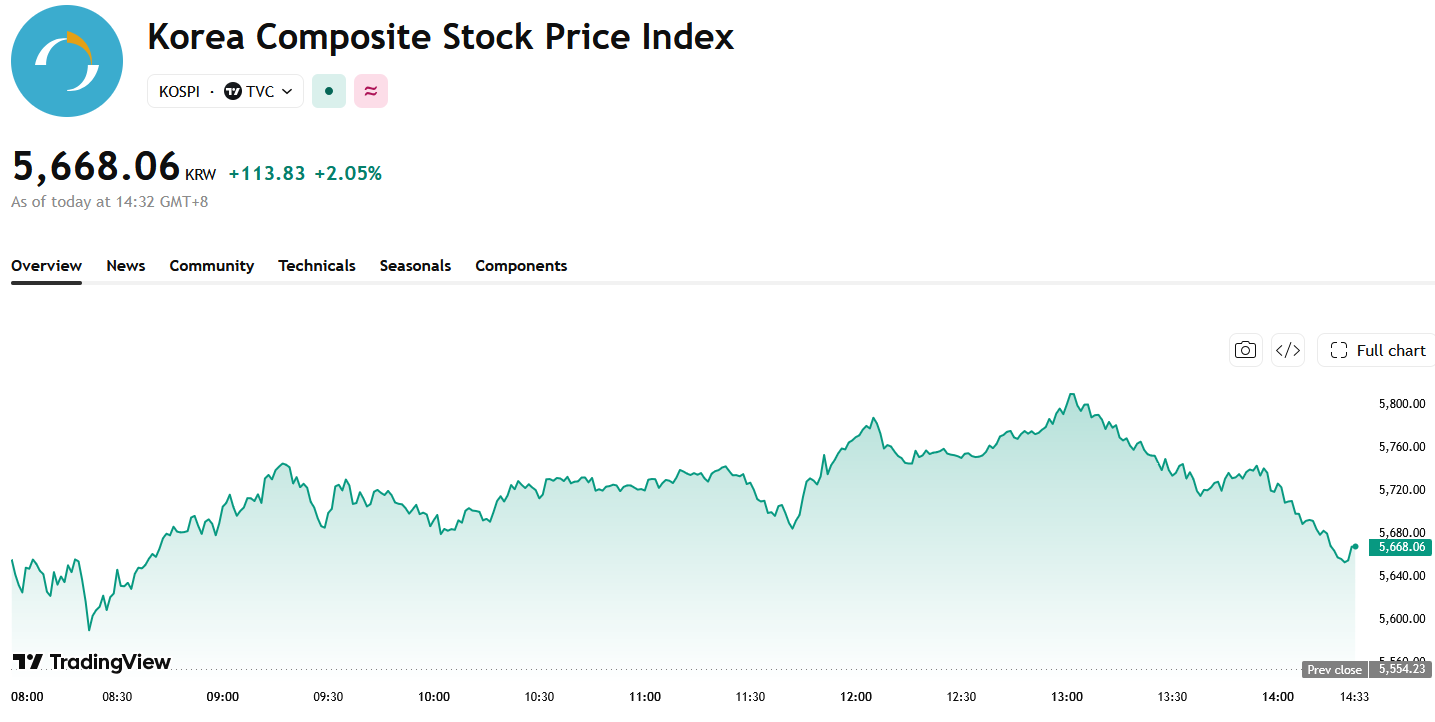
TradingKey - On October 16, Japanese and South Korean stock markets rebounded after sharp recent adjustments. Japan's Nikkei 225 Index closed up 1.39% at 65,324.24 points, but dropped 5.37% for the week, marking its largest weekly decline since July 17. South Korea's KOSPI Index closed up 2.05% at 5,668.06 points, though it slumped 14.46% for the week, recording its biggest weekly drop since October 2008.
Source: TradingView
South Korean tech stocks rebounded along with the broader market. Samsung Electronics closed up 2.62% at 215,500 won (approx. $162); SK Hynix gained 0.79% to 1.272 million won. In the Japanese market, Kioxia closed up 3.84% at 13,375 yen (approx. $85); SoftBank Group rose 1.90% to 4,944 yen.
Intraday rebound momentum in the South Korean market was relatively strong, with the KOSPI index touching 5,800 points at one point. The Korea Exchange triggered a sidecar mechanism for the KOSDAQ index during trading, showing a clear recovery following previous continuous sell-offs. However, despite Friday's bounce, South Korean stock markets suffered a major correction overall this week, with the KOSPI accumulating a decline of over 14%, reflecting that market sentiment has not fully recovered.
South Korea's Ministry of Economy and Finance stated on October 16 that it will closely monitor whether stock market volatility further spills over into the bond, foreign exchange, and money markets, and instructed relevant authorities to strengthen market monitoring and take strict measures against behaviors that disrupt market order. The ministry also emphasized that solid economic growth prospects, a continued current account surplus, and positive corporate earnings performance mean that the fundamentals of the South Korean stock market remain supportive.
This content was translated using AI and reviewed for clarity. It is for informational purposes only.
Recommended Articles











Comments (0)
Click the $ button, enter the symbol, and select to link a stock, ETF, or other ticker.