


KOSPI Opens Down 1% as Nikkei Bucks Trend to Rise; SoftBank Rebounds 5% as Samsung Electronics and SK Hynix Extend Losses



AI Podcast


During September 15 trading, Japanese and South Korean stock markets diverged amid tech sector pressures and rising oil prices. South Korea’s KOSPI declined 0.76%, pressured by falling chip stocks like Samsung and SK Hynix. Conversely, Japan’s Nikkei 225 rebounded 0.35%, led by SoftBank and Kioxia. Global concerns over AI capital expenditure returns, surging Brent crude exceeding $105 per barrel, and looming central bank rate decisions from the FOMC, BOJ, and BOE fueled imported inflation fears and cautious, risk-averse market sentiment across both export-dependent economies.

TradingKey - Japanese and South Korean stock markets diverge; South Korean stocks open lower by 0.76%, Nikkei rebounds against the trend, SoftBank surges nearly 5%, Samsung and SK Hynix come under pressure.
During Asian trading hours on September 15, both Japanese and South Korean stock markets opened weak and lower, but intraday trends diverged. Among them, South Korea's KOSPI index continued to fall 0.76% at the open to trade at 6,633.30 points; core tech chip stocks all declined, with Samsung Electronics down 0.2% to trade at 248,500 KRW, and SK Hynix opening down 0.41% to trade at 1,690,000 KRW.
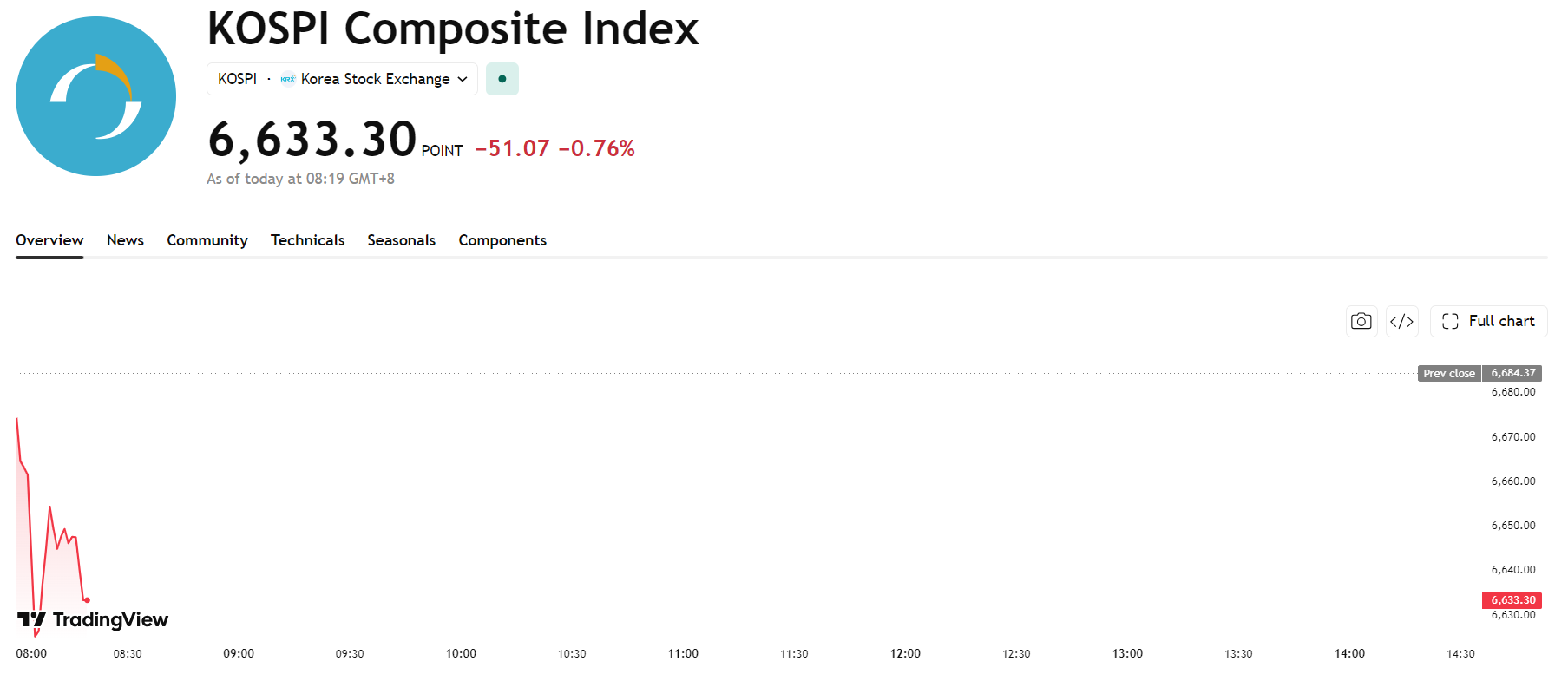 KOSPI Index Chart, Source: TradingView
Japanese stocks were generally stronger than South Korean stocks. The Nikkei 225 index opened lower but rallied higher, rising 0.35% to reclaim the 63,000 mark, trading at 63,717.83 points; two major heavyweight stocks also opened lower and moved higher, with SoftBank's stock price surging 4.85% to trade at 6,122 JPY, while Kioxia rose 1.27% to reclaim the 50,000 mark, trading at 51,230 JPY.
U.S. tech stocks continued to pull back amid global concerns over artificial intelligence (AI) capital expenditure returns and growth slowdown, with key chip giants such as Nvidia (NVDA), Intel (INTC), and Micron Technology (MU) posting significant losses. Japanese and South Korean stock markets are highly dependent on semiconductor and tech supply chains, and pressure on tech heavyweights directly caused the lower open for both the Nikkei 225 and KOSPI indices.
Escalating Middle East tensions drove international crude oil prices higher today, with Brent crude (UKOIL) surging above $105 per barrel. As both Japan and South Korea are heavily dependent on energy imports, market concerns over intensified imported inflation and rising corporate production costs driven by high oil prices further suppressed risk appetite.
Looking ahead, the Federal Reserve (FOMC), the Bank of Japan (BOJ), and the Bank of England (BOE) will release their latest interest rate decisions one after another this week. Before policy directions become clear, market capital leans toward risk aversion and a wait-and-see stance.
This content was translated using AI and reviewed for clarity. It is for informational purposes only.
Recommended Articles







Comments (1)
Click the $ button, enter the symbol, and select to link a stock, ETF, or other ticker.