


Kioxia Earnings Preview: Can Stock Rebound After 60% Slump? NAND Supply and Buybacks Are Key



Kioxia’s upcoming Q1 fiscal 2026 earnings face skepticism despite strong guidance, as shares have corrected nearly 66% from their peak. While fundamentals remain tight, market sentiment is dampened by broader AI memory sector volatility, concerns over future NAND supply growth from competitors and China’s YMTC, and Bain Capital’s complete exit. Investors are shifting focus from historical profit figures to management’s guidance on NAND pricing, capacity expansion discipline, and potential share buybacks. Consequently, the report’s ability to stabilize the stock depends less on meeting earnings expectations and more on management’s strategic response to medium-term oversupply risks.
TradingKey - On July 31, Kioxia will release its fiscal year 2027 first-quarter results (April 1, 2026 - June 30, 2026). However, the backdrop for this earnings report is already completely different from a month ago. On June 22, Kioxia's share price topped Japan's market capitalization list at 112,700 yen (about $689) per share, but as of the close on July 30, it stood at 39,500 yen per share, down nearly 66% from its peak. Beyond the first-quarter profit figures, the market is also focused on whether this earnings growth rate can be sustained?
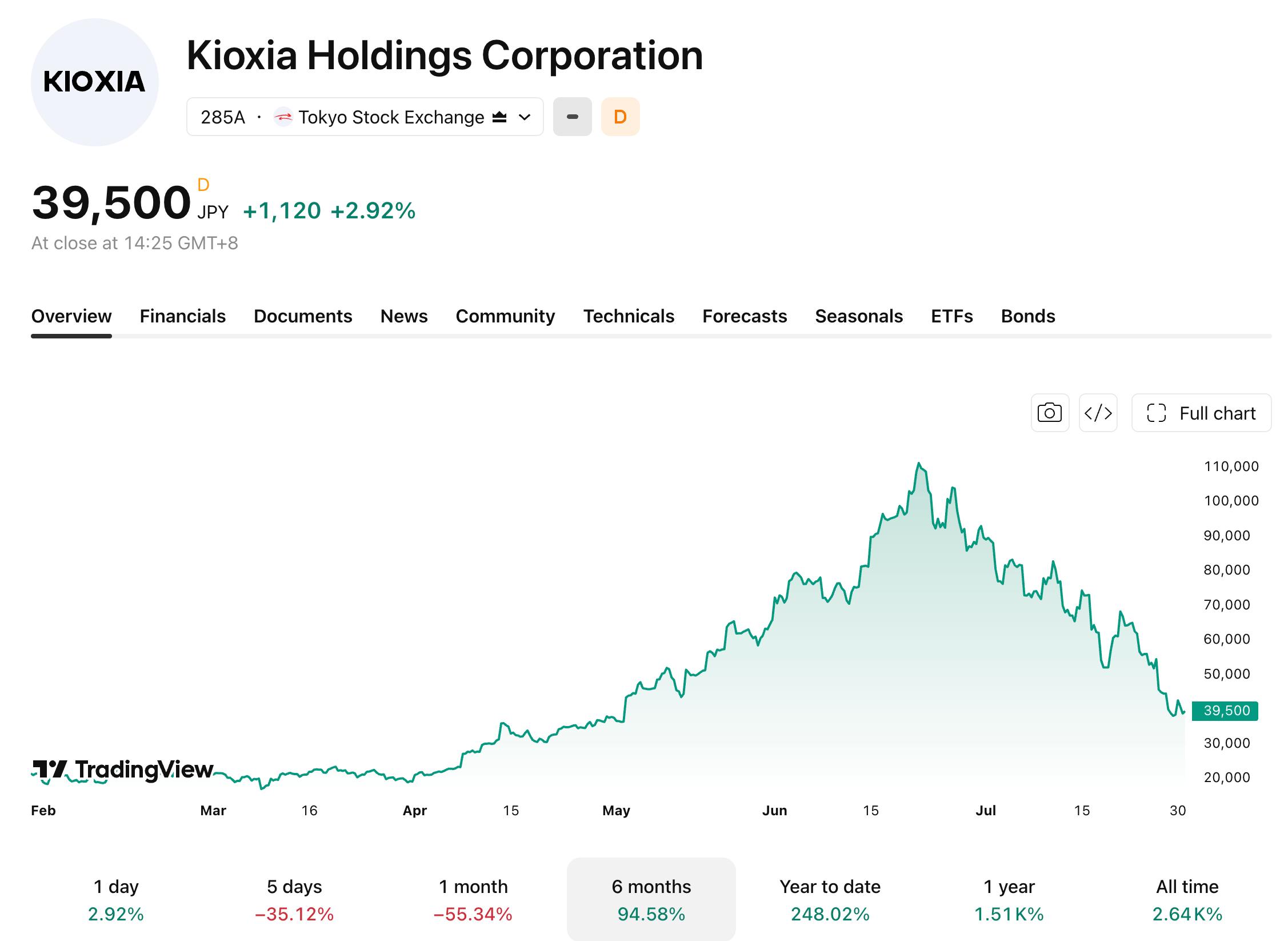
[Source: TradingView]
Earnings No Longer in Doubt as Market Focus Shifts to NAND Price Hike Logic
On May 15, Kioxia released its Q1 guidance ahead of schedule: revenue of 1.75 trillion yen, operating profit of 1.298 trillion yen, and net profit of 869 billion yen. Earnings for a single quarter exceeded those of the entire previous fiscal year (554.5 billion yen).
Institutions are even more optimistic than the company itself. Goldman Sachs ( GS) expects operating profit of 1.417 trillion yen, while Citi ( C) expects 1.40 trillion yen, with both institutions raising their target prices to 116,000 yen and 140,000 yen, respectively, at the end of June.
However, the tailwinds of high earnings growth have been fully priced in by the previous rally, and the market's focus has now shifted to the logic of NAND price increases.
Kioxia Shares Pull Back Over 60% as Market Panic Mounts
The thesis for NAND price hikes is being tested, but fundamentally, NAND supply and demand remain tight. Kioxia's May guidance clearly indicated that AI data center demand continues to strengthen, and supply will remain tight through 2027. TrendForce's latest July report also confirmed that the NAND supply deficit will be around 4% to 5% in 2026, maintaining a shortage.
With fundamentals intact, why did the stock price fall? The plunge on July 28 was not due to negative news specific to Kioxia itself, but rather collective panic across the global AI memory sector. The Philadelphia Semiconductor Index fell 2.23%, and Nvidia ( NVDA) fell nearly 5%, and SanDisk ( SNDK) fell over 11%, and South Korea's KOSPI triggered circuit breakers. The catalyst was a collapse in confidence triggered by controversy surrounding Nvidia's $750 billion revolving credit facility. Kioxia, which had registered the largest gains in the prior period, naturally became the primary target for capital flight.
Deeper concerns stem from the supply side. Samsung, SK Hynix, and Kioxia itself are all expanding capacity, and TrendForce expects supply growth to outpace demand in the second half of 2027. The China factor is accelerating this process; YMTC's Phase 3 factory has entered the equipment installation phase, with domestic equipment accounting for over 50% of procurement for the first time. It is expected to begin production by the end of 2026 and achieve a monthly capacity of 50,000 wafers in 2027.
Meanwhile, YMTC plans to build two additional factories on top of its existing fabs. Once these three factories are fully operational, they are expected to more than double total capacity. TrendForce projects that by 2027, China's share of global NAND bit output will rise to nearly 19%, representing an additional supply pressure that cannot be ignored.
Bain Capital's exit is also one of the main topics repeatedly discussed by the market. The private equity firm, which led the acquisition of Toshiba Memory (Kioxia's predecessor) in 2018, liquidated its entire stake in early July for a total cash-out of approximately $17 billion, marking the largest single return in Japan's private equity investment history. It took Bain less than two years to go from holding an approximate 55% stake at the time of the IPO to completely exiting.
However, institutional interpretation of this signal is clearly divided. Some analysts believe that finding buyers for such a large block of shares indicates that demand remains robust and eliminates the long-term overhang of major shareholder selling on the stock price, representing a positive signal. Yet, Bain's decision to exit completely after the company became Japan's largest by market capitalization has indeed prompted some investors to re-examine the stock's medium-to-long-term value.
Three Earnings Signals to Watch: Q2 Guidance, Production Pace, and Buyback Signals
Whether earnings will deliver is no longer the primary suspense, as actual figures are highly likely to land in the upper-middle range of the guidance. What will truly determine the stock price's trajectory is how management addresses three core concerns:
First is the Q2 outlook. Goldman Sachs pointed out that as of the guidance release in May, pricing for about 30% of Q2 shipment volume had not yet been locked in, and the actual transaction prices of these orders will directly impact Q2 performance. The market wants to hear management's latest assessment of NAND average selling price (ASP) and shipment volume trends, as well as whether enterprise SSD demand can offset the ongoing weakness in consumer electronics. TrendForce forecasts that global smartphone production will decline by 15%-20% year-on-year in 2026.
Second is the supply outlook. Management's assessment of capacity and price trends from the second half of 2026 through 2027 is crucial. If they signal that the pace of capacity expansion is controllable, it would help alleviate oversupply concerns. Goldman Sachs' channel checks indicate that major memory makers continue to prioritize capital expenditure on DRAM, meaning incremental new NAND capacity will remain limited, a trend expected to persist until at least 2028.
Third is shareholder returns. Against the backdrop of a deep stock price correction, share buyback plans have become a key variable influencing sentiment. Kioxia clearly stated in May that dividend distribution is a priority, while maintaining flexibility for share buybacks. Whether management announces a formal buyback at this briefing will serve as an important signal for the market to judge whether the company believes its stock is undervalued. The signaling value of a buyback could be just as important as the buyback itself.
An earnings report that merely meets expectations is highly unlikely to reverse the downward trend. On July 29, Kioxia's shares jumped as much as 9.58% intraday driven by SK Hynix's better-than-expected earnings, before taking a sharp turn downward to fall over 10%, indicating a strong willingness among capital to sell on good news. Management's stance on price trends, the pace of capacity expansion, and buybacks will do more to determine whether the stock price can stabilize than the Q1 profit figures. Against the backdrop of Bain Capital's divestment, spreading doubts over refinancing, and the collapse of sector sentiment, this earnings release faces a tougher situation than ever before.
This content was translated using AI and reviewed for clarity. It is for informational purposes only.
Recommended Articles




Comments (0)
Click the $ button, enter the symbol, and select to link a stock, ETF, or other ticker.