


Japan and South Korea Stocks Plunge; Kospi Slumps Nearly 11% Following 30% July Drop as Kioxia, Samsung, SK Hynix Tumble



On July 28, Asian semiconductor stocks faced a historic sell-off. The KOSPI plunged 10.84%, triggering a circuit breaker, while the Nikkei 225 fell 3.95%. Samsung, SK Hynix, and Kioxia suffered double-digit declines, driven by fears regarding Chinese competition from ChangXin Memory Technologies and skepticism toward AI capital return cycles. Amid this volatility, South Korea’s FSC is considering tighter leverage controls to stabilize sentiment. Investors are recalibrating focus from AI growth to industry competitive landscapes and capital efficiency, signaling that high market volatility in the semiconductor sector will likely persist in the near term.

TradingKey - On July 28, Japanese and South Korean stock markets suffered a new round of sell-offs, with the South Korean market experiencing a particularly brutal decline as Samsung plunged over 13%, SK Hynix fell over 14%, and Kioxia plummeted over 18%.
The Korea Composite Stock Price Index (KOSPI) plummeted 10.84% to close at 6,023.63 points, briefly dropping over 11% intraday and breaching the key 6,000-point psychological level to hit a recent low, bringing its cumulative decline this month close to 30%.
During morning trading, the Korea Exchange triggered a market-wide circuit breaker intraday, suspending trading for 20 minutes, marking the eighth time KOSPI has triggered a circuit breaker this year.
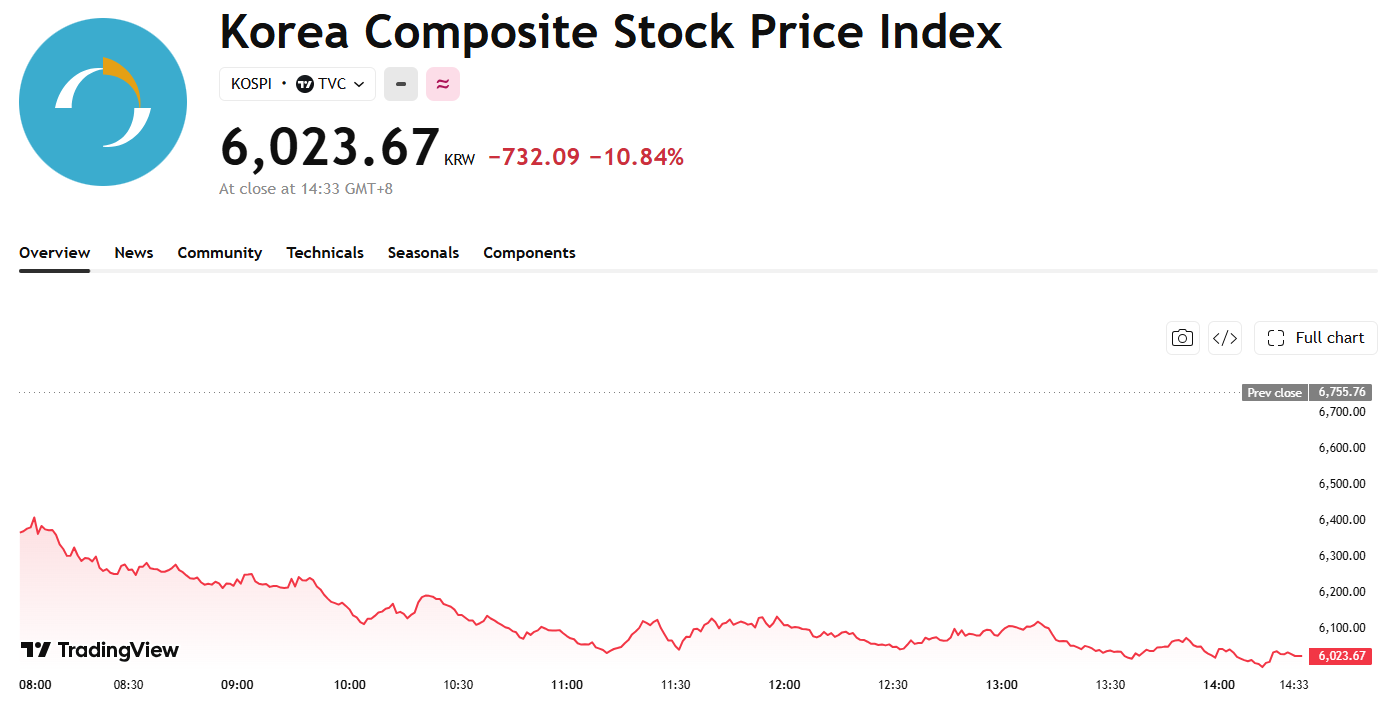
Source: TradingView
Japanese stocks were also under pressure, with the Nikkei 225 Index closing down 3.95% at 62,364.92 points, falling to its lowest level since May this year.
Dragged down by the semiconductor sector, SK Hynix slumped 14.65% to close at 1,550,000 won (approximately $1,062); Samsung Electronics fell 13.39% to close at 220,000 won (approximately $151), with both hitting multi-stage lows.
In the Japanese market, Kioxia plummeted 18.33% to close at 44,550 yen (approximately $272); SoftBank Group fell 4.43% to close at 5,095 yen (approximately $31).
Lee Eog-weon, chairman of the Financial Services Commission (FSC) of South Korea, stated that regulatory authorities are studying further tightening of trading rules for single-stock leveraged ETFs, including considering investment caps for individual investors to curb excessive market speculation and stabilize market sentiment.
Investors worry that Chinese memory chipmaker ChangXin Memory Technologies (CXMT) is accelerating capacity expansion, which could exert greater competitive pressure on the market shares of Samsung Electronics and SK Hynix in the DRAM market in the future. In addition, the massive capital investment required for AI infrastructure construction has prompted the market to re-evaluate the profitability outlook and capital return cycles of the AI industry chain.
A senior stock trader said in an interview with the Financial Times: "I don't remember ever seeing a decline so violent and so rapid." As market risk-off sentiment continues to rise, investor focus has gradually shifted from AI demand growth to capital expenditure, financing capabilities, and the competitive landscape of the industry. In the short term, the volatility of the Asian semiconductor sector may remain high.
This content was translated using AI and reviewed for clarity. It is for informational purposes only.
Recommended Articles











Comments (0)
Click the $ button, enter the symbol, and select to link a stock, ETF, or other ticker.