


Brazilian Assets Sold Off: Brazil ETFs Drop Over 27% as Lula’s Re-Election Shatters Fiscal Consolidation Expectations, Bank and Oil Stocks Tumble



AI Podcast


Following Brazilian President Lula's election victory on October 26, Eastern Time, Brazilian equities and the real experienced a sharp sell-off as markets priced out prior expectations of pro-business policies. Investor anxiety centers on fiscal discipline, public debt growth, and currency depreciation, which threaten to elevate borrowing costs and inflation. Short-term uncertainty is compounded by political disputes. Asset performance will depend on the new administration's fiscal policies, Finance Minister appointment, and debt control measures. Key indicators for monitoring include exchange rates, sovereign debt trajectories, and sector-specific fundamentals across major Brazilian equities and exchange-traded funds.

TradingKey - On October 26, Eastern Time, Brazilian President Lula defeated Flávio Bolsonaro in the second round of the presidential election to win a fourth non-consecutive presidential term. Following the announcement of the election results, Brazilian assets suffered a massive sell-off in U.S. pre-market trading.
As of press time, the iShares MSCI Brazil ETF tracking the Brazilian stock market (EWZ) fell 27.68% in pre-market trading; Banco Bradesco (BBD) and Itaú Unibanco (ITUB) both fell over 26%, while Petrobras (PBR) dropped more than 20%. The Brazilian real fell over 8% in spot market trading.
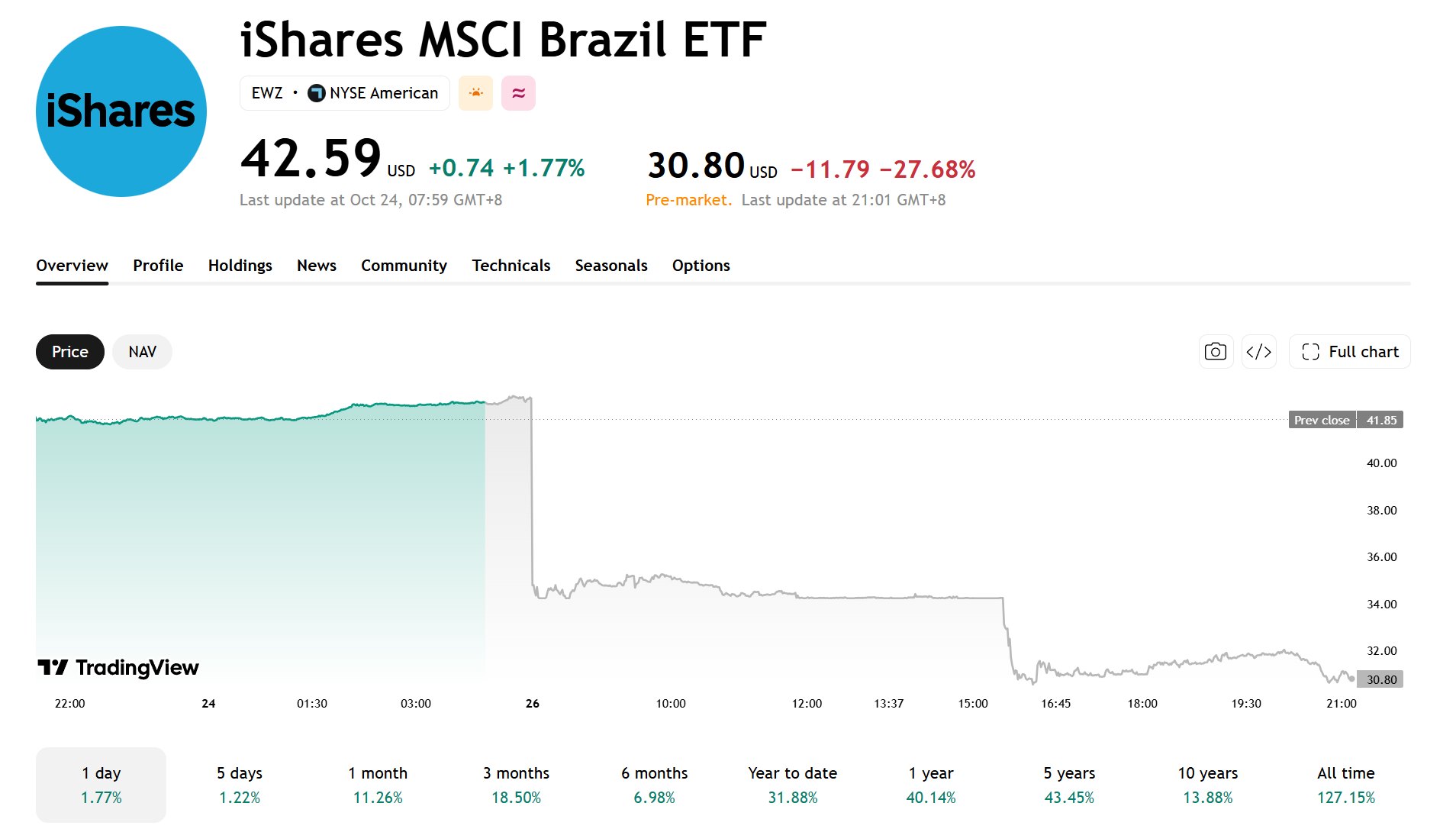
[Source: TradingView]
Why Brazilian Assets Are Plunging
The market's previous election trade quickly reversed. After the first round of voting, Flavio Bolsonaro took the lead, driving Brazilian equities and the real higher on market expectations that his victory could bring stricter fiscal discipline and more pro-business policies.
Following Lula's ultimate election victory, investors quickly adjusted their positions, sending Brazilian stocks, currency, and bonds lower in tandem.
Fiscal policy and borrowing costs became the main market focus. Investors worry that if the new government fails to effectively control public spending and debt growth, government borrowing costs could rise, potentially increasing borrowing costs for businesses and households as well, which would weigh on stock valuations. A continued depreciation of the real could also push up import costs and inflationary pressures, dampening market expectations for future interest rate cuts.
In addition, Flavio refused to concede the election results and stated he would pursue legal avenues, adding further short-term uncertainty.
Looking ahead, the market will focus on Lula's statements regarding fiscal discipline, his selection for Finance Minister, and the 2027 budget arrangements to gauge whether the government can control debt growth while maintaining social spending.
Which US Stocks and ETFs Are Worth Watching?
EWZ: Reflects the overall performance of the Brazilian stock market. The iShares MSCI Brazil ETF (EWZ) tracks the Brazilian stock market, holding listed companies across banking, energy, and other sectors. Its price is influenced not only by the rise and fall of the Brazilian stock market, but also by changes in the real exchange rate. Going forward, key areas to monitor include capital flows, exchange rates, and shifts in government fiscal policy.
PBR: Focus on Petrobras's operations and dividends. Petrobras (PBR) is one of Brazil's major oil and gas companies. Beyond political developments, its stock price depends on international oil prices, fuel pricing policies, capital expenditures, and shareholder return arrangements.
If the market fears government intervention in company operations or adjustments to dividend policies, the stock price may remain under pressure.
BBD and ITUB: Focus on bank profitability and loan quality. Banco Bradesco (BBD) and Itaú Unibanco (ITUB) are Brazilian bank stocks traded in the U.S. market.
Interest rates remaining high may increase repayment pressure on businesses and households, affecting loan demand and bad debt levels. Going forward, attention should be paid to changes in net interest margins, loan growth, and non-performing loan ratios.
MELI: Focus on the impact of the Brazilian market on the business. MercadoLibre (MELI) is a Latin American e-commerce and fintech platform with significant operations in Brazil, though it is not a locally listed company in Brazil.
A depreciation of the real may affect the revenue and profit of its Brazilian business when converted into U.S. dollars; however, the company's overall performance also depends on operations in other Latin American markets.
What Is the Outlook for Brazilian Assets?
In the short term, the performance of Brazilian assets depends on the government's new fiscal policy. Investors should focus on the candidate for finance minister, the 2027 budget plan, and public debt control measures.
For U.S. stock investors, the risks associated with EWZ, PBR, BBD, and ITUB vary. EWZ primarily reflects the overall trend of the Brazilian stock market; PBR is influenced by international oil prices, fuel pricing policies, and dividend arrangements; while for BBD and ITUB, attention should be paid to net interest margins, loan growth, and changes in non-performing loans.
If the government sends clear signals of fiscal discipline, the market's risk assessment of Brazilian assets may improve; conversely, if debt pressure intensifies and the real continues to depreciate, financing costs and valuations could face further pressure.
This content was translated using AI and reviewed for clarity. It is for informational purposes only.
Recommended Articles












Comments (0)
Click the $ button, enter the symbol, and select to link a stock, ETF, or other ticker.