


Crude Oil Price Forecast: Brent Nears $110 Amid Saudi Pipeline Outage, How Much Further Can Oil Rise?



AI Podcast


Middle Eastern supply risks and the continued outage of Saudi Arabia’s East-West Pipeline have driven Brent and WTI crude prices to fluctuate near $107 and $103 per barrel, respectively. Constrained transport through the Strait of Hormuz and damaged bypass infrastructure have eroded global supply buffers. Techncially, Brent remains in a short-to-medium-term bullish structure, trading well above its moving averages. However, with the RSI approaching overbought levels at 68.33, the market faces heightened short-term chasing risks and potential pullback pressure near the $110 resistance level, while key initial downside support holds at $103.10.

TradingKey - Supply risks in the Middle East continue to heat up, with international oil prices fluctuating at high levels.
During Tuesday's Asian trading session, Brent crude futures (UKOIL-F) rose to near $107 per barrel, while WTI crude futures (USOIL-F) advanced to around $103. Brent had briefly approached $110 on Monday before giving back part of its gains on news that the US and Iran might resume contacts, but key Saudi Arabian oil pipelines have yet to be restored, continuing to lend downside support to oil prices.
Saudi Pipeline Outage Amplifies Hormuz Supply Risks
The direct catalyst for the current surge in oil prices is the continued shutdown of Saudi Arabia's East-West Pipeline following an attack. The pipeline connects the eastern oil-producing regions of Saudi Arabia to the port of Yanbu on the Red Sea coast and serves as a vital route for exporting crude oil while bypassing the Strait of Hormuz.
Prior to the attack, Saudi Arabia transported approximately 4 million barrels of crude oil per day through the pipeline, representing about 4% of global supply. Reports indicate that repairing the damaged facilities could take three to five weeks. Analysts estimate that at least roughly 2.5 million barrels per day of crude oil are currently blocked from entering the international market as a result.
Market reports cited by Reuters show that with alternative export capacity constrained, Saudi Arabia is attempting to increase the volume of crude oil shipped through the Strait of Hormuz.
The issue is that the Strait of Hormuz itself remains under heightened tension. Prior to the escalation of the conflict, the waterway handled about one-fifth of global oil shipments, but daily vessel transits dropped to single digits last weekend, well below the average of about 14 ships per day over the preceding 10 days. Although actual transit data may be skewed as some vessels might have turned off their Automatic Identification Systems, the overall slowdown in shipping activity is already quite clear.
The U.S. and Iran have offered differing accounts regarding the cause of an attack on a supertanker. Iran's Islamic Revolutionary Guard Corps claimed the vessel struck a sea mine and exploded after entering a restricted area, whereas U.S. Central Command rejected this explanation, stating that the ship was attacked by missiles and drones.
While the facts of the incident remain disputed, its market impact is relatively clear: shipping companies face higher insurance, rerouting, and security costs, and even if crude oil can be exported, transport efficiency is likely to decline.
Simultaneous constraints on Saudi Arabia's bypass pipeline and the Strait of Hormuz mean that the market's existing supply buffer is eroding. As long as the East-West Pipeline remains offline, oil prices are unlikely to see a sustained decline based solely on diplomatic statements.
Crude Oil Price Technical Analysis
Source: TradingView
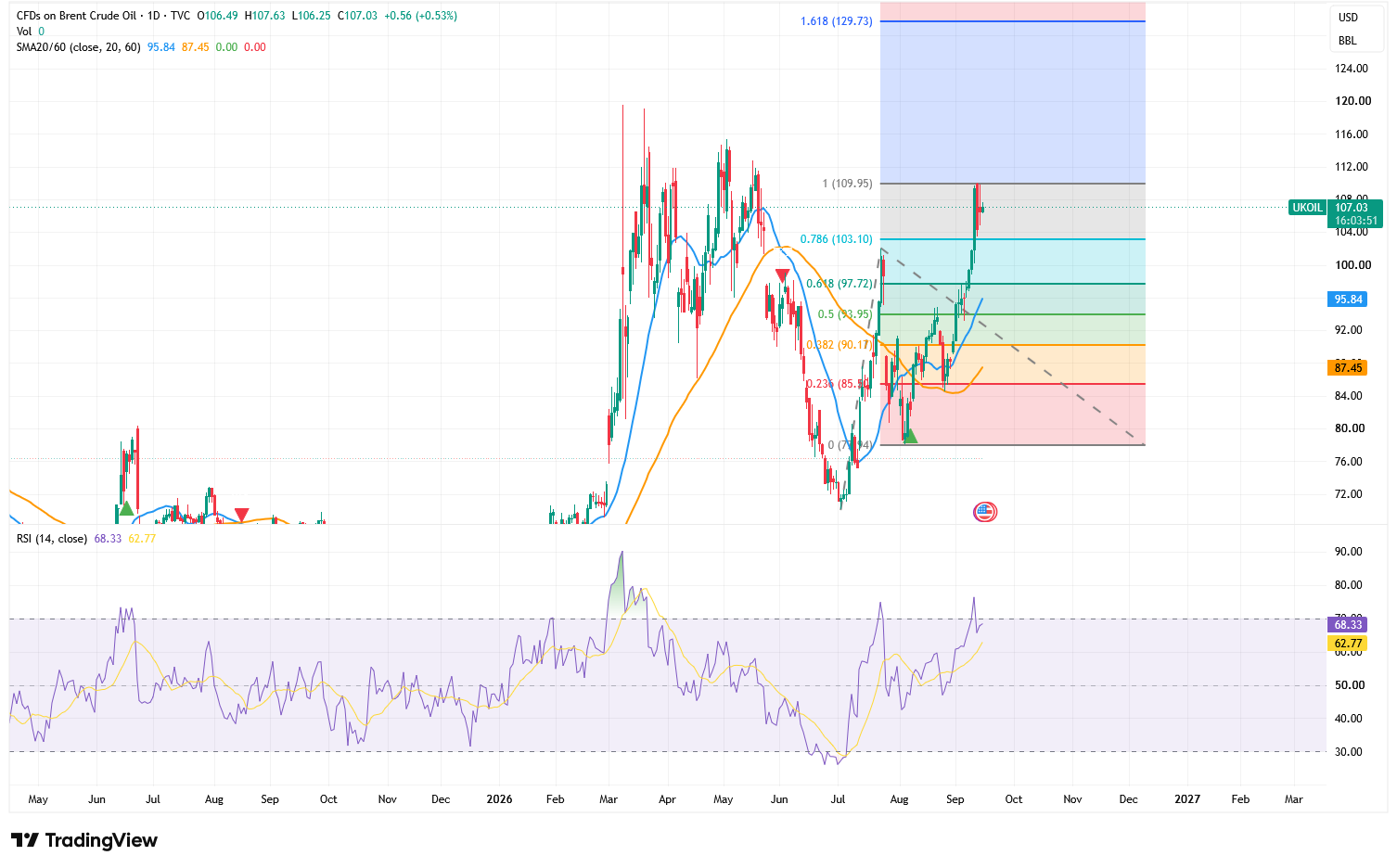
Looking at the daily chart, Brent crude oil continued its strong rally, last trading at $107.03, significantly above its 20-day moving average of $95.84 and 60-day moving average of $87.45. The 20-day moving average remains above the 60-day moving average and continues to trend upward, while oil prices have also broken above the previous downtrend line, indicating that the short-to-medium-term bullish structure remains intact.
Oil prices have broken above the 0.786 level at $103.10 and are currently testing the 1.0 extension level at $109.95–$110. This area is also close to previous highs, serving as the most critical short-term resistance. To the upside, further key levels to watch are $112–$115, followed by $118–$120; only a breakout above the previous highs could make the 1.618 extension level at $129.73 a medium-term target.
However, the RSI has risen to 68.33, above its signal line of 62.77 and approaching the overbought territory of 70, indicating that upward momentum remains strong, but the risk of chasing gains in the short term is also increasing. Oil prices have surged rapidly recently, creating a significant divergence from the 20-day moving average; therefore, consolidation or a technical pullback may occur first near $110.
To the downside, initial support lies at $103.10, with further support at $100 as well as the $97.72–$95.84 area. As long as a pullback holds above $103, the strong upward structure can still be maintained; if it falls below $100, oil prices may retest the 20-day moving average.
This content was translated using AI and reviewed for clarity. It is for informational purposes only.
Recommended Articles










Comments (0)
Click the $ button, enter the symbol, and select to link a stock, ETF, or other ticker.