


 Discount


AMD Shares Plunge 8% as Ties to Multiple US Entity List Firms Draw Scrutiny, Export Controls May Curb Overseas Sales



AI Podcast


On November 19, Eastern Time, AMD shares fell 8% to $487.41 amid reports that newer AMD firmware appeared in products of restricted Chinese server maker Inspur Information. Simultaneously, new U.S. licensing rules for advanced chips took effect in markets including Singapore, which accounted for 12.4% of AMD’s annual revenue. Investors face risks regarding potential delivery delays, licensing impacts, and inventory write-downs similar to previous export restriction charges.

TradingKey - On November 19, Eastern Time, Advanced Micro Devices (AMD) shares tumbled. Investigative media outlet Hunterbrook reported that after Chinese server maker Inspur Information (IEIT Systems) was added to the U.S. export control Entity List, new versions of AMD firmware continued to appear in its products. Meanwhile, new U.S. licensing rules for advanced chips targeting markets such as Singapore took effect.
Weighed down by the negative news, AMD shares fell 8% to $487.41.
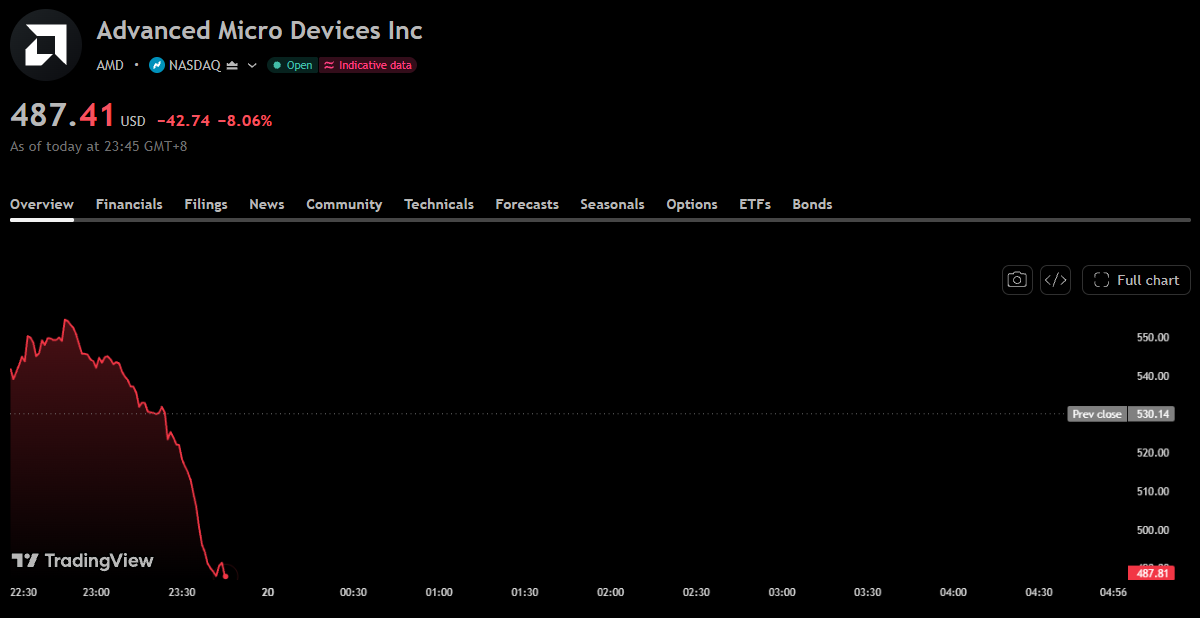
AMD stock chart, Source: TradingView
New AMD Firmware Found in Restricted Vendor Products With Supply Path Unclear
According to an investigation by Hunterbrook, Inspur Information was added to the Entity List in March 2025. Since then, its server products have integrated at least six newer versions of AMD firmware, with the most recent update released on October 19 this year. Such firmware is used to support the operation of AMD chips in servers, drawing scrutiny not only to who the chips were sold to, but also to who provides updates after the products are delivered.
Hunterbrook also found that the firmware provided by China-based Maginfra, Singapore-based Kaytus, and US-based Aivres is highly similar to Inspur Information's version. Documents cited in the report show that Kaytus lists Inspur Information as its ultimate parent company, while AMD's official website lists Aivres as a server manufacturer using its Instinct AI chips.
Singapore Accounts for Over 10% of AMD Revenue as License Approvals May Impact Deliveries and Inventory
In contrast to the issues still to be clarified in the investigation, changes to export rules have already taken effect. Under new U.S. Department of Commerce regulations that took effect on November 19, exporting or transferring certain advanced chips to Singapore, Malaysia, Indonesia, Thailand, and Brazil is subject to new licensing requirements. For orders requiring a license, manufacturers may be unable to ship as originally scheduled, even if customers have already placed orders.
According to AMD's fiscal 2025 annual report, based on customer billing location, Singapore contributed $4.284 billion in revenue, accounting for approximately 12.4% of the annual total; mainland China and Hong Kong combined contributed $7.751 billion, accounting for about 22.4%.
There is already a precedent for how export restrictions can impact AMD's profits. In the second quarter of 2025, export restrictions targeting the Instinct MI308 led the company to recognize approximately $800 million in inventory and related charges; only after that was AMD permitted to supply certain Chinese customers. For shareholders, the most critical factors to monitor this time are which products require new license applications, whether approvals delay deliveries, and whether inventory that cannot be shipped on schedule can be resold. These developments illustrate the actual impact of tightening export controls on AMD's performance far better than regional revenue breakdowns.
Recommended Articles










Comments (0)
Click the $ button, enter the symbol, and select to link a stock, ETF, or other ticker.