


 Discount


Will Silver Prices Continue to Fall? 2027 Silver Price Trend Analysis and Forecast



AI Podcast


In 2026, silver experienced extreme volatility, peaking at $121.64 in January before suffering a 65% drawdown amid Federal Reserve policy tightening, a surging U.S. dollar, and industrial demand destruction via substitution. While downside momentum has slowed, lingering monetary headwinds, trapped long positions, and structural shifts in photovoltaic manufacturing suggest silver may test lower psychological thresholds of $30 or $25. A meaningful trend reversal and recovery toward the $50–$55 range are anticipated by the second half of 2027, driven by potential macroeconomic easing and subsequent financial liquidity inflows.
Silver 2026 Price Trend Review
TradingKey - In 2026, silver (XAGUSD) staged an extreme roller-coaster ride comparable to the historic levels of 2011: extending its frantic rally from 2025 early in the year, silver prices subsequently embarked on a deep 10-month correction, bringing the maximum drawdown for the year to 65%, which not only erased the excess gains of the past year or more, but also saw a pace of decline nearly twice that of gold over the same period.
In early 2026, silver prices broke through the $100 mark and touched an all-time peak of $121.64 on January 29; subsequently, in just one week, they plunged 50% to around $60. In the third quarter of 2026, silver prices saw repeated back-and-forth trading in the $55–$68 range, weakening again toward the end of the quarter. In late October, silver broke below the $50 mark, and in mid-to-late November, it tested the $40 threshold, hitting its lowest level since September 2025.
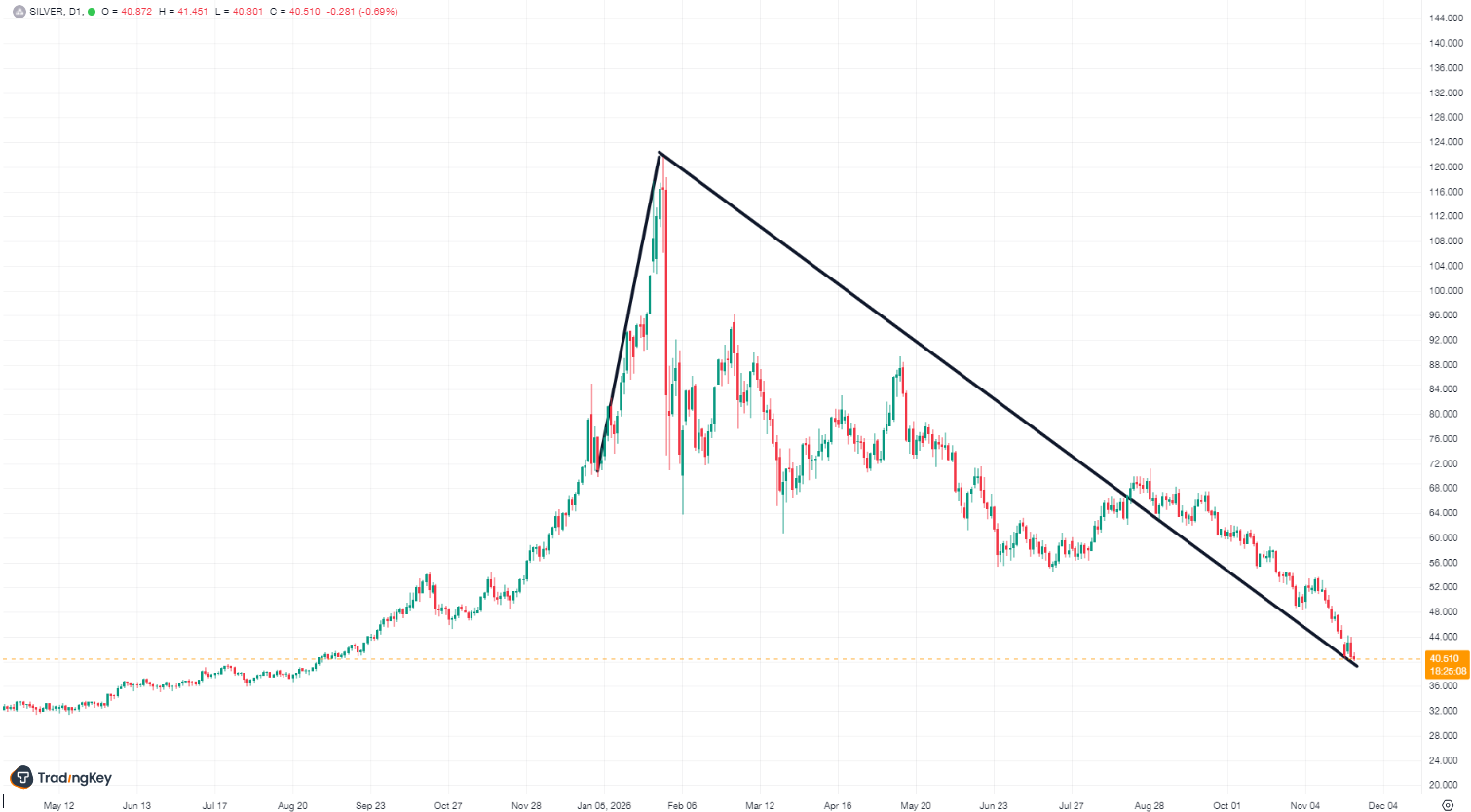 Silver price chart, Source: TradingKey
Why Are Silver Prices Falling?
At the end of 2025, the market widely expected the Federal Reserve to continue its rate-cutting cycle in 2026, and a heavy influx of momentum and speculative buying pushed silver prices to record highs. However, after early 2026, sticky inflation forced the Fed to pivot back toward tightening and resume interest rate hikes. Surging real interest rates and a strengthening US dollar triggered a wave of liquidations across highly leveraged futures and derivatives, causing the high-level bubble to burst rapidly.
In the second half of 2026, although AI data center expansions, 5G, and new energy vehicles continued to provide steady demand for electrical silver, elevated silver prices eroded portions of end-user consumption. On one hand, the solar photovoltaic industry accelerated technological substitution and silver-thrifting processes; on the other hand, India's import demand for jewelry and silverware also declined due to the price shock, causing the industrial sector's defensive moat to fail in the face of the excessively high prices seen earlier in the year.
Will Silver Prices Fall Further?
After silver prices experienced a severe 65% correction, whether silver will continue to fall depends on the interplay between the tail end of macroeconomic tightening and the absorption capacity of industrial and physical buying. From the perspective of current market structure and technicals, silver still faces the risk of retesting its low or fluctuating downward, but downside room and the slope of the decline have narrowed noticeably compared to the previous ten months.
As long as U.S. inflation remains sticky and market pricing for the Federal Reserve to keep interest rates elevated or hike further in December has not fully dissipated, the U.S. dollar and real Treasury yields will continue to weigh on non-yielding precious metals. For silver, which is highly reliant on financial liquidity, rebounds will likely run into headwinds until monetary policy clearly pivots toward easing.
In addition, the sky-high price of over $100 in early 2026 has forced downstream photovoltaic module manufacturers to accelerate silver thrifting and copper paste substitution processes, meaning that even if silver prices are halved, unit silver consumption in the PV sector will struggle to immediately return to its previous high growth rate; if global manufacturing PMIs remain sluggish, industrial demand will find it difficult to independently trigger a trend reversal in the short term.
Silver Price Trend Forecast 2027
After a persistent 10-month decline, silver broke below $50, accumulating a substantial overhang of stopped-out longs and trapped dip-buyers. Before a formal trend reversal occurs, every sharp bounce is likely to trigger break-even selling pressure, leaving silver prone to stalled rallies and retesting previous lows in a secondary bottoming pattern. Prices could potentially drop to the next psychological threshold of $30, or even test $25 under extreme panic—a zone that represents the mining cost floor overlaid with previous strong resistance from the 2020–2024 rally.
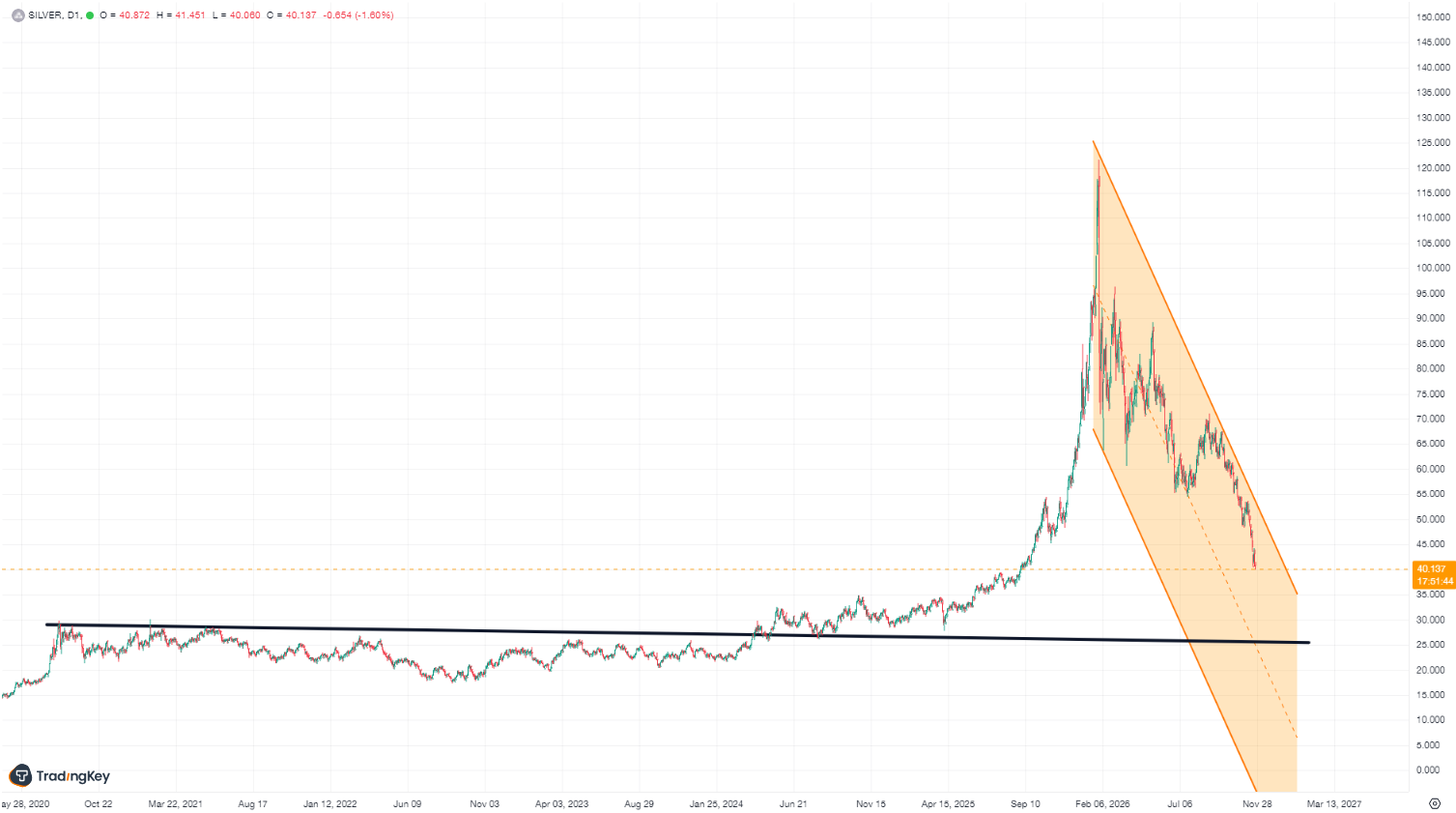 Silver price chart, Source: TradingKey
If silver fails to quickly reclaim and hold above $50 between late 2026 and early 2027, the technicals will confirm a decisive breakdown below the long-term neckline, meaning the first half of 2027 will still require a period of bottom-clearing and position turnover. Entering the second half of the year, a recovery in silver prices becomes more likely.
As the cooling effects of high interest rates on the U.S. economy and labor market emerge, the market is expected to reprice expectations that the Federal Reserve will halt rate hikes and pivot toward easing in mid-to-late 2027. Once the U.S. Dollar Index peaks and pulls back, silver—having undergone substantial deleveraging—will be poised to attract strong financial buying and short covering, with prices expected to climb into the $50–$55 range.
This content was translated using AI and reviewed for clarity. It is for informational purposes only.
Recommended Articles






Comments (0)
Click the $ button, enter the symbol, and select to link a stock, ETF, or other ticker.