


 Discount


Dow Gains Nearly 600 Points in Half-Day US Session for Biggest Weekly Gain Since October 2022; Tech Stocks Surge, Anthropic Jumps Nearly 11%



AI Podcast


U.S. stocks closed broadly higher on Friday, November 27, Eastern Time, capping a volatile week with gains exceeding 5% across major indices. Tech shares outperformed, driven by positive developments at Anthropic and strong semiconductor momentum. Meanwhile, Nvidia paused certain Southeast Asian server shipments amid new U.S. export controls, and CEO Jensen Huang prepared for upcoming congressional inquiries. In corporate news, Tesla eyed a potential SpaceX merger ahead of its shareholder meeting, while Apple expanded its U.S. market share to 57%. Macroeconomically, Goldman Sachs projected significant near-term selling by systematic funds, and memory markets faced looming supply tightness.
TradingKey - On Friday, November 27, Eastern Time, U.S. stocks closed broadly higher in a shortened post-Thanksgiving trading session. Tech stocks drove the Nasdaq to lead the gains, with all three major indices rising more than 5% for the week after a week of sharp volatility.
For the week, the Dow gained 5.46%, posting its largest weekly gain since October 2022; the S&P 500 climbed 5.60%, marking its best weekly performance since April 2025; and the Nasdaq surged 6.68%, recording its largest weekly gain since April of this year.
At the close, the Dow Jones Industrial Average rose 1.18% to 50,774.94 points; the Nasdaq Composite Index gained 2.31% to 24,129.50 points; and the S&P 500 Index rose 1.60% to 7,297.49 points.
Tech Stock Performance
Anthropic (ANT) rose nearly 11% to $91.88.
Anthropic recently disclosed that after revamping its backend systems, the median wait time for Claude Code users from submitting a request to seeing the initial response was reduced by approximately 20%. The resources required for the company to process each request also decreased significantly, with central processing unit (CPU) usage falling by about 70% and memory usage per request across all production systems dropping by more than 80%. This overhaul addresses a practical issue brought on by rapid business growth. From early 2024 to the fall of 2026, request volume on Anthropic's proprietary platform surged to roughly 1,800 times its original level, including calls from the company's own products. Each time a user submits a prompt to Claude, the backend must inspect the request, pass the content to the model, and return the response. With these steps now consuming fewer resources, the same fleet of servers is expected to handle more requests, easing the company's pressure to expand capacity as its business grows.
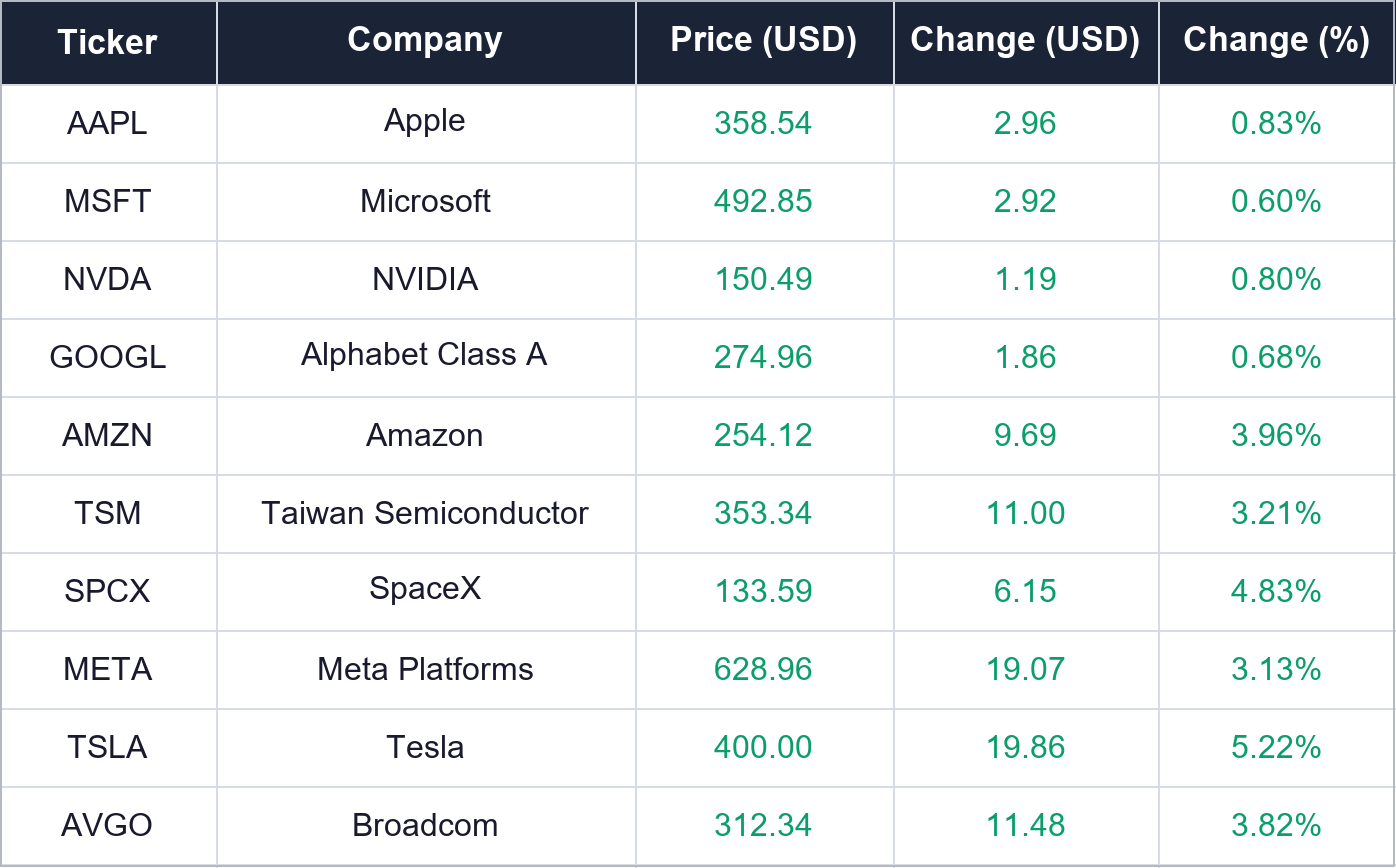
The performance of major tech stocks today is shown below:
The Philadelphia Semiconductor Index rose 4.69% to 9,186.71, with all 30 constituent stocks advancing across the board.
Memory stocks led the gains: SanDisk (SNDK) surged 15.96%, Seagate Technology (STX) rose 7.90%, Micron Technology (MU) gained 7.60%, SK Hynix (SKHY) rose 7.52%, and Western Digital (WDC) gained 7.22%.
Goldman Sachs expects the global DRAM market to experience one of its most severe supply shortages in more than 15 years in 2027, though supply-demand tightness will ease significantly by 2028, with global DRAM supply deficits projected at 5.1% in 2027 and 1.2% in 2028. The NAND supply deficits for next year and the following year are projected at 2.2% and 0.3%, respectively.
Company News
Nvidia Reportedly Pauses AI Server Shipments to Four Southeast Asian Countries
Nvidia (NVDA) has reportedly requested manufacturing partners to pause shipments of servers powered by its chips to Malaysia, Singapore, Thailand, and Indonesia. Partners including Dell (DELL) and Super Micro Computer (SMCI) have notified local buyers that affected orders cannot be fulfilled for the time being. The pause comes after a new round of U.S. export restrictions took effect. The new regulations require export licenses for shipping advanced chips to certain countries, aiming to curb the flow of such chips to China via third-party jurisdictions. It remains unclear whether the halt is merely a temporary measure to comply with the new rules, and the timeline for resuming shipments has not been specified.
Jensen Huang to Face Congressional Inquiries Next Week, Attend Public Hearing on Dec. 3
Following Jensen Huang's resumption of his role as Nvidia CEO, U.S. congressional inquiries into the company will proceed as scheduled. On December 1, Huang will sit for closed-door interviews with the House Intelligence Committee, Foreign Affairs Committee, and Select Committee on China, with the sessions forming a formal record. On December 2, Nvidia General Counsel Tim Teter will be questioned by these committees. On December 3, Huang will testify at an open hearing held by the Senate Banking Committee on U.S. AI chip export controls, where he is currently the sole listed witness. While the first two sessions will be closed to the public, Thursday's hearing will be livestreamed, serving as the primary public window next week for investors to observe how Nvidia addresses export compliance and national security concerns.
Tesla to Hold Shareholder Meeting on Dec. 3 as Market Eyes SpaceX Merger Progress
Tesla (TSLA) will hold its annual shareholder meeting on December 3, Eastern Time. In addition to progress on electric vehicles, the Robotaxi, and the Optimus humanoid robot, investors will also be watching to see whether Elon Musk addresses a potential merger with SpaceX (SPCX). A vote on the merger is not included in the meeting's formal agenda.
Negotiations between the two parties have reportedly progressed, with a deal potentially announced as early as December, though it could also be delayed until early 2027. Based on recent market valuations, the combined entity would be valued at approximately $3.3 trillion. If finalized, the transaction could become one of the largest corporate mergers in history, bringing EV and robotics operations together with AI models, space-based computing, and satellite communications under a single company. Neither party has disclosed the terms of the deal.
Anthropic and Meta Reportedly in Talks with JERA to Build Data Centers in Japan
JERA, Japan's largest power generation company, is reportedly in talks with U.S. tech firms including Anthropic and Meta to build data centers near power plants in the Tokyo area. JERA stated that it is also discussing potential collaborations with Amazon, Microsoft, and Google.
In October, JERA signed a memorandum of understanding with Dell and U.K. infrastructure developer RHAELM to establish a data center development model that can be scaled across multiple locations in Japan. The debut project is a planned $15 billion hyperscale data center in Chiba Prefecture near Tokyo. RHAELM is responsible for engaging potential clients and is currently in discussions with several major cloud service providers, though partnerships remain at the negotiation stage.
Apple's U.S. Smartphone Market Share Rises to 57% as Memory Price Hikes Hit Low-End Android Devices
According to data from Counterpoint Research, U.S. smartphone shipments fell 9% year-over-year in the third quarter, while Apple's (AAPL) market share climbed to 57% from 50% in the prior-year period, making it the only major vendor that did not experience a decline in shipments. Samsung's share ticked up slightly to 25%, while Motorola's dropped to 8%, and handset sales across the three major U.S. carriers fell 4% over the same period.
Rising memory costs have hit low-end Android devices the hardest. Due to slim profit margins in this price tier, manufacturers struggle to absorb these costs while maintaining retail prices and shipment volumes. Counterpoint expects elevated memory costs and smartphone price increases to continue dampening year-end demand, while carriers may also adopt a more cautious approach to promotions. Apple's U.S. Black Friday event will run through November 30, offering gift cards of up to $300 on eligible purchases for future use.
Industry & Macro News
Goldman Sachs: Systematic Funds May Sell About $100 Billion in Global Equities Over the Coming Week
Goldman Sachs' trading desk estimates that systematic strategies sold about $70 billion of global equities over the past week and could sell another $100 billion or so over the coming week. Despite Friday's rebound in US stocks, trend-following funds and volatility-sensitive strategies remain defensive and may continue to reduce holdings in the near term.
Under Goldman Sachs' baseline scenario, systematic flows are expected to shift to modest net buying in early December once this wave of selling subsides. If the stock market rally continues, capital flows that previously weighed on the market could turn around to provide support.
Citi: Foreign Investors Adjusting US Equity FX Hedges May Explain Counter-Trend Dollar Strength
On Monday, global equities rose, US Treasury yields declined, and international oil prices eased, yet the US dollar strengthened sharply against a basket of major currencies. Kristjan Kasikov, head of FX Quantitative Investor Solutions at Citi, believes this was linked to foreign investors adjusting their currency hedges after tech stocks led a decline on Friday and the S&P 500 entered a technical correction.
Foreign institutions holding US equities typically sell US dollar forward contracts to hedge against the risk of dollar depreciation. When US stocks fall, their dollar asset exposure shrinks, prompting institutions to buy back some dollars and reduce their original hedge positions. Citi noted that some of its institutional clients were net buyers of dollars on Friday and Monday, before turning into net sellers on Tuesday following Monday's rebound in US equities. With foreign investors holding trillions of dollars in US equities, such hedging adjustments are significant enough to affect the short-term trajectory of major currency pairs.
TrendForce: DRAM Procurement Slows Slightly, Conventional DRAM Contract Prices Expected to Turn Lower in 2028
TrendForce stated that since the beginning of the fourth quarter, the supply chain has begun reassessing production and sales plans for 2027 to 2028, leading to a slight slowdown in overall DRAM procurement. Market players are monitoring whether US policy shifts might slow data center construction, whether Nvidia will adjust financing support for emerging cloud service providers, and how advanced chip export restrictions and geopolitical changes could impact computing power leasing and server demand.
Under the baseline scenario, TrendForce projects that contract price gains for conventional DRAM will narrow quarter by quarter in 2027, potentially flatten in the second half of the year, and turn downward in 2028. Under a pessimistic scenario, if server manufacturers further cut purchases and emerging cloud service providers trim investments, destocking could occur earlier, with contract prices potentially falling starting in the fourth quarter of 2027 and declines widening in 2028.
This content was translated using AI and reviewed for clarity. It is for informational purposes only.
Recommended Articles






Comments (0)
Click the $ button, enter the symbol, and select to link a stock, ETF, or other ticker.