


Gold Price Forecast: Why Are Gold Prices Still Falling After the Fed Pauses Rate Hikes? September PCE May Determine Gold's Direction



Following the Federal Reserve’s decision to keep interest rates unchanged at 3.75%–4.00% on Wednesday, Oct. 28, Eastern Time, gold prices pulled back 1% to trade near $4,025 during the Asian session on October 29. While December rate hike expectations slightly eased, persistent inflation and a resilient U.S. economy continue to cap gold's rebound. Market focus now shifts to the upcoming September PCE price index to gauge future monetary policy direction. Technically, gold exhibits short-term downside pressure with the RSI at 38.7, facing critical support at $4,000–$3,980 and resistance at $4,080.
TradingKey - On Thursday (October 29), gold prices (XAUUSD) continued to pull back following the Federal Reserve's latest interest rate decision. As of the Asian trading session on October 29, gold was trading down near $4,025, with an intraday decline of around 1%. Although the Fed held interest rates steady as expected, the market remains cautious about the U.S. inflation outlook. The September PCE data scheduled for release today may determine the short-term direction for gold.
Fed Holds Rates Unchanged; September PCE to Impact December Hike Expectations
On Wednesday, October 28, Eastern Time, the Federal Reserve announced it would keep the target range for the federal funds rate unchanged at 3.75% to 4.00%, in line with market expectations. The decision was approved by a 10-2 vote, with two dissenters favoring a 25-basis-point rate hike.
In its policy statement, the Fed noted that U.S. economic activity continues to expand at a strong pace, domestic consumption remains resilient, and job growth broadly matches labor supply, but inflation remains elevated. Fed Chair Kevin Warsh stated that the U.S. economy has not shown obvious signs of overheating, and monetary policy needs to continue to be guided by economic data.
Although there was no rate hike at this meeting, the Fed did not send a clear signal of rate cuts either. According to the CME FedWatch Tool, following the announcement, the market's expected probability of a December rate hike fell from 84% to about 78%. This indicates that the market has slightly dialed back expectations for further monetary policy tightening by the end of the year, though a rate hike remains the primary priced-in scenario.
Gold failed to sustain gains despite the decline in rate-hike probabilities, pulling back toward $4,025 during Thursday's Asian trading session. On the one hand, the Fed's positive assessment of economic growth reduced market expectations for a near-term shift toward monetary easing; on the other hand, U.S. inflationary pressures have yet to ease significantly, and the higher interest rate environment continues to cap gold's rebound.
Looking ahead, market focus shifts to the U.S. September PCE price index set to be released today. Based on market expectations, headline PCE is currently projected to rise 3.6% year-over-year, up from 3.4% in August, and 0.5% month-over-month, above the previous reading of 0.3%. Core PCE is expected to rise 3.1% year-over-year, up from 3.0% in August, and 0.3% month-over-month, higher than the previous 0.2%.
Overall, the market expects U.S. inflation pressures to increase in September, with rising energy prices in particular likely driving headline PCE further up. The previously released September CPI and PPI figures both indicated an acceleration in U.S. inflation. Therefore, whether the upcoming PCE data confirms a re-acceleration in core inflation will serve as a crucial basis for markets to gauge whether the Fed will raise rates again in December.
If core PCE comes in higher than expected, particularly if the month-over-month increase reaches 0.4% or higher, it could prompt the market to further raise the probability of a December rate hike, potentially strengthening the U.S. dollar and Treasury yields and putting pressure on gold. Conversely, if core PCE comes in below expectations—for instance, with a month-over-month rise of only 0.2%—it would suggest underlying inflation pressures may not be as strong as reflected in the earlier CPI and PPI data. In that case, the market may downgrade expectations for a year-end rate hike, creating conditions for a gold rebound.
Gold Price Technical Analysis
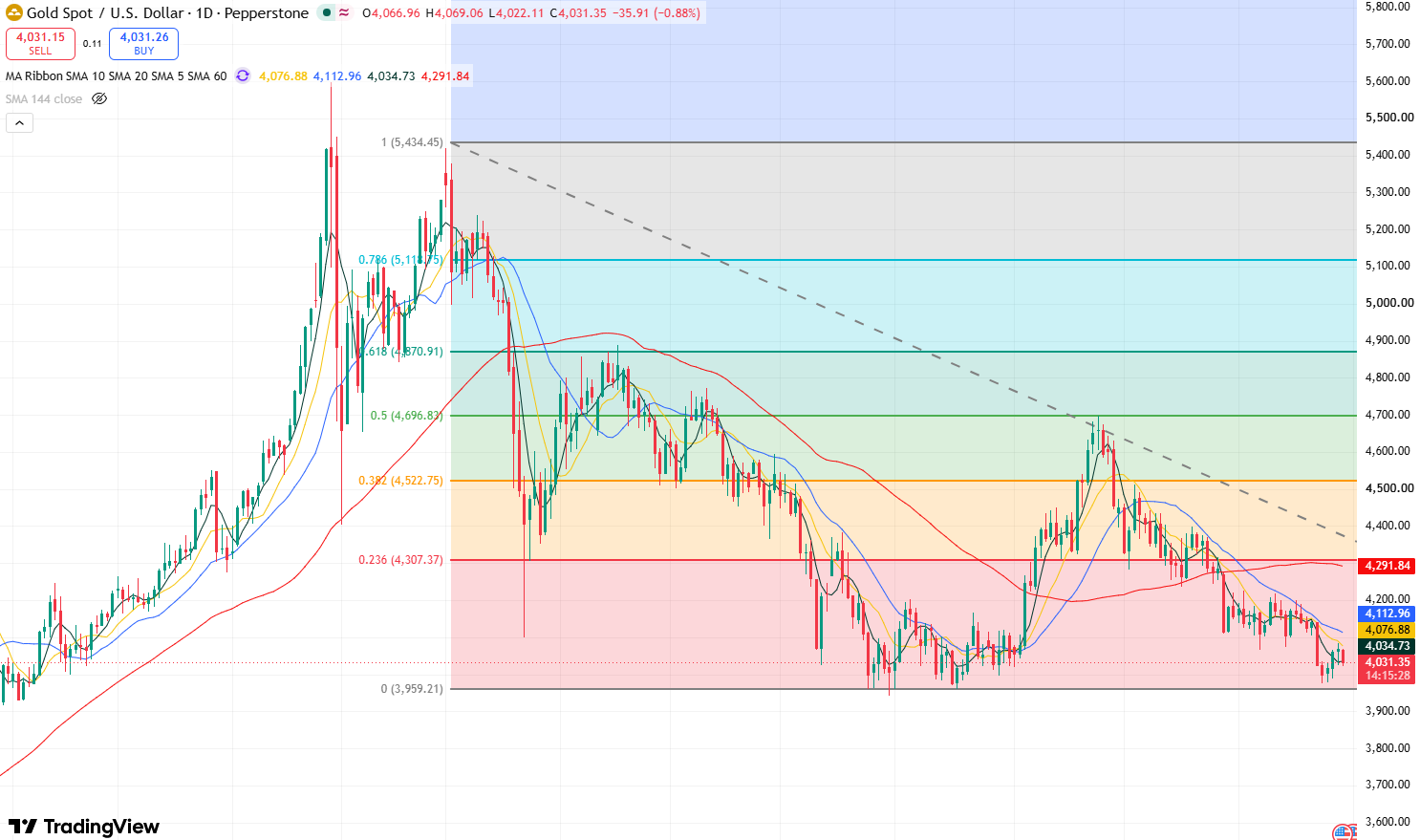
Gold Price Daily Chart, Source: TradingView
Looking at the daily chart, gold has recently experienced a continuous pullback from above $4,200. Although it briefly found support near $3,980 this week, it faced resistance again after rebounding to around $4,080 and currently sits back near $4,030, indicating that short-term downside pressure has not been fully eliminated.
Regarding technical indicators, the Relative Strength Index (RSI) hovers around 38.7 and has not yet entered oversold territory, signaling that bears hold a clear upper hand in market sentiment. Meanwhile, gold prices continue to be capped by the 10-day and 20-day moving averages, further indicating a short-term bearish bias.
Currently, key initial downside support for gold is at $4,000–$3,980. If the September PCE data comes in higher than expected and pushes gold below $3,980, prices may further test the support level near $3,940. If this level is lost, gold could drop more sharply toward the $3,900 mark.
Conversely, if the September PCE data reflects cooling inflation, it could support gold in testing the resistance level of $4,080 again. A breakthrough above this level could push prices to test the $4,100–$4,140 range. If gold breaks out and holds above $4,140, it will open up upside potential toward $4,200.
This content was translated using AI and reviewed for clarity. It is for informational purposes only.
Recommended Articles











Comments (0)
Click the $ button, enter the symbol, and select to link a stock, ETF, or other ticker.