


Gold Price Forecast: Can Gold Keep Rising as Fed Rate Hike Expectations Heat Up and US-Iran Conflict Escalates?



AI Podcast


Gold prices extended declines during the Asian session on August 31, briefly dipping below $4,400 to $4,396.36, pressured by Fed Chair Kevin Warsh’s hawkish remarks at Jackson Hole that spiked September rate hike expectations to 60%. Simultaneously, rising Treasury yields, a stronger U.S. dollar, and renewed U.S.-Iran tensions lifting crude oil prices increased the opportunity cost of holding gold. Technically, prices are testing crucial support near the $4,400 mark and the 20-day moving average. A failure to hold this level could trigger a deeper correction toward $4,330, while a firm hold may spark a rebound targeting $4,500.

TradingKey - As of the Asian session on August 31, gold prices today (XAUUSD) extended last Friday's decline, briefly falling below $4,400 during intraday trading to hit a low of $4,396.36. Last Friday, gold prices closed down over 3% as Fed Chair Kevin Warsh's hawkish speech at the Jackson Hole symposium significantly boosted expectations for a September rate hike, while the renewed escalation of the US-Iran military conflict over the weekend and rising international oil prices further intensified inflation fears, putting heavy pressure on gold's upside; however, technical analysis indicates that gold prices still have upside potential.
Why Gold Prices Are Falling
From a fundamental perspective, the primary reasons for the recent drop in gold prices lie in the hawkish signals sent by Warsh at the Jackson Hole Economic Symposium and the renewed escalation of tensions between the U.S. and Iran.
Warsh stated last Friday that if the Federal Reserve cannot be confident that underlying inflation is returning to its 2% target quickly enough, policymakers still "have work to do." Although Warsh did not explicitly announce a rate hike in September, this marked his clearest hint at a rate hike since taking office as Fed Chair.
Markets quickly recalibrated rate expectations. Following Warsh's speech, the probability of a Fed rate hike in September rapidly rose from about 35% previously to around 60%. The U.S. 2-year Treasury yield rose about 11 basis points to 4.34% last Friday, the 10-year Treasury yield advanced to near 4.72%, and the U.S. Dollar Index climbed roughly 0.6%. For non-yielding gold, the simultaneous rise in Treasury yields and the U.S. dollar significantly increased the opportunity cost of holding gold, driving gold prices down by over 3% last Friday.
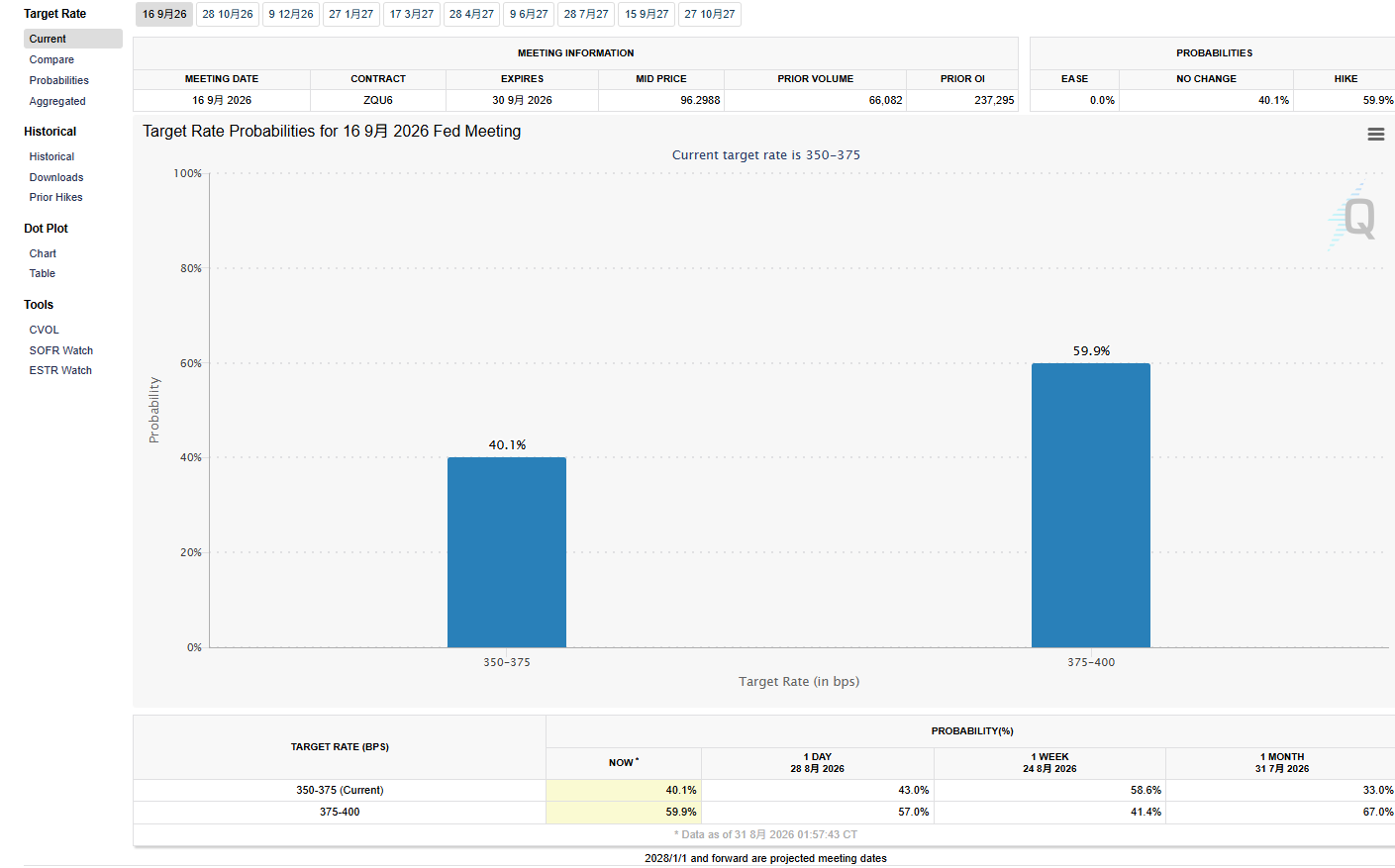
Source: CME Group
Meanwhile, U.S.-Iran tensions showed signs of heating up again over the weekend. Military actions between the U.S. and Iran heightened market concerns over a further escalation in the Middle East, while shipping and energy supply risks in the Strait of Hormuz regained attention. Driven by this, international crude oil prices rose, with Brent crude climbing back above $90. If transport disruptions in the Strait of Hormuz push global oil prices continuously higher, it could also push up U.S. inflation expectations, affecting market expectations for Fed rate policy and further pressuring gold prices.
Gold Price Technical Analysis
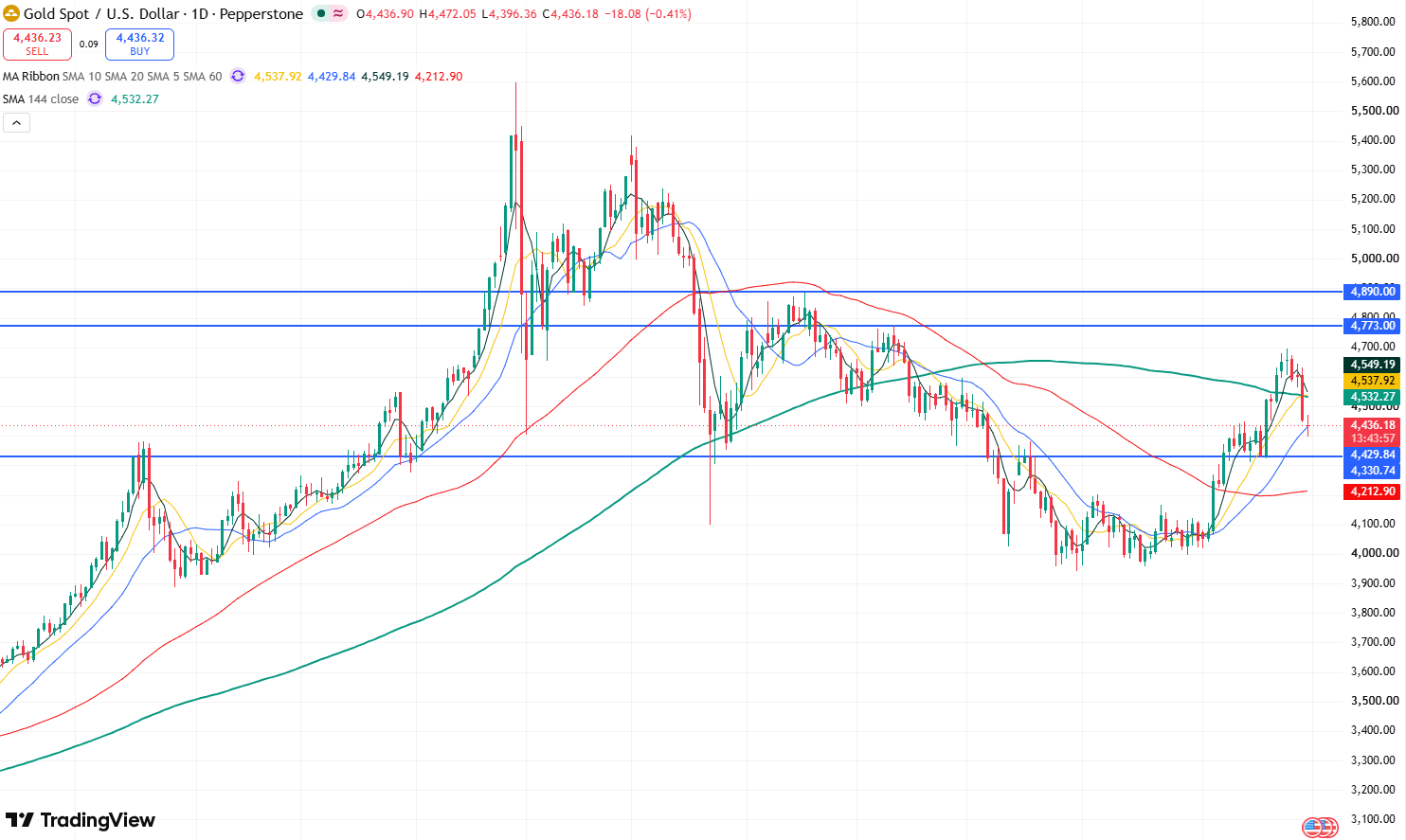
Gold price daily chart, Source: TradingView
Looking at the daily chart of gold prices, gold previously surged rapidly from near $4,300 to approach $4,700 at its peak, but failed to achieve a valid breakout near $4,700. Hawkish remarks from Warsh served as a catalyst for profit-taking by bulls; gold prices plummeted over 3% in a single day last Friday and probed further down to around $4,396 this Monday, indicating that market sentiment is currently dominated by bears.
Currently, gold prices have fallen near the $4,400 mark. Although prices dipped intraday to $4,396, they quickly rebounded back above $4,400, demonstrating a degree of support at this level. Meanwhile, as this level lies near the 20-day moving average, it may form a confluent support structure, weakening the short-term bearish momentum of gold prices.
It is worth noting that if gold prices close below the 20-day moving average today while also breaking below the $4,400 mark, gold prices may enter a deeper correction phase in the short term.
To the downside, the primary support level to watch for gold is $4,400. If this level fails to hold, gold prices may fall toward the support level of $4,330, and a further decline could test the $4,200 mark.
To the upside, if today's closing price confirms a firm hold above $4,400, gold prices will see a short-term rebound. The primary target will be testing the $4,500 mark on the upside, followed by $4,600. A successful breakout and consolidation above this level would see gold prices continue to challenge the $4,700 mark.
This content was translated using AI and reviewed for clarity. It is for informational purposes only.
Recommended Articles









Comments (0)
Click the $ button, enter the symbol, and select to link a stock, ETF, or other ticker.