Coinbase's payment push goes country-scale as El Salvador pivots into stablecoins


The new remittance and identity app, Sivar, built by Modveon for El Salvador, runs on Coinbase’s payments infrastructure, according to a Tuesday announcement by the US-based exchange.
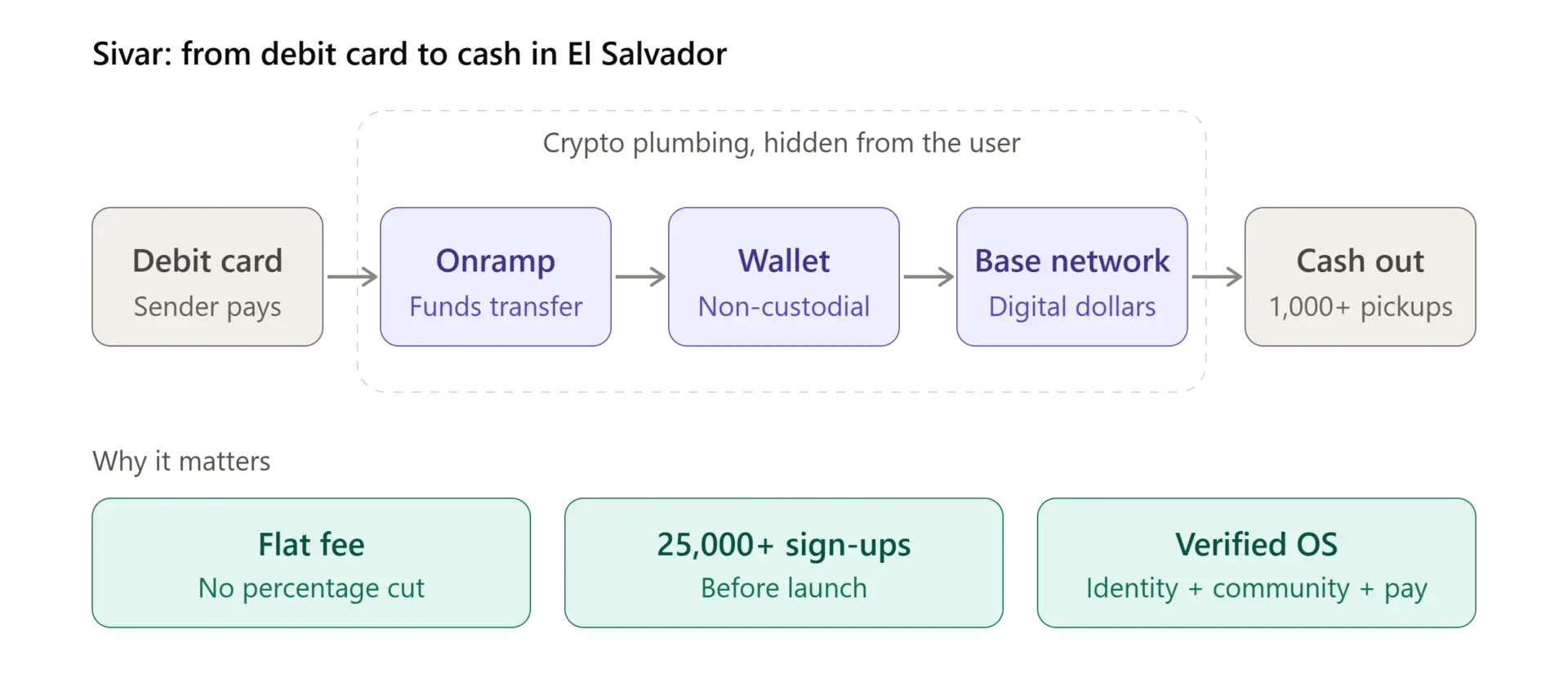
The app built by the firm based in Palo Alto will allow eligible senders to transfer funds from the U.S. to verified recipients in El Salvador for a flat $2 fee, regardless of the transaction amount.
Coinbase and Modveon said that more than 25,000 Salvadorans signed up for Sivar ahead of today’s launch.
How El Salvador’s Sivar remittance app works
El Salvador’s Sivar platform works like a traditional payments app on the frontend while Coinbase’s crypto infrastructure runs in the background, moving peer-to-peer transfers over Coinbase APIs, and settling the value in stablecoins on Base, Coinbase’s Ethereum layer-2 network.
The flow works like this, according to Coinbase:
- Senders fund a transfer from a debit card through Coinbase Onramp.
- Each user gets a non-custodial wallet inside the app.
- Recipients can collect cash at more than 1,000 locations across El Salvador.
Coinbase Chief Policy Officer Faryar Shirzad hit the cost pitch, saying that the company can charge a flat fee instead of percentage cuts because the money “moves entirely in digital dollars.”
CEO and co-founder Nana Murugesan called the Sivar app the first national rollout of Modveon’s “Verified Operating System,” which bundles identity, community features and payments.
Why Coinbase is expanding into El Salvador
Presenting a flat fee solution to people receiving money from abroad is a big market, especially in El Salvador. According to Coinbase, U.S.-based Salvadorans accounted for about 92% of roughly $9 billion that people living abroad sent to recipients in the country in 2025.
That was what President Nayib Bukele was thinking about when El Salvador made Bitcoin legal tender in 2021.
However, Bitcoin payments did not reach the intended adoption rate. As Cryptopolitan reported in August, one staff member at a restaurant in the town known as Bitcoin Beach, El Zonte, declared the local Bitcoin payment scene “dead.”
Coinbase is helping El Salvador move to stablecoin rail
Sivar reflects how far El Salvador’s crypto policy has drifted from its origins. Under its 40-month loan program with the International Monetary Fund, the country amended its Bitcoin Law in January 2025 to make merchant acceptance voluntary and bar tax payments in Bitcoin.
The IMF’s combined second and third review, reached at staff level in early September, stated that majority ownership and operational control of the state Chivo wallet had passed to a private operator. Cryptopolitan reported the deal unlocks about $140 million and that El Salvador’s public-sector Bitcoin stock, near 7,764 BTC, has not grown through new purchases.
Adriana Mira, Vice Minister of Foreign Affairs of the Republic of El Salvador described Sivar as “a step toward a more personal digital experience designed to meet the needs of Salvadorans, wherever they may be.”
Sivar arrives a day after Coinbase said it had deepened its partnership with Citi to give businesses fiat-and-stablecoin payment rails, using Citi’s Virtual Account Wallet and letting Citi’s institutional clients accept stablecoin payments through Spring by Citi.
In its Q4 2025 shareholder letter, Coinbase named scaling stablecoins and payments infrastructure as one of three priorities for 2026. Sivar takes that stack to what Coinbase calls country scale.
The smartest crypto minds already read our newsletter. Want in? Join them.