


MRVL: In the AI inference era, is connectivity more valuable than compute?



Marvell Technology (MRVL) released FY2027 Q1 results after the U.S. close on May 28 Beijing time. The quarter ended in Apr 2026.
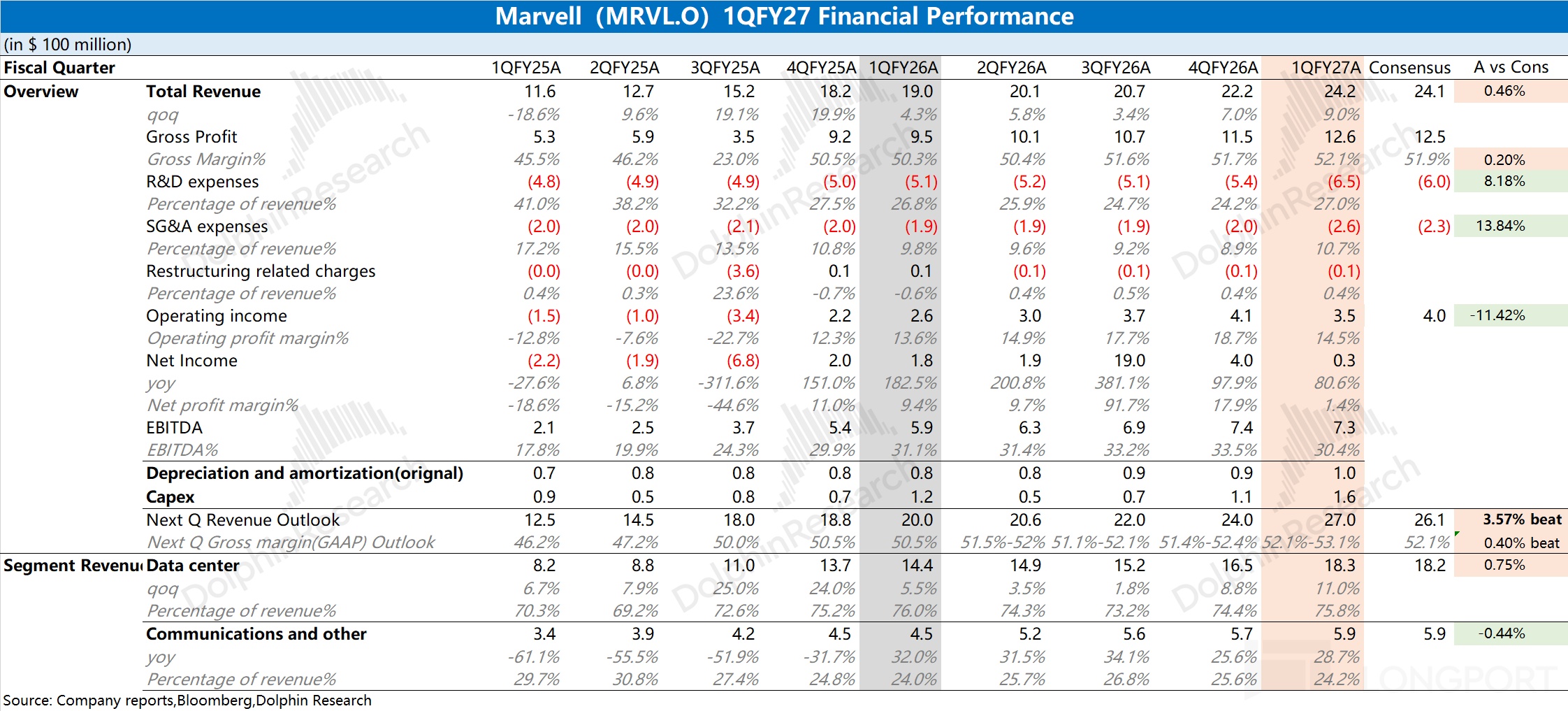
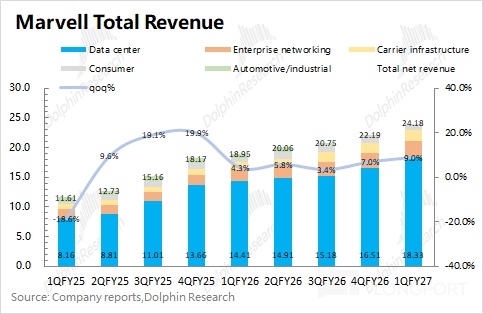
1. Revenue: $2.42bn this quarter, +9% QoQ, in line with consensus ($2.41bn). The ~$0.2bn sequential uplift was essentially all driven by data center.
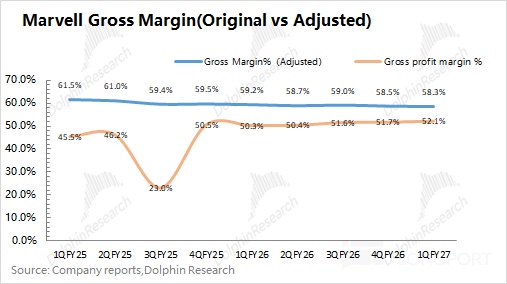
2. GPM: GAAP GPM was 52.1%, up 40bps QoQ. Because GAAP margins are affected by acquisition-related amortization, they do not fully reflect underlying operations. Ex-amortization, our reference Adj. GPM was 58.3%, down 20bps QoQ. Lower-margin custom ASIC mixed in, keeping overall GPM on a slight downward trend.
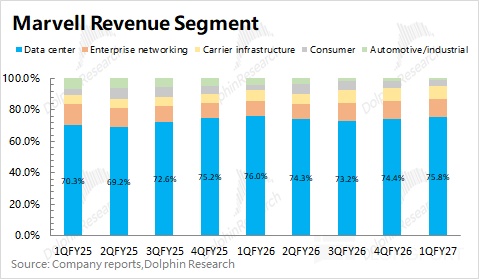
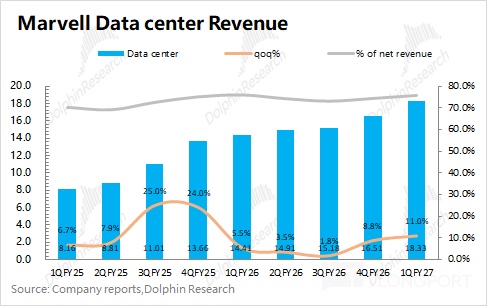
3. Data center: the key focus. Segment revenue was $1.83bn, +11% QoQ, mainly on stronger optical interconnect; data center accounted for 75.8% of total.
Previously, the Street’s AI focus was on custom ASIC, but MRVL’s exposure via Amazon’s Trainium underperformed. The company still supplies Trainium 2.5 to Amazon, while the newly announced Trainium 3 is primarily sourced from Alchip, which weighed on the shares at the time.
As AI moves into inference, raw compute matters less while storage, CPUs and interconnects gain importance. Marvell is relatively ahead in interconnects, and even with softer ASICs near term, robust demand for connectivity should support high growth.
4. Next-quarter guide: revenue $2.7bn, above Street ($2.61bn), with QoQ growth led by interconnect demand ; GAAP GPM 52.1%–53.1%, broadly stable.
5. Full-year outlook: FY2027 revenue raised to $11.5bn (prior $11.0bn), +40% YoY. The lift is mainly from interconnect growth now guided to >70% (prior 50%+), while ASIC growth stays >20%; FY2028 revenue raised to $16.5bn (prior $15.0bn), +43% YoY.
Dolphin Research view: well-positioned for the AI super-cycle; interconnect underpins growth
The print broadly matched expectations, with growth driven mostly by data center (interconnect). Ex-amortization, Adj. GPM was 58.3%, down 20bps QoQ.
Last quarter management recut disclosure from five lines to two (data center; communications & others). Data center was the primary growth engine this quarter, up 11% QoQ. ASICs were relatively weak, while growth was led by interconnect demand.
Marvell guides next-quarter revenue to $2.7bn (+11% QoQ), above Street at $2.61bn. With full-year guidance now in place, the next-quarter guide carries less incremental importance.
The recent share rally reflects a shift in the narrative. The market had worried about Trainium share loss, 1.6T DSP ramp timing and Broadcom (AVGO) competition. But in an optical super-cycle, even if custom ASICs lag, interconnect products (e.g., DSPs) still offer high-visibility growth.
In the inference era, the AI stack is better defined as storage + XPU + connectivity. Marvell is strong in optical/electrical interconnects and has augmented AI networking via M&A. Sell-side models were already moving up, and management’s FY2027/FY2028 revenue guides to $11.5bn/$16.5bn largely meet those higher expectations.
Beyond the quarterly numbers, Marvell’s growth vectors include:
1) Rack-scale networking: a recent M&A spree—XConn (PCIe/CXL switch), Celestial AI (photonic interconnect), Polariton (silicon photonics). This builds out three AI networking layers—Scale-Out, Scale-Up and Scale-Across—delivering a full high-speed interconnect portfolio from within-rack to cross-DC.

2) CXL memory expansion/pooling (Structera): not for cold data storage, but for adding a tier in the active memory hierarchy. AI inference needs massive KV cache; HBM is costly and DRAM is constrained, so NAND/storage-class memory is required for expansion.
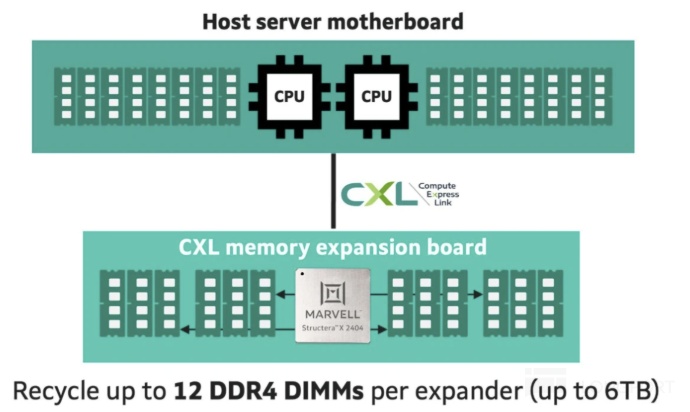
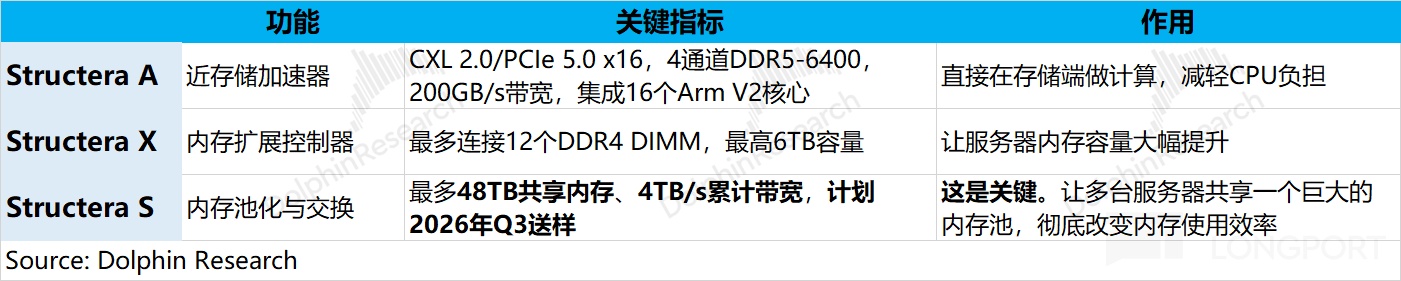
Marvell’s CXL lineup comprises Structera A, Structera X and Structera S for near-memory acceleration, memory expansion control, and memory pooling & switching, respectively.
3) Full-stack optical interconnect
Connectivity is evolving from copper to pluggable optics (with a relative lead in PAM4 DSP) to LPO/OBO (board-level optics) to CPO (co-packaged optics) to all-optical networks. Marvell has positioned across each phase.
Today, in Scale-Out deployments, pluggable optics remain the dominant form factor. Hyperscalers like NVIDIA and Google rely mainly on pluggables, while CPO is expected to enter small-batch use only in H2 2026.
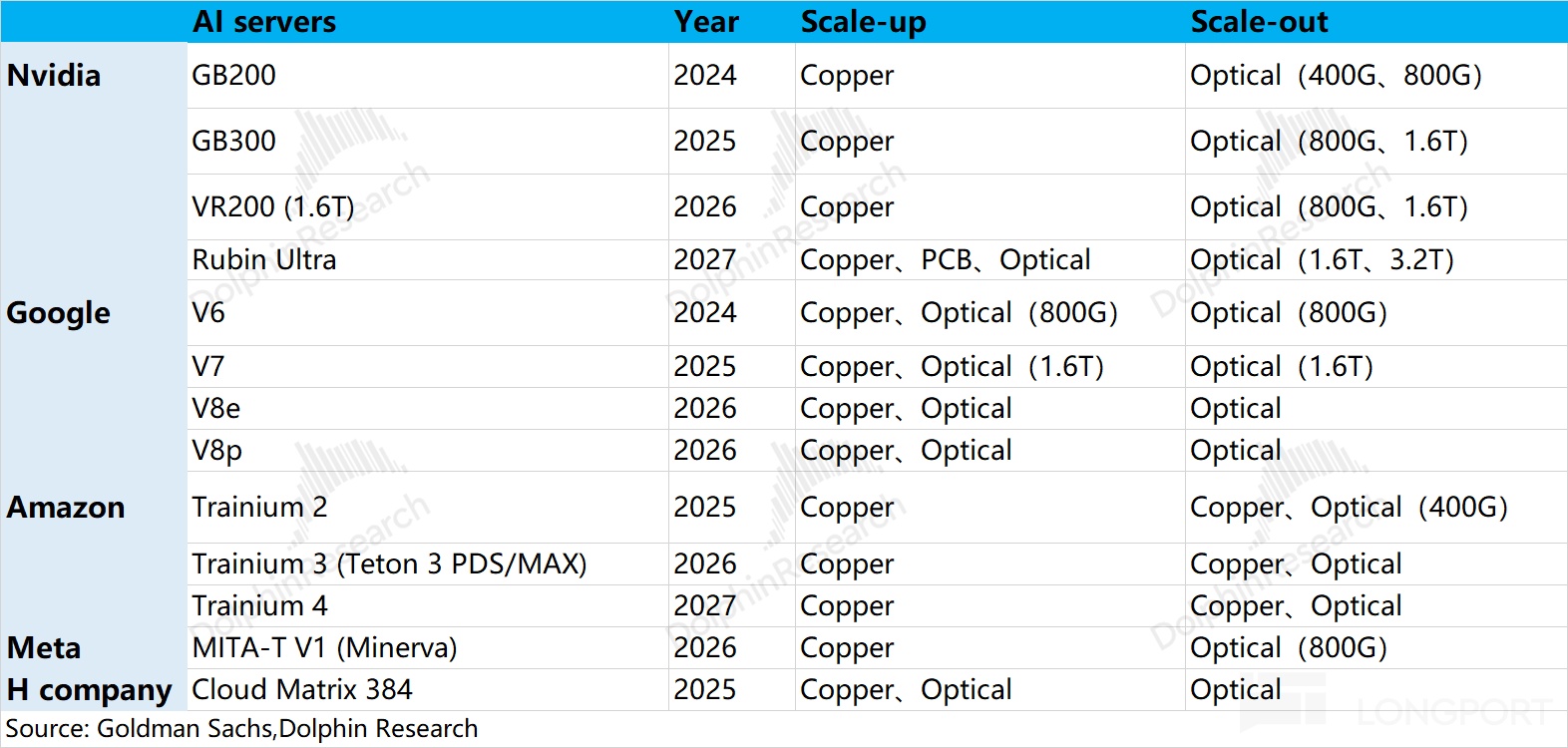
Marvell’s PAM4 DSP holds a relative lead in pluggables. Management noted the 1.6T solution has begun volume production and should ramp quickly in FY2027, which will be a major near-term growth driver for connectivity. Beyond DSPs, Marvell has active roadmaps in LPO/OBO, CPO and all-optical domains.
At MRVL’s current market cap (~$173.7bn), implied FY2028 Adj. net income multiple is ~37x, assuming ~+45% revenue CAGR, 57.5% Adj. GPM and 11.5% Adj. tax rate.
On this quarter’s print alone, results were ‘okay’. With full-year guidance provided, quarterly moves matter less. FY2027/FY2028 revenue outlooks broadly match the Street after recent upward revisions.
The rich multiple embeds high expectations, and the annual guide did not deliver incremental upside, which could prompt some near-term disappointment. That said, under the new guide, growth above 40% for the next two years remains intact, underscoring sustained high growth.
Beyond connectivity, ASICs, CXL memory expansion/pooling (Structera) and rack-scale solutions add medium-to-long term optionality. Even if the annual guide felt ‘plain’, the high-growth narrative remains in place.
Dolphin Research’s detailed analysis of MRVL’s results follows below:
I. Marvell’s biz.
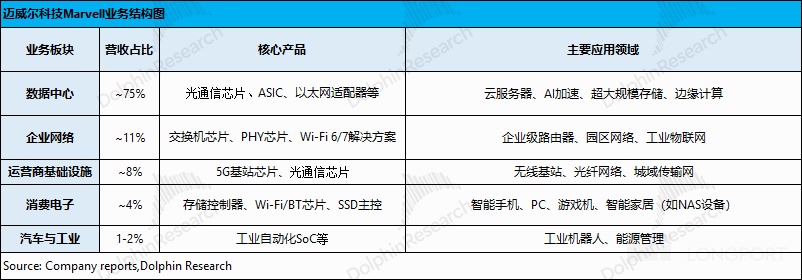
Founded on storage, Marvell expanded via a series of bolt-on M&A. Data center has become the largest revenue stream.
By segment:
1) Data center (~75%): high-growth, propelled by data center and ASIC demand and the main investor focus. It includes optical/electrical interconnect, SSD controllers and custom ASICs (e.g., Amazon AWS, Google Axion CPU), serving cloud servers and edge computing.
2) Others (~25%): the legacy enterprise networking, carrier infrastructure, consumer, and auto/industrial have been consolidated into ‘communications & others’.
II. Key metrics: connectivity heating up, revenue growth re-accelerates QoQ
2.1 Revenue
FY2027 Q1 revenue was $2.42bn, +9% QoQ and in line with the $2.41bn consensus. Growth was mainly driven by optical/electrical interconnects.
2.2 Gross profit
Gross profit was $1.26bn, up ~$110mn QoQ. GAAP GPM was 52.1% this quarter.
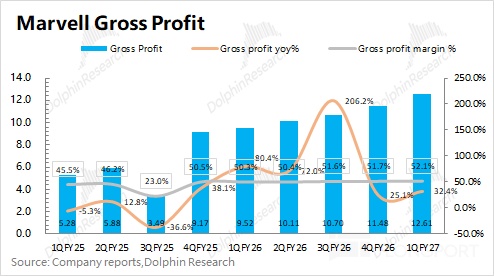
GAAP GPM is affected by acquisition-related amortization, so it does not fully reflect operations. On an adjusted basis we reference below.
Adj. GPM was 58.3%, down 20bps QoQ. The mix impact from lower-margin custom ASICs kept margins trending lower.
2.3 Opex and profitability
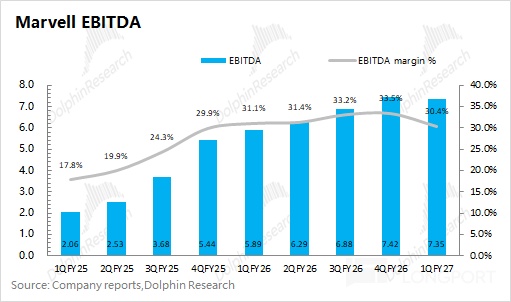
Net income was $35mn in FY2027 Q1. Ex-nonrecurring items, EBITDA was $735mn with EBITDA margin at 30.4%, pressured by lower Adj. GPM and a notable increase in opex.
III. Segment detail: connectivity drives high growth; ‘growth angles’ well stocked
Since 2018 Marvell has acquired Cavium, Innovium and others, bolstering connectivity and ASIC capabilities. Demand for interconnect and custom ASIC has lifted data center, now the biggest swing factor for results.
From last quarter, legacy lines were grouped into communications & others. Enterprise networking, carrier, consumer, and auto/industrial each fell to around or below a 10% revenue share.
3.1 Data center
FY2027 Q1 data center revenue was $1.83bn, +11% QoQ and in line with the $1.82bn consensus, driven mainly by stronger optical/electrical interconnect demand.
The focus within data center is interconnect and custom ASIC.
1) Custom ASIC: the largest program is Amazon’s Trainium.
Marvell continues to supply Trainium 2.5, while Trainium 3 is primarily provided by Alchip. This is a key reason for recent softness in ASIC.

For FY2027, the ASIC outlook is modest with ~20% YoY growth, well below CSP capex growth and reflecting share loss at a major customer (Amazon). For FY2028–FY2029, management is more constructive. They expect custom revenue to double in FY2028 and exceed $10bn in FY2029, roughly consistent with a 20% long-term market share target and including Microsoft’s next-gen Maia, plus CXL and NIC attach products.
2) Interconnect: the largest data center contributor
With ASIC softer, interconnect is delivering the bulk of incremental growth. We estimate interconnect revenue at ~$900mn this quarter, roughly half of data center.
As inference scales, the importance of ‘AI infra = storage + XPU + connectivity’ is clearer. Pluggable optics remain the mainstream Scale-Out method, and Marvell’s PAM4 DSP is a relative leader, while the company is also invested across copper, LPO/OBO, CPO and all-optical. Management raised FY2027/FY2028 revenue guides largely on interconnect strength. They now expect interconnect revenue to grow >70% YoY in FY2027 (prior 50%+), and remain fast-growing in FY2028.
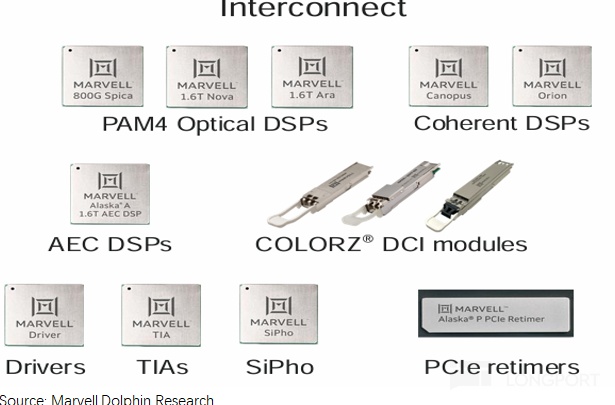
3) Other incremental areas:
i) DC switch silicon: after buying Innovium, Marvell strengthened its Ethernet switch position. Related revenue was about $300mn in FY2026 and is expected to reach ~$600mn/$1bn+ in FY2027/FY2028, supported by AI demand.
ii) Full network-layer capability: recent deals for XConn (PCIe/CXL switch), Celestial AI (photonic interconnect) and Polariton (silicon photonics) build out Scale-Out, Scale-Up and Scale-Across layers, enabling a full high-speed interconnect portfolio from in-rack to cross-DC.
iii) CXL memory expansion & pooling: main offerings are Structera A, Structera X and Structera S for near-memory acceleration, memory expansion control, and memory pooling/switching.
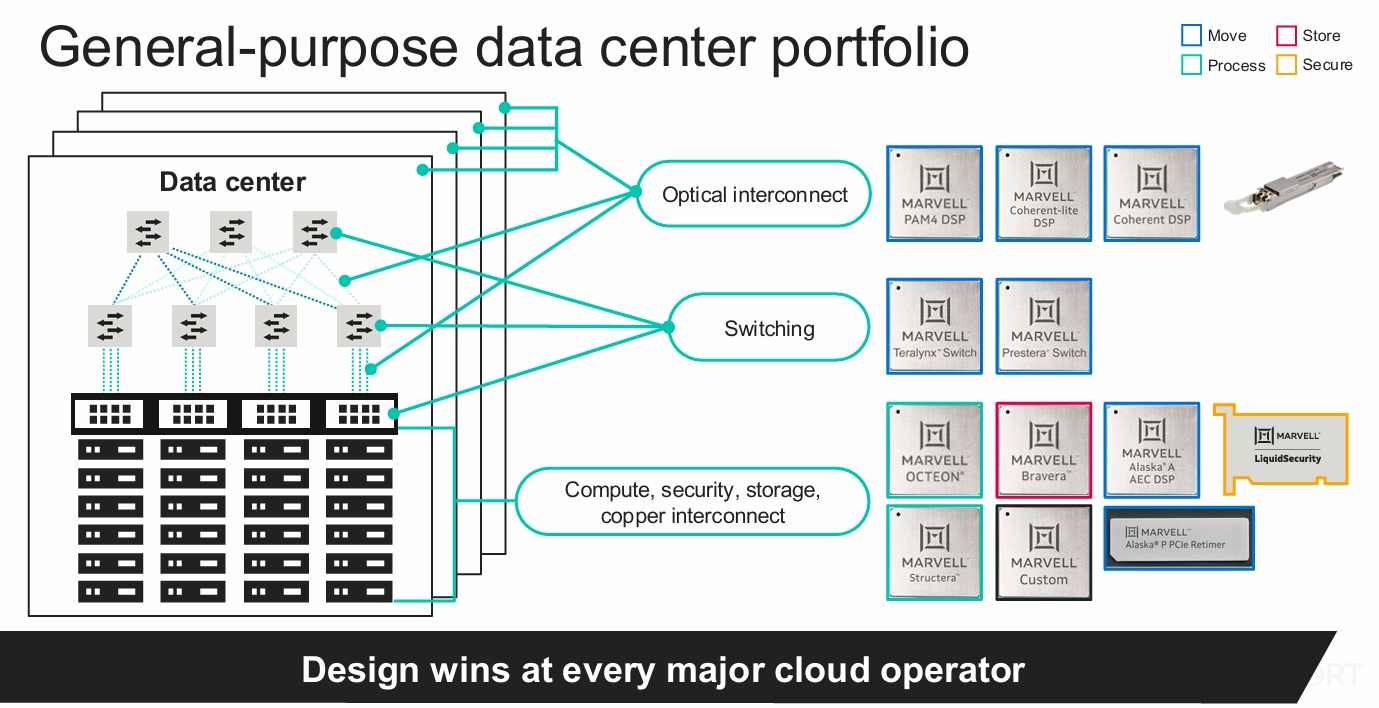
Through these acquisitions, Marvell has built Scale-Out, Scale-Up and Scale-Across capabilities. The company aims to offer full solutions, not just sell chips.
Marvell also expanded collaboration with NVIDIA, including i) optics (building from DSP/TIA/driver supply into silicon photonics to enable Scale-Up networks); ii) NVLink Fusion integration (custom chips and networking silicon that interoperate with NVIDIA infra to give hyperscalers mix-and-match flexibility); and iii) AI-RAN (tighter coupling of OCTEON baseband processors with NVIDIA GPUs so operators can run 5G/6G and high-performance AI on the same software-defined platform).
In the inference phase, connectivity is increasingly critical, driving near-term results and supporting longer-term growth visibility. Near term, interconnect contributes the main data center uplift, with ASIC, CXL memory expansion/pooling (Structera) and rack-scale solutions as longer-term options.
3.2 Communications & others
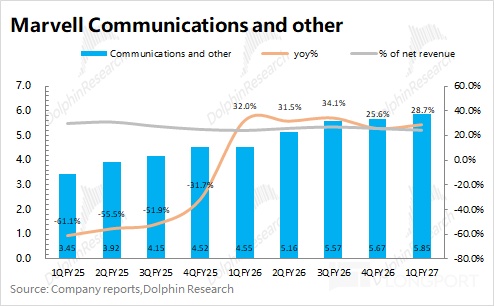
Management now reports only the combined communications & others line, no longer breaking out enterprise networking, carrier, consumer and industrial.
FY2027 Q1 communications & others revenue was $585mn, +28% YoY. As data center accelerated, the segment’s mix fell to 24%.
For this segment, the annual outlook is unchanged: about +10% in FY2027 and low single-digit growth in FY2028.
Prior Dolphin Research coverage on MRVL:
Earnings:
Mar 6, 2026 call Trans: Marvell (Trans): Hikes revenue guide again; second XPU to ramp in FY28
Mar 6, 2026 note: Marvell: ASIC card missed; connectivity powers the AI comeback
Dec 3, 2025 call Trans: Marvell (Trans): AWS becomes Celestial AI’s lead customer
Dec 3, 2025 note: Marvell: M&A fills gaps; a faster NVIDIA alternative?
Aug 29, 2025 call Trans: Marvell (Trans): Still not addressing Alchip’s challenge head-on
Aug 29, 2025 note: Marvell: Hyperscaler spend rises, but why didn’t ASICs benefit?
May 30, 2025 call Trans: Marvell (Trans): AI to reach half of revenue in the future
May 30, 2025 note: Marvell: AI sequential growth stalls; where is the next trump card?
Mar 6, 2025 call Trans: Marvell (Trans): Data center growth faltered
Mar 6, 2025 note: Marvell: Cooling expectations on AI; ASIC warning signs
Deep dives:
Jan 14, 2025: ASIC wars: Can Marvell beat Broadcom?
Jan 2, 2025: Marvell vs. the trillion-dollar Broadcom: Can ASIC ignite a comeback?
Risk disclosure & disclaimer: Dolphin Research disclaimer and general disclosure
Recommended Articles






Comments (0)
Click the $ button, enter the symbol, and select to link a stock, ETF, or other ticker.