


Xiaomi: Doubting After the Selloff? The Worst Is Over



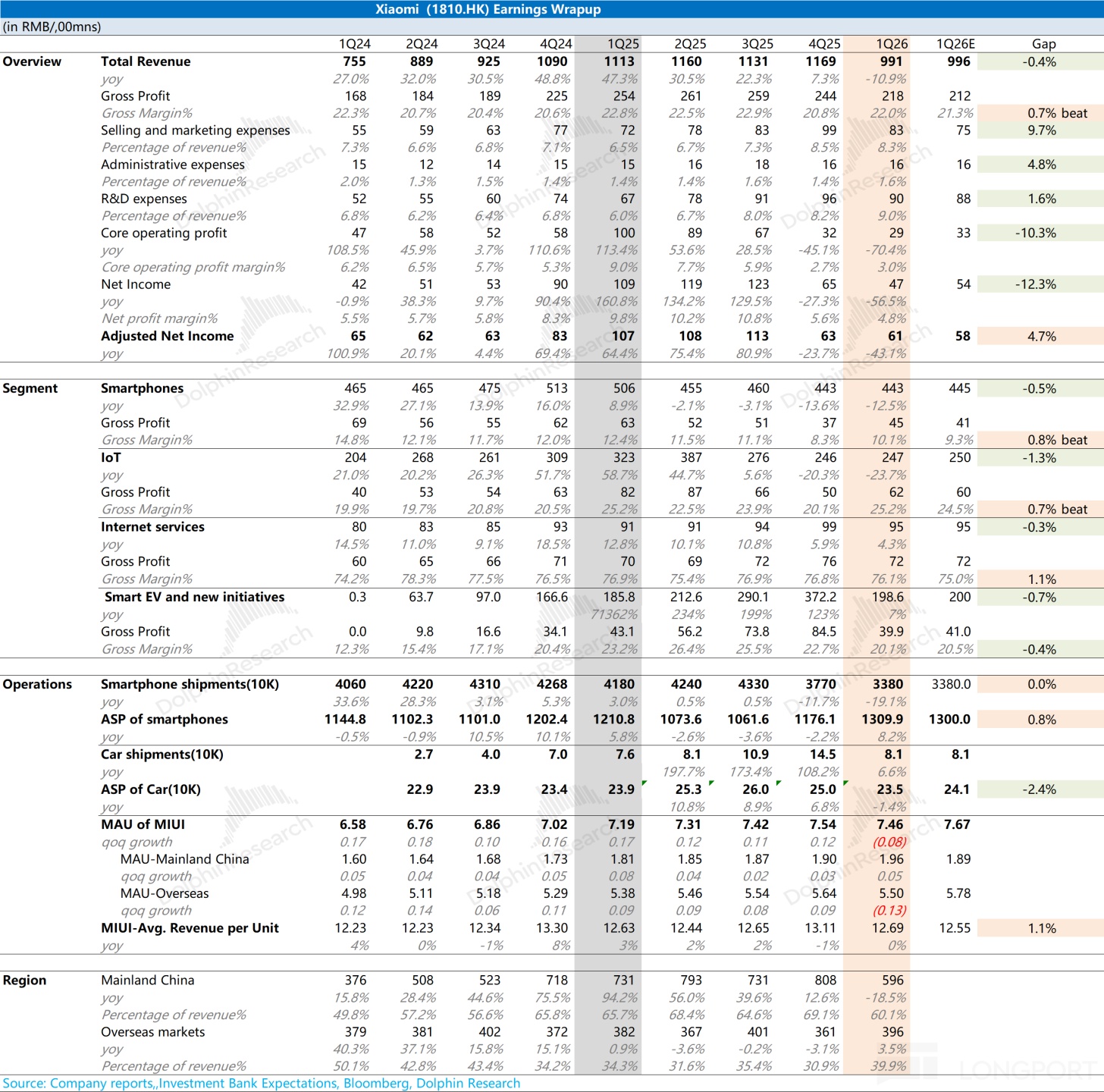
Xiaomi Group (1810.HK) released its Q1 2026 results (through Mar 2026) after Hong Kong market close on May 26, Beijing time. The key points are as follows:
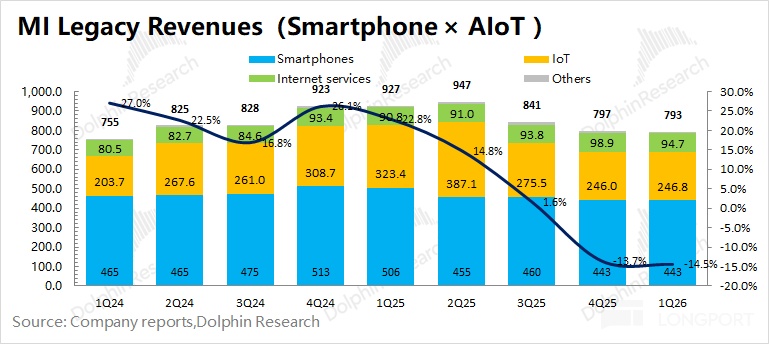
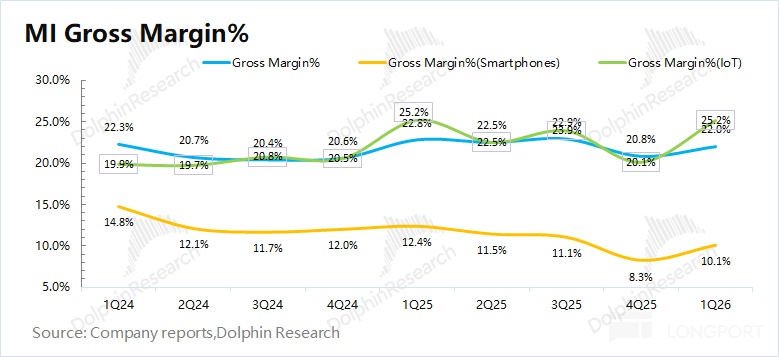
1. Overall results: revenue RMB 99.1bn, down 11% YoY. The decline was driven by smartphones and IoT, with legacy hardware (smartphones x AIoT) revenue down 14.5% YoY this quarter. GPM was 22%, down 80bps YoY, mainly pressured by lower margins in smartphones and autos versus a year ago.
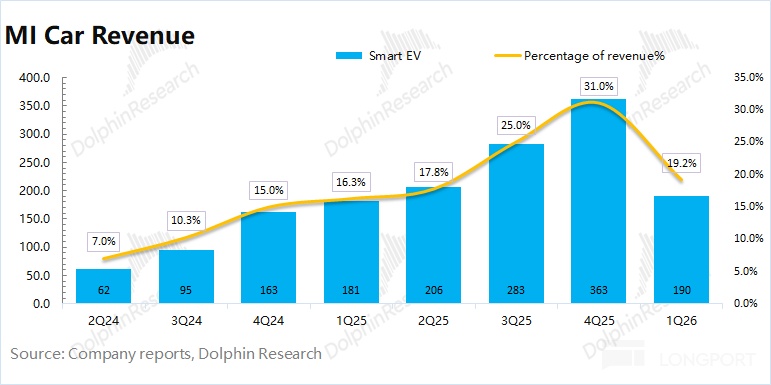
2. Auto biz:$XIAOMI-W(01810.HK) auto-related revenue was RMB 19.86bn this quarter, broadly in line with expectations. Shipments were 81k units, with ASP down to RMB 235k per unit. Sales fell due to the discontinuation of the old SU7 and production reallocations, while ASP declined on purchase-tax subsidies and a higher mix of lower-ASP inventory sales.
Auto GPM fell to 20.1%, close to market expectations (20.5%), mainly on lower ASP. This reflects Xiaomi’s purchase-tax subsidy and sales of some lower-priced inventory this quarter. With margin contracting again, Dolphin Research estimates core OP for the auto segment swung back to a loss of RMB 3.1bn in Q1.
Purchase-tax subsidy impact: Xiaomi previously announced that orders locked by 24:00 on Nov 30, 2025, but invoiced and delivered in 2026 due to production or logistics, would get a subsidy via a reduction of the final payment. For the YU7, the purchase-tax subsidy reduced per-unit ASP by roughly RMB 12k.
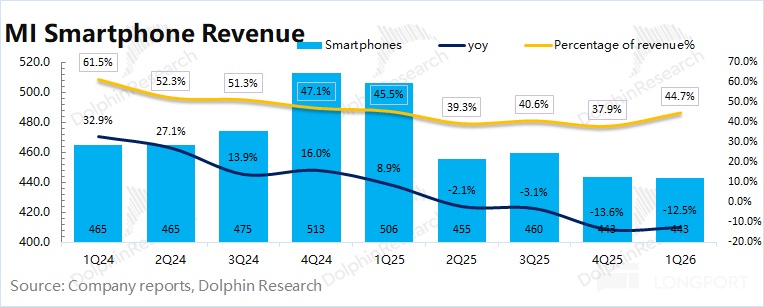
3. Smartphones: RMB 44.3bn, down 12.5% YoY, vs. market est. RMB 44.5bn. Xiaomi smartphone shipments fell 19% YoY this quarter, while smartphone ASP rose 8% YoY. By market: domestic shipments fell 34.6% YoY, overseas fell 12% YoY. Memory shortages directly constrained shipments. With smartphone GPM up QoQ, Dolphin Research believes memory was prioritized to higher-priced models, lifting ASP.
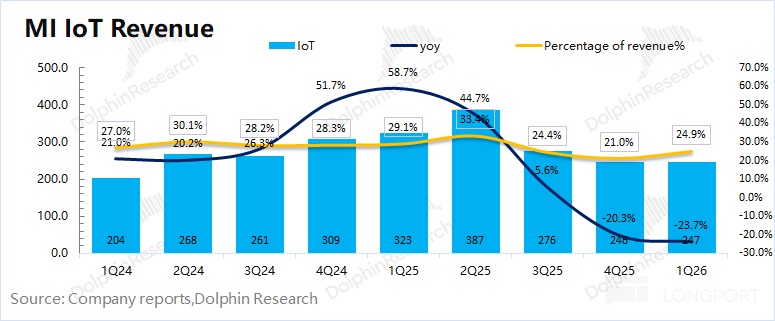
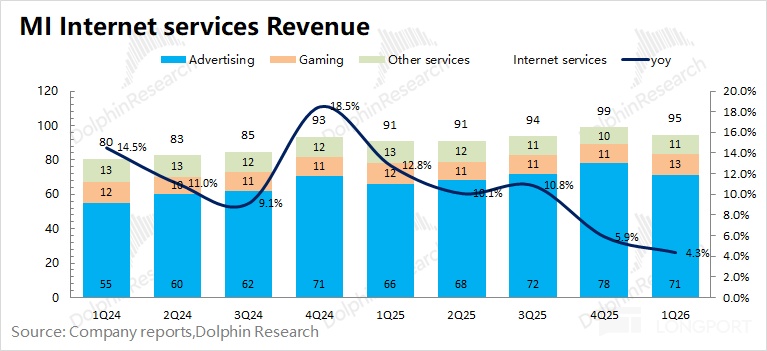
4. IoT: RMB 24.7bn, down 24% YoY, near market est. RMB 25.0bn, mainly due to fading state subsidies and memory issues. Large appliances were more affected by the subsidy rollback, with some products previously enjoying RMB 1–2k per-unit subsidies. 5. Internet services RMB 9.5bn, up 4% YoY, in line with market est. RMB 9.5bn, driven by ads. MIUI MAUs rose 4% YoY, while ARPU edged up 0.5% YoY.
By region: overseas internet revenue was RMB 2.97bn, while domestic was ~RMB 6.5bn. MIUI users in China continued to grow this quarter, while overseas users moderated.
6. Profitability:$Xiaomi Corporation(XIACY.US) core OP RMB 2.9bn, with Adj. net income RMB 6.1bn. Legacy businesses generated about RMB 6.0bn core OP, while autos lost RMB 3.1bn this quarter. Amid tight memory, the company prioritized higher-ASP models, lifting GPM and legacy core OP QoQ. Auto swung back to a loss on purchase-tax subsidies and lower volume.
Dolphin Research view: Share price halved, but the hand isn’t as bad as feared
Xiaomi’s Q1 print broadly matched market expectations. The YoY revenue decline was driven by legacy smartphones and IoT. Operationally, pressures remain significant this quarter. Smartphones and IoT both saw double-digit YoY declines, and auto growth and GPM also fell notably.
The stock has slid from ~HKD 60 to ~HKD 30, reflecting memory tightness, weak smartphones, and cooling sentiment on Xiaomi Auto. A sustained recovery likely requires operational improvement, with focus on autos, smartphones, and IoT execution:
1) Autos: full-year target of 550k units
Q1 auto sales were 81k units, down 44% QoQ. Discontinuation of the old SU7 and the launch of the new SU7 weighed on near-term capacity. With the new SU7, Apr sales rebounded to roughly 50k units.
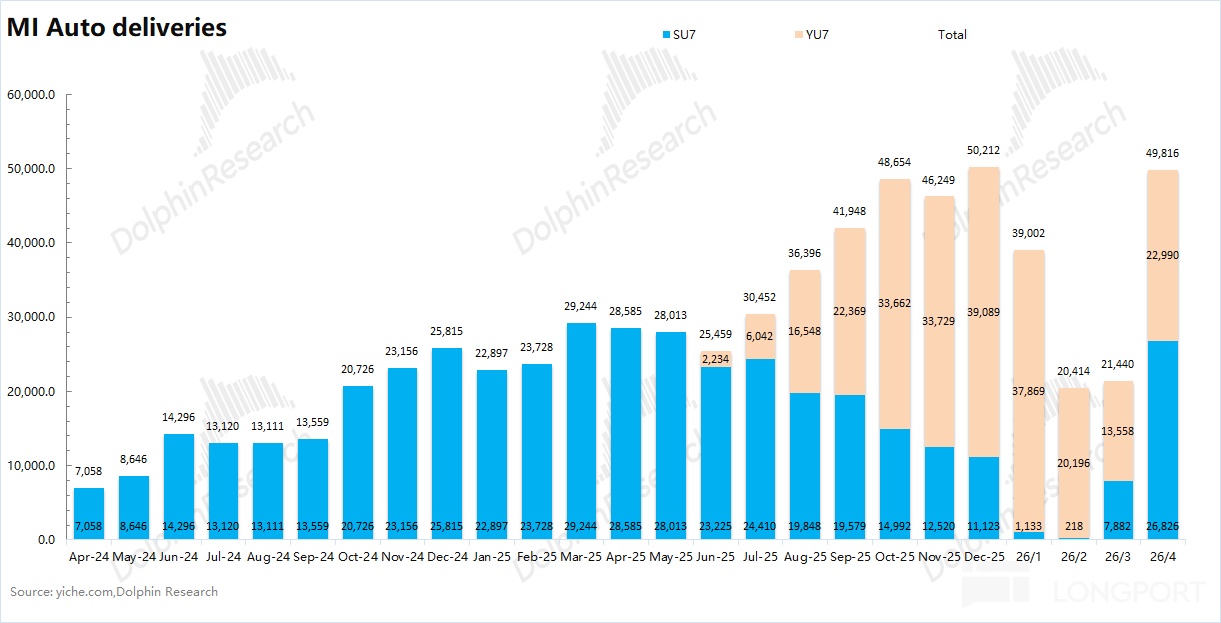
Although monthly sales returned to ~50k units post the new SU7, delivery wait-time trends suggest it is a transitional product rather than a breakout model like the YU7. The YU7 delivery cycle has fallen to within 10 weeks, implying most backlog has been absorbed. The new SU7’s wait has lengthened since the May Day holiday, and the current ~3-month cycle looks normal.

Management guided to 550k auto sales for 2026; with only 81k in Q1, the remaining three quarters need 470k (i.e., 155k+ per quarter), which is challenging. As the YU7 order pool clears, autos shift from supply-constrained to demand-driven, making volumes more sensitive to new order intake. b) Legacy (smartphones x AIoT): memory pressure persists, GPM holding at low levels.
i) Smartphones and IoT: both saw steep declines this quarter, driven by memory cost inflation and tighter state subsidies. China smartphone shipments fell 34% for Xiaomi in Q1, pressured by Apple’s iPhone 17 spec bump at the same price and memory tightness. Apple’s China shipments rose 34% YoY (vs. market down 3.6%).
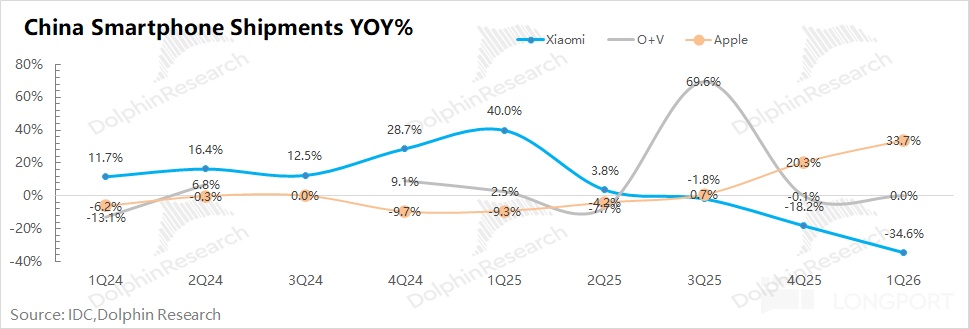
Qualcomm management noted that channel inventory digestion is easing, China Android should bottom next quarter, and return to sequential growth in 2H. End-demand hasn’t recovered yet, but memory headwinds look priced in after the stock’s decline. With legacy hardware GPM stabilizing despite rising memory prices, further operating deterioration looks less likely.
Overall, legacy (smartphones and IoT) remains under pressure, with margins at relatively low levels, but hardware GPM improved QoQ this quarter. Autos carry the key 550k full-year target, and new model performance is the main watch item. With multiple headwinds, the stock has halved from ~HKD 60. At this stage, bottom-up valuation work is more relevant.
Under a relatively bearish case (smartphone revenue -9% YoY, IoT slightly down), legacy declines by low single digits. Autos meet the 550k target, but ASP and margins soften. We estimate 2026 legacy core after-tax OP at ~RMB 20.0bn (-16% YoY); auto revenue ~RMB 140bn (+32% YoY). Sum-of-the-parts: assign 15–20x PE to legacy and 1.5x PS to autos (based on Xiaomi’s 2026 shipment target +34% YoY), implying HKD 600–700bn EV (HKD/CNY=0.87), or ~HKD 23–27/share. This is a reference band under a pessimistic case.
In this setup, the 550k auto target must be delivered. If guidance becomes hard to achieve or is cut, the stock could see another air pocket. As for legacy, much of the bad news looks priced in, awaiting demand recovery for an earnings upturn.
Dolphin Research maintains the HKD 23–27 range from last quarter. While the stock has fallen below HKD 30 and downside is narrowing, some funds may nibble early. That said, operations have yet to show clear improvement, and dips toward ~HKD 25 would offer a better cushion.
The following is Dolphin Research’s detailed read of Xiaomi’s results:
I. Overall: revenue down again, GPM has stabilized
With autos added, Xiaomi’s P&L now breaks out legacy ‘smartphones x AIoT’ and the new ‘autos and innovation’ bucket. The separate disclosure underscores management’s focus on autos. The company’s prior move above HKD 1tn market cap was also largely driven by auto expectations.
1.1 Revenue
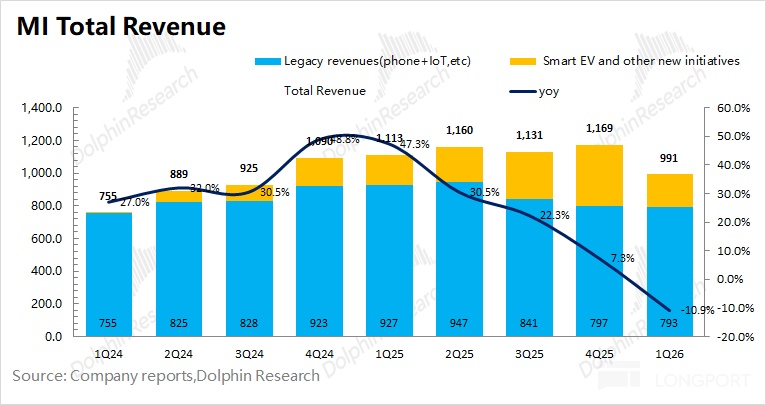
Q1 2026 revenue was RMB 99.1bn, down 11% YoY, broadly in line with the RMB 99.6bn market view, with weakness coming from smartphones and IoT. 1) Legacy smartphones x AIoT delivered RMB 79.3bn, down 14.5% YoY. Hardware remained weak, with smartphones -12.5% YoY and IoT -24% YoY.
2) New businesses including smart EVs posted RMB 19.86bn, up 7% YoY, shaped by YU7 deliveries, discontinuation of the old SU7, and ramp preparations for the new SU7.
1.2 Gross margin
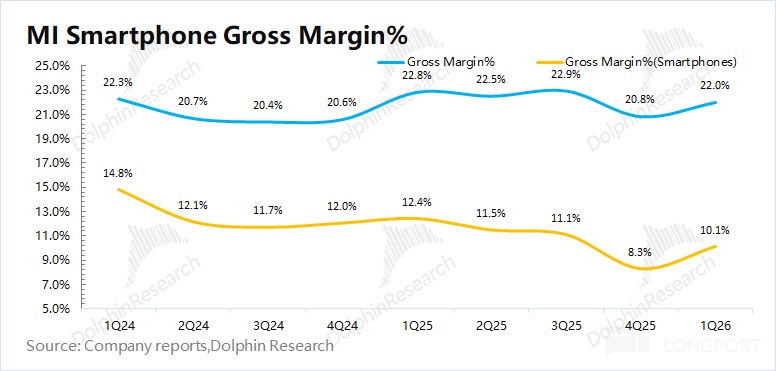
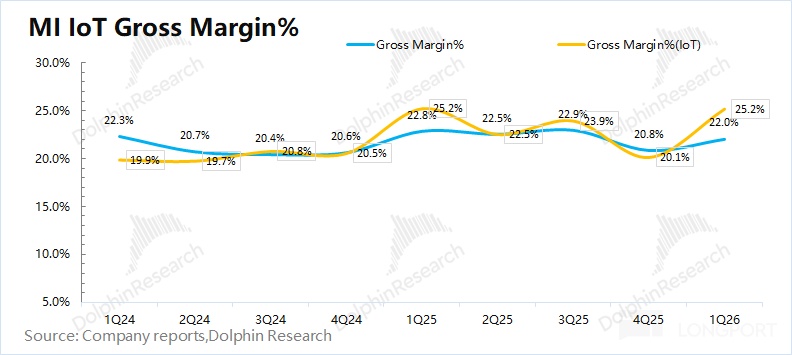
Group GPM was 22% in Q1 2026, above the 21.3% market view. Smartphone and IoT margins fell QoQ, and auto margins continued to decline. a) Legacy GPM was 22.5%, up 250bps QoQ, as memory was prioritized to higher-ASP products. Smartphone GPM rose QoQ to 10.1%, and IoT GPM rebounded to 25.2%.
Other legacy segments recorded a RMB 80mn GP loss this quarter, including services such as AC installation. If attributed to IoT, IoT’s ‘true’ GPM would be ~24.9%. 2) Auto and other new businesses GPM was 20.1%, near the 20.5% market view. The QoQ decline reflected purchase-tax subsidies and sales of some lower-priced inventory.
Purchase-tax subsidy impact: Xiaomi previously said orders locked by 24:00 on Nov 30, 2025 but delivered in 2026 due to production or transport would get a subsidy via final payment reductions. For YU7, the per-unit ASP impact is roughly RMB 12k.
II. Auto: maintaining the 550k full-year target
Auto revenue was RMB 19.0bn, and together with peripheral auto revenue, totaled RMB 19.86bn, broadly in line with the ~RMB 20.0bn market view. Shipments were 81k units with per-unit ASP at RMB 235k, down RMB 15k QoQ, mainly on purchase-tax subsidies and sales of lower-priced inventory. Dolphin Research estimates the subsidy at ~RMB 12k per car.
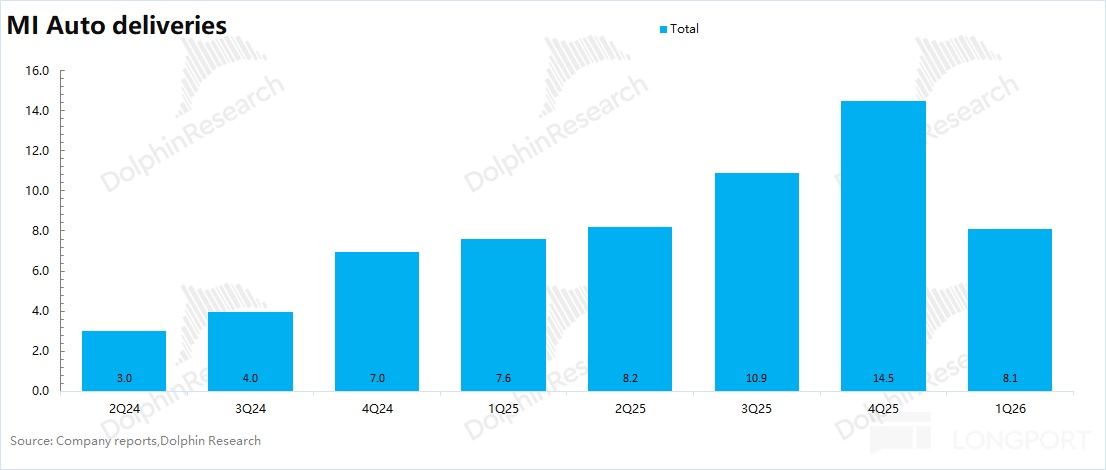
Auto GPM was 20.1%, down 260bps QoQ. The decline was driven by lower ASP from subsidies for orders locked before Nov 30, 2025. Order and delivery-cycle data indicate that the earlier YU7 backlog has largely been cleared. The new SU7 lifted sales near term, but delivery cycles do not suggest a blockbuster.
Current delivery times are within 10 weeks for YU7 and ~13 weeks for the new SU7, both reasonable and without a large order pile-up. Management still guides to 550k units in 2026; with only 81k in Q1, the remaining three quarters require 470k (155k+ per quarter). Given current SU7/YU7 trends, this is clearly challenging and hinges on standout new models.
III. Smartphones: holding price and margin over volume
Q1 2026 smartphone revenue was RMB 44.3bn, down 12.5% YoY, due to tight memory and intensified competition.
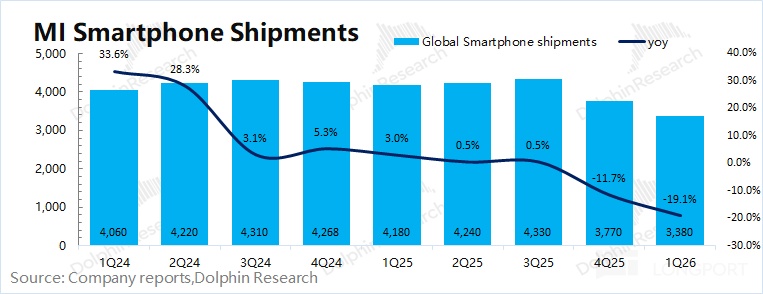
Dolphin Research decomposes volume and price for smartphones: Volume: shipments were 33.8mn units, down 19% YoY, with China down 34.6%.
By market: i) China share fell to 12.6% (down ~8ppt YoY) on memory tightness and tougher competition. ii) Overseas shipments fell 12% YoY, with overseas share down 80bps YoY.
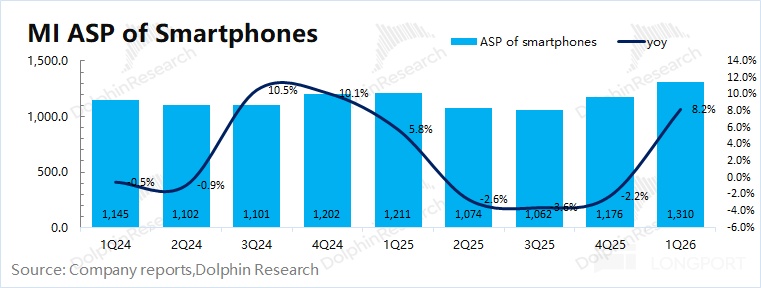
Price: smartphone ASP was RMB 1,310, up 8% YoY. Dolphin Research believes the ASP uptick reflects memory being prioritized to higher-priced models rather than stronger demand, given sharply lower volumes.
Smartphone GPM was 10.1%, up 180bps QoQ. Margin expansion was driven by higher ASP, while volumes showed weak downstream demand. Under memory tightness, the company’s playbook is to prioritize ASP > GPM > volume.
IV. IoT: clearly hit by tighter state subsidies
Q1 2026 IoT revenue was RMB 24.7bn, down 23.7% YoY. The decline reflected fading state subsidies and memory constraints, with large appliances more exposed (some products had RMB 1–2k per-unit subsidies previously).
IoT GPM was 25.2%, up 510bps QoQ, driven by higher margins and mix of certain lifestyle products overseas, and margin recovery in PRC large appliances and tablets.
V. Internet services: growth slowed with lower smartphone shipments
Q1 2026 internet services revenue was RMB 9.5bn, up 4% YoY. Ads remained the main driver. a) Ads: RMB 7.1bn, up 7% YoY, with growth slowing from prior double digits.
Core ad inventory is in app distribution and pre-installs, effectively the ‘distribution tax’ for most apps. Pre-installs are particularly high-margin. Because pre-installs correlate with smartphone shipments, the sharp shipment decline directly pressured this revenue stream.
b) VAS: mainly game distribution, Youpin e-commerce, and Xiaomi Finance. This segment delivered ~RMB 2.4bn, roughly flat YoY, and remained stable. Overall, internet services are structurally tethered to hardware shipments, and Xiaomi classifies them as legacy in its revised disclosure. Sustained internet monetization hinges on an integrated hardware-software strategy, and declining smartphone shipments weigh on growth near term.
VI. Overseas: growth in both hardware and internet
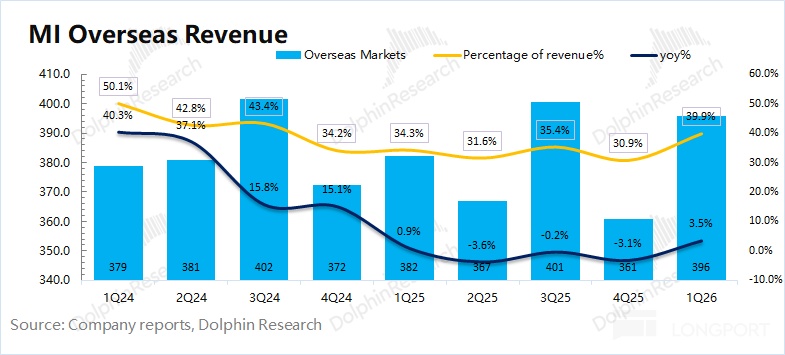
Q1 2026 overseas revenue was RMB 39.6bn, up 3.5% YoY. With domestic demand soft, overseas contribution rebounded to ~40% of total. By segment, overseas internet revenue rose 10% to RMB 3.0bn, while overseas hardware revenue rose 3% YoY, signaling recovery in demand for IoT and related categories.
VII. Profit: legacy improving, autos back to loss
Q1 2026 total opex was RMB 18.9bn, with the opex ratio up to 19%. Auto and AI/innovation opex was RMB 7.1bn, broadly stable around RMB 7.0bn. Ex-auto, legacy opex was ~RMB 11.76bn, up 10.5% YoY. Legacy opex ratio fell to 14.8%, with higher R&D the main YoY increase. Xiaomi’s R&D headcount reached 26k, rising for eight consecutive quarters.
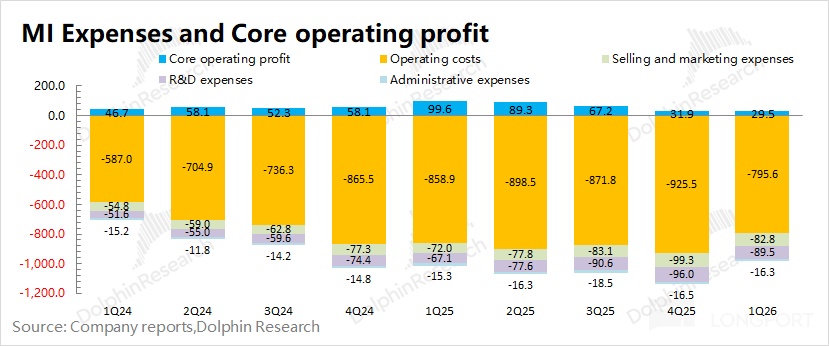
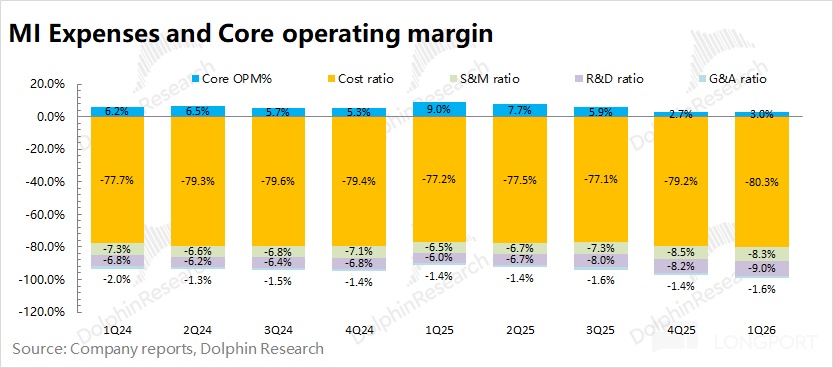
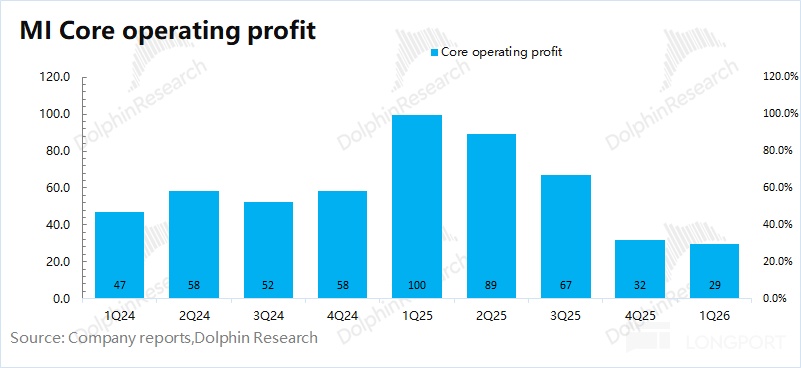
Q1 2026 Adj. net income was RMB 6.1bn. However, Dolphin Research has long disagreed with Xiaomi’s adjustment methodology — financial income and dividends from investees remain in the adjusted figures. Even if sustainable, these are non-core and do not reflect the durability of operating earnings. Overall, we focus on core OP (revenue - COGS - opex), which better reflects sustainable earnings power from core operations.
Core OP was RMB 2.9bn this quarter, with a 3% core OPM. The decline in core profits was mainly driven by lower revenue, while QoQ margin recovery came from hardware GPM stabilization. By segment, legacy core OP was ~RMB 6.05bn (+RMB 3.9bn QoQ), while autos recorded a core OP loss of RMB 3.1bn (-RMB 4.1bn QoQ).
Dolphin Research’s Xiaomi archive:
Product launch coverage
Mar 20, 2026 SU7 launch: ‘Xiaomi (Spring Event): SU7’s low-key refresh, MiMo free push to the charts’
Sep 26, 2025 smartphone launch: ‘Xiaomi (with transcript): going head-to-head with iPhone, spec bump at same price’
Jul 3, 2025: ‘Lei Jun roundtable: won’t race to the bottom on low-price cars, outbound in 2027’
Jun 26, 2025 YU7 launch: ‘Xiaomi Auto: YU7’s explosive debut — can it knock Tesla off the pedestal?’
May 22, 2025 YU7 teaser: ‘Xiaomi (transcript): the ‘godfather of domestic brands’ brings YU7 — is Model Y at risk?’
Earnings season
Mar 24, 2026 call: ‘Xiaomi (transcript): memory upcycle lasts longer than expected, AI monetization still early’
Mar 24, 2026 take: ‘Xiaomi: freefall from heaven to hell — what underpins faith now?’
Nov 18, 2025 call: ‘Xiaomi (transcript): rising memory costs hit low-ASP vendors harder’
Nov 18, 2025 take: ‘Xiaomi: state subsidies fade — can autos carry the mantle?’
Aug 19, 2025 call: ‘Xiaomi (transcript): smartphone target cut to 175mn, autos won’t join the price war’
Aug 19, 2025 take: ‘Xiaomi: smartphones hit another cold snap — autos to the rescue?’
May 27, 2025 call: ‘Xiaomi (transcript): full-year smartphone target maintained at 180mn units’
May 27, 2025 take: ‘Xiaomi: one hand on autos, one on state subsidies — is this the big win?’
Mar 18, 2025 call: ‘Xiaomi (transcript): smartphone ambition at 200mn units, no strict profit target for autos’
Mar 18, 2025 take: ‘Xiaomi: billed as the strongest ever — is it that good?’
Risk disclosure and disclaimer: Dolphin Research disclaimer and general disclosure
Recommended Articles





Comments (0)
Click the $ button, enter the symbol, and select to link a stock, ETF, or other ticker.