


Realty Income Stock's Boring Success: A Blueprint for 2025's Reliable Growth



Boring isn't a big selling point when it comes to investments. But being boring isn't a bad thing, particularly when you are talking about a stock that is focused on paying reliable dividends.
Realty Income (NYSE: O) is very boring. Here's why 2024 was so boring and why that's a good thing for shareholders in 2025 and beyond.
What does Realty Income do?
Realty Income is a real estate investment trust (REIT), a corporate structure specifically designed to pass income on to shareholders in a tax-advantaged manner via the ownership of real estate.
The company avoids corporate-level taxation as long as it distributes at least 90% of taxable income to shareholders, who have to treat the dividends as regular income, so this isn't a free lunch. But REITs avoid double taxation of dividends, which is good.

Image source: Getty Images.
That said, Realty Income is also a net lease REIT, which means that it largely owns single-tenant properties for which the tenant is responsible for paying most operating costs. It is a fairly simple approach to property ownership, as Realty Income avoids things like taxes and maintaining the properties it owns. There is a large risk associated with any single property, but Realty Income owns more than 15,400 properties, so the overall risk is very low.
Its portfolio is also fairly well diversified, which further reduces risk. While about 73% of rents come from retail properties, those assets are relatively small and fungible. They are easy to buy, sell, and release, as needed.
The rest of the portfolio is spread among industrial assets and some larger unique investments, including vineyards and casinos. Geographically, Realty Income's portfolio is largely based in North America, but it has a growing presence in Europe. Add in an investment-grade balance sheet, and this REIT has a very solid foundation.
What's happened so far in 2024 at Realty Income?
As 2024 comes to a close, it is clear that Realty Income is having a pretty boring year. To be fair, there was a big bang at the start, when the company closed on its acquisition of competitor Spirit Realty. However, that was mostly big news from 2023 spilling over into 2024.
The most notable thing that the REIT did in 2024 through the first three quarters of the year was buy new properties, with the goal of hitting about $3.5 billion in property acquisitions by year-end.
While that $3.5 billion target is more than earlier company estimates, it isn't a shocking upward revision. The REIT is simply handling the acquisition volume it is capable of digesting. Meanwhile, Realty Income's occupancy remained solid at 98.7% at the end of the third quarter. And it was able to recapture 105% of expiring lease rents in the quarter.
Those two stats basically mean that its locations are strong enough that it can raise rents on new leases as old leases roll over. Once again, however, this is just mundane, day-to-day execution. Nothing particularly exciting.
About the most notable thing that it announced was that it plans to create an asset management business for institutional investors. The goal is to generate fees for doing the same basic thing that the company does every day for shareholders, only for a new set of investors. This isn't something new in the REIT industry; it's just Realty Income preparing another avenue for growth in the future. And, in typical fashion, it's being open with shareholders about what it is doing.
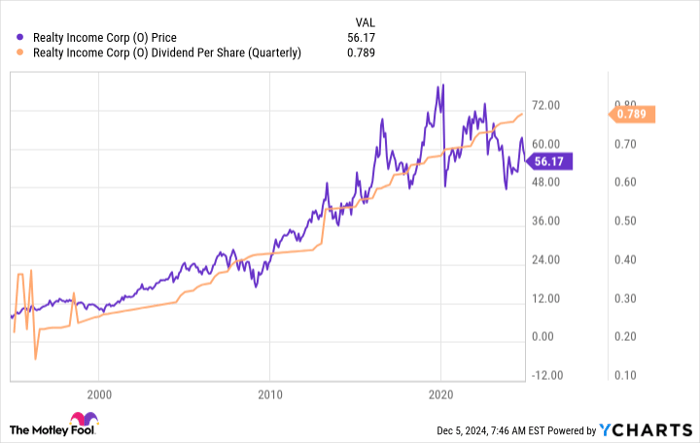
But this is basically the same game plan that Realty Income has been running for years. Adding new avenues for growth was the reason for expanding into Europe. It was why the REIT started to invest in casinos. It is why management expanded into the data center market, as well.
Slowly expanding the business is just what management does, and it sets the stage for more slow and steady growth in 2025 and beyond as the company's levers for growth multiply.
"The Monthly Dividend Company"
Realty Income has trademarked the nickname "The Monthly Dividend Company." That's both a statement of the frequency with which its pays dividends and a bold statement about the purpose of the business.
All in, 2024 was a pretty boring year. Sure, it completed an acquisition and announced plans to build a new business line, but neither of those things are really out of character with the long-term goal of the company to be a reliable dividend stock.
While Realty Income stock has basically gone nowhere in 2024, its business has performed exactly as you would expect: with slow and steady growth. Add in a 5.6% dividend yield and four more quarterly payout increases, and dividend investors of all stripes should like what they see here.
Should you invest $1,000 in Realty Income right now?
Before you buy stock in Realty Income, consider this:
The Motley Fool Stock Advisor analyst team just identified what they believe are the 10 best stocks for investors to buy now… and Realty Income wasn’t one of them. The 10 stocks that made the cut could produce monster returns in the coming years.
Consider when Nvidia made this list on April 15, 2005... if you invested $1,000 at the time of our recommendation, you’d have $872,947!*
Stock Advisor provides investors with an easy-to-follow blueprint for success, including guidance on building a portfolio, regular updates from analysts, and two new stock picks each month. The Stock Advisor service has more than quadrupled the return of S&P 500 since 2002*.
*Stock Advisor returns as of December 2, 2024
Reuben Gregg Brewer has positions in Realty Income. The Motley Fool has positions in and recommends Realty Income. The Motley Fool has a disclosure policy.
Recommended Articles







Comments (0)
Click the $ button, enter the symbol, and select to link a stock, ETF, or other ticker.