


EUR/USD (EURUSD) Is up 0.52% on Nov 2: What Signals Does the Macro Data Send?


EUR/USD (EURUSD) is up 0.52% at Nov 2 03:40(ET), now at $1.12135, with a 7-day up of 0.36%.
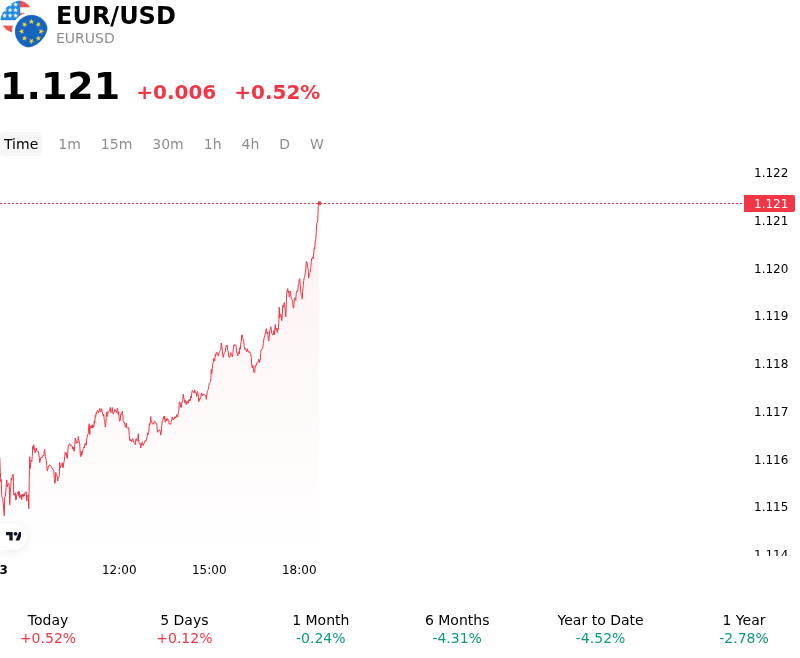
What is driving EUR/USD (EURUSD)’s stock price up today?
The rebound in EURUSD was primarily driven by a pullback in global energy prices and a modest retreat in U.S. Treasury yields, which provided relief to European macroeconomic sentiment and prompted short-covering in the single currency. Lower crude oil and natural gas benchmarks helped temper market concerns regarding elevated European import costs and stagflationary pressures on the Eurozone industrial sector. Concurrently, a minor easing in broader U.S. dollar demand allowed the euro to bounce from recent multi-month lows as market participants reassessed short-term policy trajectories following late-October rate guidance from both the Federal Reserve and the European Central Bank.
From a rate-differential perspective, the movement reflects a temporary pause in the U.S. dollar's upward momentum as U.S. real yields consolidated after recent gains. While the Federal Reserve maintains a higher terminal policy rate, markets have increasingly priced in a synchronized holding stance across both major central banks ahead of their final policy decisions of the year. The European Central Bank's cautious stance and acknowledgment of lingering inflation risks provided marginal support to euro money-market yields. This narrowed the yield advantage of U.S. paper relative to German Bunds at the margin, encouraging institutional investors to trim stretched long-dollar positions.
Despite the advance, the broader macroeconomic landscape for EURUSD remains constrained by persistent structural challenges within the euro area. Ongoing fiscal headwinds in member states, notably elevated borrowing costs and budget deficit concerns in France, continue to act as an overhang on European asset allocations. Furthermore, divergent growth trends between a resilient U.S. economy and sluggish Eurozone activity suggest that the intraday move represents a tactical relief rally driven by position adjustments rather than a fundamental trend reversal. Institutional market participants continue to monitor upcoming U.S. economic data, European inflation prints, and energy market stability to gauge the durability of the euro's recovery.
Technical Analysis of EUR/USD (EURUSD)
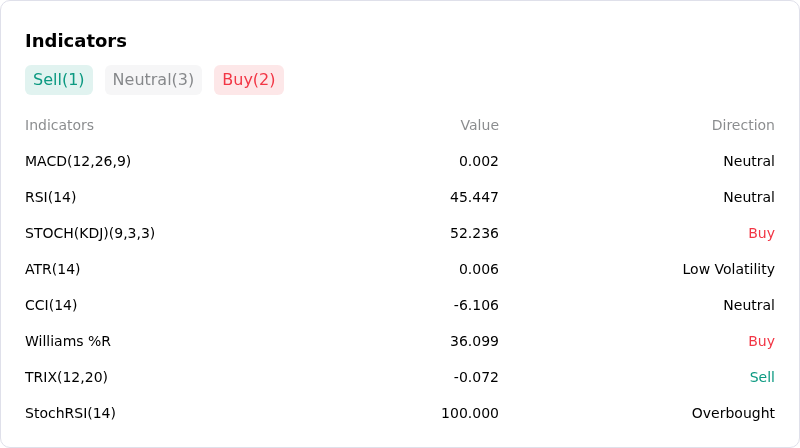
Technically, EUR/USD (EURUSD) shows a MACD (12,26,9) value of 0.002, indicating a neutral signal. The RSI at 45.447 suggests neutral condition and the Williams %R at 36.099 suggests buy condition. Please monitor closely.
More details about EUR/USD (EURUSD)
Recent Events and Risks:
- French Sovereign Fiscal Turmoil: Credit ratings agency Fitch recently revised France's sovereign outlook to negative amid political fragmentation and persistent budget challenges, keeping French OAT-Bund spreads elevated and applying structural pressure to the Euro.
- US Dollar Yield Advantage and Resilient Growth: Strong U.S. macroeconomic data and persistent inflation have kept U.S. Treasury yields high relative to European benchmarks, widening the yield spread advantage in favor of the U.S. dollar and leaving EUR/USD vulnerable to downside breaks.
- Stagflationary Energy Shocks and Credit Contraction: Elevated European natural gas and crude oil costs alongside falling corporate loan demand in the Eurozone threaten regional economic growth, limiting the European Central Bank's room for monetary maneuverability.
- ECB Leadership Transition Uncertainty: Heightened policy ambiguity surrounding European Central Bank President Christine Lagarde's announced early departure in early 2027 leaves Eurozone monetary strategy vulnerable to governance risks and sudden dovish repricing.
This article may include AI-generated content that is human-reviewed, which is for reference and general information purposes only and does not constitute investment advice.
Recommended Articles








Comments (0)
Click the $ button, enter the symbol, and select to link a stock, ETF, or other ticker.