


EUR/USD (EURUSD) Is down 0.51% on Oct 1: Are Market Expectations Adjusting?



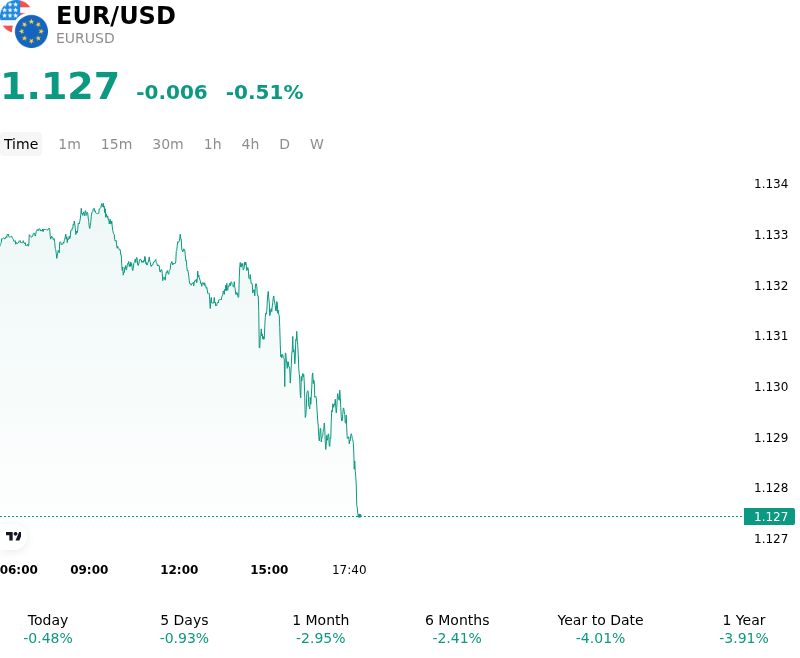
EUR/USD (EURUSD) is down 0.51% at Oct 1 06:00(ET), now at $1.12707, with a 7-day down of 0.96%.
What is driving EUR/USD (EURUSD)’s stock price down today?
The decline in EURUSD was primarily driven by widening yield differentials in favor of the U.S. dollar, alongside mounting stagflationary concerns across the Eurozone. Although preliminary inflation metrics across key Eurozone economies showed a sharp acceleration in headline consumer prices, market participants viewed the increase as an energy-driven shock rather than a sustainable expansion in underlying core pressures. Consequently, money markets scaled back expectations for aggressive tightening from the European Central Bank, particularly after central bank communications signaled a measured stance to avoid compounding downside risks to regional economic growth.
In contrast, the U.S. dollar received robust fundamental backing from elevated U.S. Treasury yields, with benchmark ten-year yields remaining near multi-year highs. Solid macroeconomic indicators, including resilient U.S. manufacturing activity, reinforced the narrative of relative American economic outperformance. This structural divergence in growth momentum maintained high short-term interest rate expectations for the Federal Reserve relative to the ECB, prompting institutional capital flows out of the single currency and into dollar-denominated assets.
Geopolitical friction and persistent energy market volatility further exacerbated asymmetric risks for the currency pair. As an energy-importing economy, the Eurozone faces a sharper terms-of-trade degradation from elevated fuel costs, which threatens consumer demand and corporate margins across major member states. This macroeconomic headwind prevented the euro from benefiting from elevated headline inflation, leaving the single currency vulnerable to technical selling as price action broke below key technical support levels.
Overall, the movement reflects a market environment where higher U.S. real yields and superior growth momentum continue to dominate localized inflation spikes in Europe. Until Eurozone economic fundamentals demonstrate structural stabilization or U.S. growth momentum cools sufficiently to prompt a dovish repricing from the Fed, interest rate differentials and macroeconomic sentiment remain supportive of U.S. dollar strength relative to the euro.
Technical Analysis of EUR/USD (EURUSD)
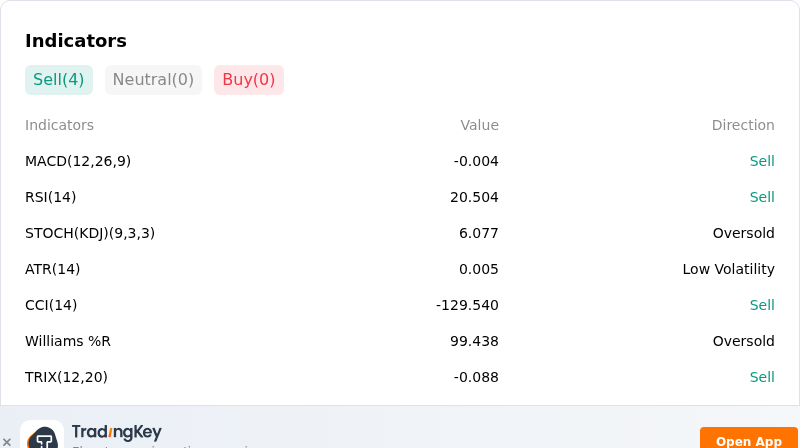
Technically, EUR/USD (EURUSD) shows a MACD (12,26,9) value of -0.004, indicating a sell signal. The RSI at 20.988 suggests sell condition and the Williams %R at 99.360 suggests oversold condition. Please monitor closely.
More details about EUR/USD (EURUSD)
Recent Events and Risks:
- Surging US Treasury Yields and Widening Spreads: US 10-year Treasury yields rising toward multi-decade highs near 5.30% have sharply widened US-German yield differentials in favor of the Greenback, driving sustained downward pressure on EUR/USD toward multi-month lows.
- Eurozone Stagflation Risks Driven by Energy Shocks: Hotter-than-expected inflation releases across major Eurozone economies—fueled largely by rising energy costs—are acting as a tax on regional economic growth rather than a catalyst for rate-driven currency buying, intensifying stagflation concerns for the Euro.
- Dovish ECB Rate Guidance: ECB President Christine Lagarde's emphasis on a cautious, measured policy response and her assertion that rising bond yields are already tightening financial conditions have lowered expectations for near-term ECB rate hikes, blunting Euro support.
- Bearish Options Hedging and Technical Breakdown Risk: Implied volatility skew in options markets shows increased demand for Euro puts over calls, leaving EUR/USD vulnerable to accelerated downside momentum toward the 1.1200 floor if current support around 1.1300 fails to hold.
This article may include AI-generated content that is human-reviewed, which is for reference and general information purposes only and does not constitute investment advice.
Recommended Articles










Comments (0)
Click the $ button, enter the symbol, and select to link a stock, ETF, or other ticker.