


Snowflake Inc Stock (SNOW) Moved Down by 3.66% on Aug 25: A Full Analysis



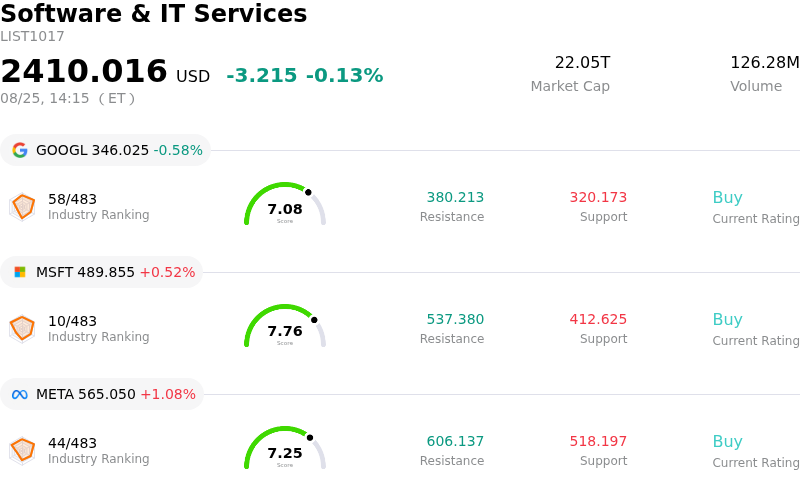
Snowflake Inc (SNOW) moved down by 3.66%. The Software & IT Services sector is down by 0.13%. The company underperformed the industry. Top 3 stocks by turnover in the sector: Alphabet Inc Class A (GOOGL) down 0.61%; Microsoft Corp (MSFT) up 0.52%; Meta Platforms Inc (META) up 1.08%.
What is driving Snowflake Inc (SNOW)’s stock price down today?
Snowflake experienced downward momentum and heightened intraday volatility as investors engaged in pre-earnings profit-taking and valuation digestion ahead of its upcoming fiscal second-quarter financial results. Following a powerful multi-month rally that drove shares close to 52-week highs, market participants re-evaluated the company's premium price-to-sales multiple relative to the broader enterprise software sector. With significant growth expectations already priced in ahead of the report, institutional investors chose to trim exposure and lock in gains, setting a high performance hurdle for the company's top-line beat and forward guidance.
Adding to the selling pressure was market reaction to recent insider equity sales disclosed in regulatory filings. Substantial liquidations by prominent insiders, including former chief executive and current director Frank Slootman along with senior executive leadership, created a temporary supply overhang. Although pre-arranged trading plans are standard practice, the magnitude of these share sales weighed on market sentiment, dampening the positive impact of favorable Wall Street analyst research and target price upward revisions ahead of earnings.
Operational and technical factors also influenced trading behavior. Recent company updates highlighting optimization features that reduce client query costs on AI platforms fueled short-term debate regarding consumption revenue dynamics. While lower compute costs enhance customer retention and drive long-term workload migration, consumption-based billing models can create transient headwinds as enterprise clients optimize their credit usage. Combined with technical resistance at short-term moving averages following an extended advance, the convergence of high valuation, insider supply, and pre-catalyst risk management drove the downward pressure.
Technical Analysis of Snowflake Inc (SNOW)
Technically, Snowflake Inc (SNOW) shows a MACD (12,26,9) value of -7.275, indicating a neutral signal. The RSI at 52.140 suggests neutral condition and the Williams %R at 81.416 suggests oversold condition. Please monitor closely.
Fundamental Analysis of Snowflake Inc (SNOW)
Snowflake Inc (SNOW) is in the Software & IT Services industry. Its latest annual revenue is $4.68B, ranking 69 in the industry. The net profit is $-1.33B, ranking 605 in the industry. Company Profile
Over the past month, multiple analysts have rated the company as Buy, with an average price target of $322.58, a high of $500.00, and a low of $110.00.
More details about Snowflake Inc (SNOW)
Company Specific Risks:
- Elevated Valuation and Multiple Compression Pressure: Following a massive multi-month stock rally, Snowflake's premium valuation metrics—including a Forward P/E ratio near 169x and Price-to-Sales ratio above 22x—have left the equity highly vulnerable to intraday profit-taking and sharp valuation compression ahead of its upcoming earnings release.
- Surge in Executive and Insider Share Dispositions: Recent SEC filings in mid-to-late August 2026 reveal ongoing insider selling by key leadership figures, including former CEO Frank Slootman, EVP Christian Kleinerman, and Director Michael Speiser, fueling institutional concern over top-level profit-taking.
- Enterprise AI Monetization and Cost Governance Friction: At the August 25, 2026 Six Five Summit, CEO Sridhar Ramaswamy highlighted that enterprise clients face significant hurdles converting AI capabilities into tangible business value without strict data and cost governance, exacerbating execution risks around customer AI adoption.
- Consumption-Based Model Exposure to Workload Optimization: Snowflake's usage-based revenue architecture exposes the business to volatility from corporate cloud cost optimizations, where customer efforts to streamline data querying and compute spend directly threaten net revenue retention and product margin expansion.
This article may include AI-generated content that is human-reviewed, which is for reference and general information purposes only and does not constitute investment advice.
Recommended Articles









Comments (0)
Click the $ button, enter the symbol, and select to link a stock, ETF, or other ticker.