


MAIR.NB Stock (MAIR) Moved Down by 7.02% on Aug 20: What Signal Does It Send?



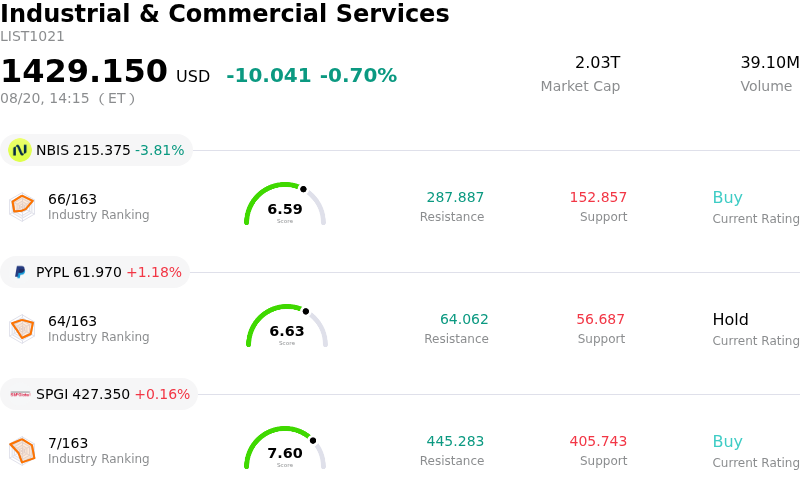
MAIR.NB (MAIR) moved down by 7.02%. The Industrial & Commercial Services sector is down by 0.70%. The company underperformed the industry. Top 3 stocks by turnover in the sector: Nebius Group NV (NBIS) down 3.81%; PayPal Holdings Inc (PYPL) up 1.18%; S&P Global Inc (SPGI) up 0.16%.
What is driving MAIR.NB (MAIR)’s stock price down today?
Madison Air Solutions Corporation experienced selling pressure and elevated intraday volatility primarily driven by market indigestion surrounding its recent major corporate acquisition. The company agreed to acquire Germany-based airflow technology provider ebm-papst in a multi-billion-dollar enterprise transaction. While the deal strategically expands Madison Air's global indoor air quality and commercial cooling footprint, the heavy capital requirements have ignited investor concerns over execution risks and elevated balance sheet leverage. The transaction relies heavily on debt financing commitments and equity funding, raising immediate questions regarding leverage management and potential shareholder dilution.
Compounding this downward momentum is the stock's rich valuation profile following its large initial public offering earlier in the year. Prior to the decline, Madison Air traded at an elevated enterprise value-to-EBITDA multiple and high price-to-earnings metrics relative to industrial equipment peers. In an market environment where institutional investors remain cautious regarding debt-funded expansion, high-valuation industrial stocks often face sharp recalibrations when undertaking large-scale leverage. The prospective debt load triggered institutional profit-taking and portfolio adjustments, fueling volatile trading as investors reassessed the medium-term risk profile.
Operational headwinds within the indoor air quality sector have also tempered market enthusiasm. Although commercial demand and specialized data center cooling backlogs remain robust, persistent softness in the residential building products market continues to act as a drag on overall sentiment. Concerns surrounding potential gross margin compression and slowing order velocity in the coming quarters have further encouraged caution among institutional investors. Share price stabilization will depend on management's ability to outline a clear deleveraging path, execute seamless cross-border operational integration, and defend commercial margins.
Technical Analysis of MAIR.NB (MAIR)
Technically, MAIR.NB (MAIR) shows a MACD (12,26,9) value of -0.569, indicating a sell signal. The RSI at 28.551 suggests sell condition and the Williams %R at 100.000 suggests oversold condition. Please monitor closely.
Fundamental Analysis of MAIR.NB (MAIR)
MAIR.NB (MAIR) is in the Industrial & Commercial Services industry. Its latest annual revenue is $3.34B, ranking 47 in the industry. The net profit is $97.00M, ranking 68 in the industry. Company Profile
Over the past month, multiple analysts have rated the company as Buy, with an average price target of $41.00, a high of $49.00, and a low of $33.00.
More details about MAIR.NB (MAIR)
Company Specific Risks:
- Surging Debt and Balance Sheet Leverage: The August 17 announcement of a $5.4 billion acquisition of ebm-papst is projected to elevate pro forma net leverage from 2.8x to nearly 4.0x at closing, driving institutional concern over heightened balance sheet risk and elevated debt servicing obligations.
- Shareholder Dilution via Capital Structure Plans: To fund the $5.4 billion transaction, management confirmed plans to utilize new debt and equity offerings, prompting a 14% multi-day sell-off as market participants price in substantial equity dilution.
- Earnings Performance Miss and Premium Valuation: Second-quarter GAAP earnings per share of $0.15 missed analyst estimates, exposing the company to steep valuation compression given an elevated price-to-earnings multiple that leaves little margin for error.
- Complex Cross-Border Integration Exposure: Expanding into Germany via ebm-papst requires navigating European regulatory frameworks and managing distinct manufacturing operations, raising execution risks around achieving $160 million in projected annual cost synergies.
This article may include AI-generated content that is human-reviewed, which is for reference and general information purposes only and does not constitute investment advice.
Recommended Articles






Comments (0)
Click the $ button, enter the symbol, and select to link a stock, ETF, or other ticker.