


USD/MXN (USDMXN) Moved Sharply on Aug 7: Are Central Bank Expectations Shifting?



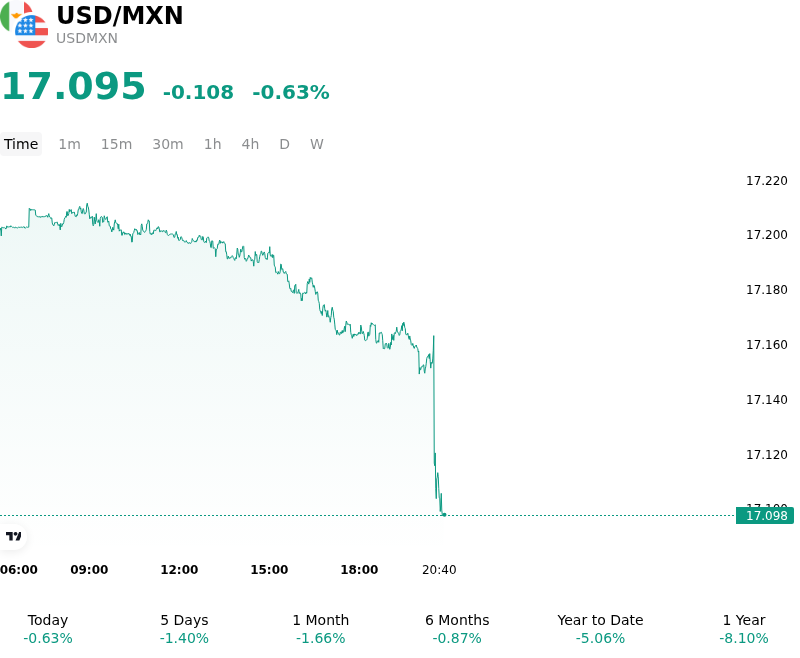
USD/MXN (USDMXN) is down 0.63% at Aug 7 08:50(ET), now at $17.09499, with a 7-day down of 1.40%.
What is driving USD/MXN (USDMXN)’s stock price down today?
The depreciation of the U.S. dollar against the Mexican peso was primarily driven by a softer-than-expected July employment report in the United States, which significantly recalibrated market expectations for Federal Reserve monetary policy. The Non-Farm Payrolls data revealed a cooling in labor demand and a marginal increase in the unemployment rate, prompting a sharp decline in U.S. Treasury yields. As investors increased their bets on a more front-loaded easing cycle from the Fed, the greenback lost its yield advantage, triggering a broad-based sell-off against high-carry emerging market currencies.
The Mexican peso outperformed as the interest-rate differential between the two nations remained wider than the market had previously hedged for. While the U.S. data suggests a softening economic outlook, the Bank of Mexico (Banxico) has maintained a relatively hawkish posture, emphasizing the need to keep rates restrictive to combat persistent core inflation in the services sector. This policy divergence enhances the attractiveness of the peso for institutional carry-trade participants, who favor the MXN’s high nominal yields in an environment of declining U.S. rates.
Broader risk-on sentiment also provided a significant tailwind for the peso. The market interpreted the cooling U.S. labor market as a "Goldilocks" scenario that could facilitate a soft landing and a non-disruptive pivot by the Fed. This encouraged a rotation of capital into Mexican assets, which are viewed as a liquid proxy for Latin American growth. The move was further supported by a stabilization in commodity prices, which bolstered the fiscal outlook for emerging market exporters.
The intraday move appears to be a fundamental repricing of the U.S. growth trajectory rather than a temporary spike in volatility. The breach of key psychological support levels for the USDMXN pair triggered a cascade of algorithmic selling and stop-loss liquidations, accelerating the dollar's decline. While the current move is supported by the shift in the interest-rate outlook, investors remain cautious regarding potential volatility stems from domestic political developments in Mexico and the upcoming headline inflation prints, which will determine if Banxico has room to follow the Fed's dovish lead later this year.
Technical Analysis of USD/MXN (USDMXN)
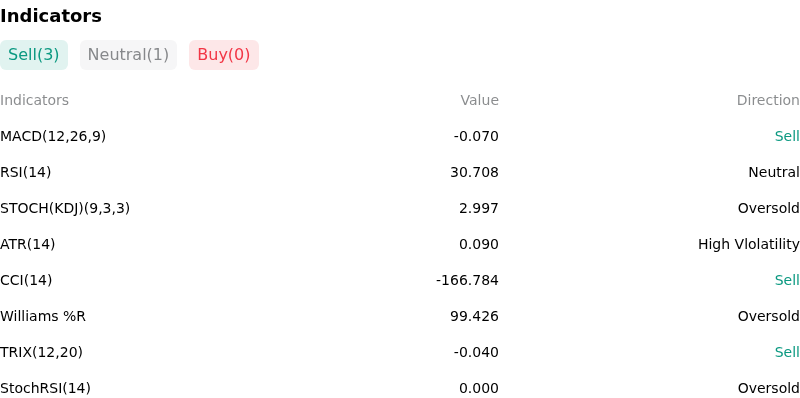
Technically, USD/MXN (USDMXN) shows a MACD (12,26,9) value of -0.070, indicating a sell signal. The RSI at 30.708 suggests neutral condition and the Williams %R at 99.426 suggests oversold condition. Please monitor closely.
More details about USD/MXN (USDMXN)
Recent Events and Risks:
- Institutional and Judicial Reform Concerns: Market participants remain highly sensitive to the proposed "Plan C" constitutional reforms, particularly the judicial overhaul, which has sparked fears regarding the erosion of legal certainty and the independence of democratic institutions in Mexico, leading to sustained pressure on the Peso.
- Monetary Policy Divergence: While the Federal Reserve maintains a "higher-for-longer" narrative following recent resilient US labor data, signs of a cooling Mexican economy have prompted analysts to speculate on a more aggressive easing cycle from Banxico, potentially narrowing the interest rate differential that supports the MXN carry trade.
- US Election Rhetoric and Trade Protectionism: Increased volatility is stemming from US political commentary regarding potential tariffs and the renegotiation of the USMCA agreement, creating significant tail risks for Mexico’s export-oriented economy and prompting institutional hedging against a weaker Peso.
- Carry Trade Unwind and Liquidity Shocks: As a high-yielding proxy for emerging market sentiment, USDMXN is vulnerable to sharp intraday spikes if global volatility (VIX) rises, leading to a rapid liquidation of crowded carry positions by hedge funds and speculative accounts.
This article may include AI-generated content that is human-reviewed, which is for reference and general information purposes only and does not constitute investment advice.
Recommended Articles







Comments (0)
Click the $ button, enter the symbol, and select to link a stock, ETF, or other ticker.