


USD/CHF (USDCHF) Is up 0.51% on Jul 30: Are Market Expectations Adjusting?



USD/CHF (USDCHF) is up 0.51% at Jul 30 03:55(ET), now at $0.81741, with a 7-day up of 0.16%.
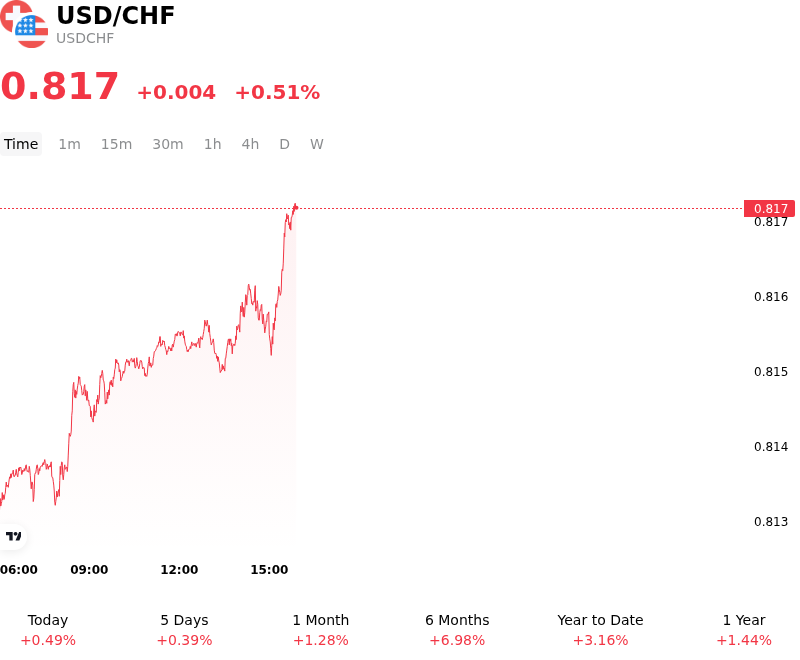
What is driving USD/CHF (USDCHF)’s stock price up today?
The primary catalyst for the advance in USDCHF is the widening yield differential between U.S. Treasuries and Swiss Confederation bonds. Market participants have adjusted their expectations for the Federal Reserve's policy trajectory following more resilient-than-expected domestic economic activity. This shift has pushed U.S. front-end yields higher, increasing the carry-trade appeal of the dollar relative to the franc, which remains burdened by the Swiss National Bank's comparatively more accommodative stance and its focus on curbing excessive currency strength.
On the Swiss side of the pair, cooling inflationary pressures within the Alpine economy have diminished the likelihood of further restrictive action from the Swiss National Bank. Investors are increasingly pricing in a period of policy stability or even potential easing if global growth slows, which has removed the immediate floor of support for the franc. The SNB’s historical willingness to intervene in the foreign exchange market to prevent franc overvaluation continues to linger in the background, further discouraging long positions in the currency during periods of broad dollar strength.
Global risk sentiment has also played a pivotal role in the intraday movement. A rotation into riskier asset classes has reduced the demand for traditional safe-haven currencies like the Swiss franc. As equity markets stabilize and concerns over immediate geopolitical escalation recede, institutional capital flows have shifted away from defensive hedges toward higher-yielding U.S. dollar-denominated assets. This transition is being amplified by month-end rebalancing flows, which frequently see institutional managers adjusting their currency hedges in favor of the dollar when U.S. asset performance remains robust relative to European peers.
The trajectory of USDCHF remains heavily dependent on the upcoming U.S. labor market data and the Federal Reserve’s interpretation of wage growth and productivity. While the current move is supported by fundamental yield advantages and a shift in risk appetite, the pair remains sensitive to any sudden deterioration in global financial stability. However, as long as the interest-rate differential remains significantly in favor of the dollar and Swiss inflation remains well-anchored below the central bank's target, the upward pressure on the exchange rate appears supported by broader macro divergence.
Technical Analysis of USD/CHF (USDCHF)
Technically, USD/CHF (USDCHF) shows a MACD (12,26,9) value of 0.000, indicating a buy signal. The RSI at 61.241 suggests neutral condition and the Williams %R at 20.116 suggests buy condition. Please monitor closely.
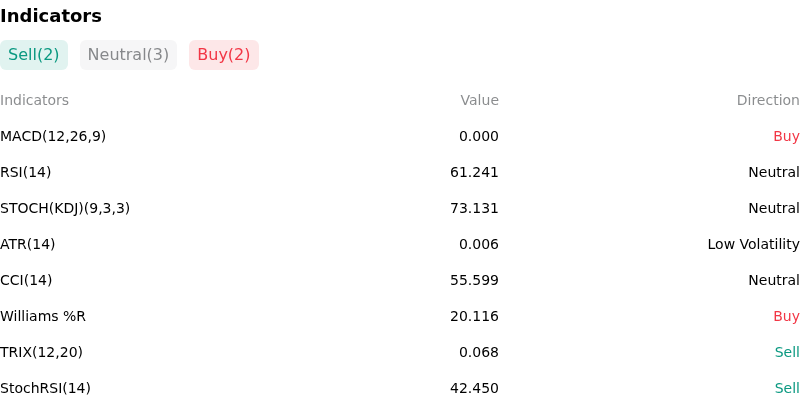
More details about USD/CHF (USDCHF)
Recent Events and Risks:
- SNB Verbal Intervention and Policy Pivot: Recent statements from Swiss National Bank officials highlighting that a weak Swiss Franc poses upside risks to domestic inflation have increased the likelihood of direct currency intervention or a more restrictive monetary path, creating immediate downside pressure on the USDCHF pair.
- US Treasury Yield Volatility: Following the release of hawkish FOMC minutes within the last 48 hours, the market has priced in a "higher-for-longer" scenario; however, any signs of softening in U.S. labor or consumer data could trigger a rapid decompression of yields and a sharp liquidation of long-USD positions.
- Safe-Haven Risk Reversal: Heightened geopolitical uncertainty in the Middle East and shifting risk appetites in global equity markets continue to support the Swiss Franc’s status as a premier defensive asset, making the pair vulnerable to sudden drops during "risk-off" episodes.
- Carry Trade Unwinding: As market participants recalibrate expectations for global rate cuts, the narrowing of the interest rate differential between the Fed and the SNB—combined with high positioning levels in the Dollar—increases the risk of a technical correction and carry trade unwind.
This article may include AI-generated content that is human-reviewed, which is for reference and general information purposes only and does not constitute investment advice.
Recommended Articles







Comments (0)
Click the $ button, enter the symbol, and select to link a stock, ETF, or other ticker.