


Sumitomo Mitsui Financial Group Inc Stock (SMFG) Moved Down by 3.25% on Jul 17: A Full Analysis



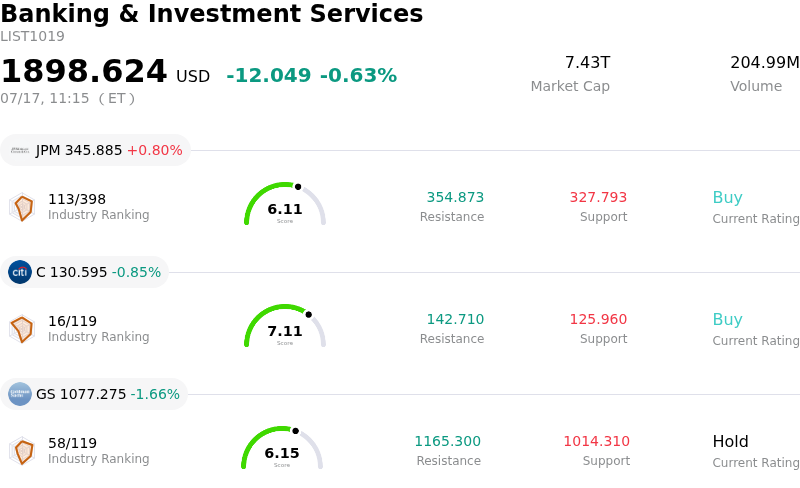
Sumitomo Mitsui Financial Group Inc (SMFG) moved down by 3.25%. The Banking & Investment Services sector is down by 0.63%. The company underperformed the industry. Top 3 stocks by turnover in the sector: JPMorgan Chase & Co (JPM) up 0.80%; Citigroup Inc (C) down 0.85%; Goldman Sachs Group Inc (GS) down 1.66%.
What is driving Sumitomo Mitsui Financial Group Inc (SMFG)’s stock price down today?
The primary driver behind the recent downward pressure on Sumitomo Mitsui Financial Group stems from shifting expectations regarding the Bank of Japan's monetary policy trajectory. Recent communications from central bank officials have suggested a more cautious approach to further interest rate hikes than the market had previously priced in. As a major Japanese lender, the company's net interest margin outlook is heavily sensitive to the yield on Japanese Government Bonds. When expectations for domestic rate normalization cool, the anticipated expansion in lending profitability faces headwinds, prompting institutional investors to recalibrate their positions in the banking sector.
The movement is also closely tied to volatility in the yen-dollar exchange rate. A sudden appreciation of the yen, often triggered by safe-haven flows or narrowing interest rate differentials between the Federal Reserve and the Bank of Japan, typically weighs on the valuation of large-cap Japanese financials. Since the group has significant international operations and dollar-denominated assets, a strengthening yen reduces the translated value of overseas earnings. Furthermore, broader global macroeconomic concerns and signs of cooling industrial activity have induced a risk-off sentiment that disproportionately affects liquid financial stocks.
From an institutional standpoint, the volatility reflects a period of tactical profit-taking following a period of relative outperformance in the Japanese financial index. Large-scale portfolio rebalancing by global funds, reacting to domestic inflation data that fell short of aggressive forecasts, has led to a temporary rotation out of value-oriented banking plays. Additionally, market participants remain sensitive to updates regarding capital adequacy requirements and shareholder return policies. While the firm has maintained a robust stance on share buybacks, any perceived uncertainty regarding the pace of future distributions leads to short-term price adjustments as investors wait for clearer guidance on long-term capital efficiency.
Technical Analysis of Sumitomo Mitsui Financial Group Inc (SMFG)
Technically, Sumitomo Mitsui Financial Group Inc (SMFG) shows a MACD (12,26,9) value of 0.188, indicating a buy signal. The RSI at 63.678 suggests neutral condition and the Williams %R at 25.750 suggests buy condition. Please monitor closely.
Fundamental Analysis of Sumitomo Mitsui Financial Group Inc (SMFG)
Sumitomo Mitsui Financial Group Inc (SMFG) is in the Banking & Investment Services industry. Its latest annual revenue is $39.34B, ranking 11 in the industry. The net profit is $10.50B, ranking 11 in the industry. Company Profile
Over the past month, multiple analysts have rated the company as , with an average price target of $28.86, a high of $28.86, and a low of $28.86.
More details about Sumitomo Mitsui Financial Group Inc (SMFG)
Company Specific Risks:
- Monetary Policy Sensitivity: Increased intraday volatility is driven by uncertainty surrounding the Bank of Japan's interest rate normalization path, which poses a valuation threat to the group’s significant holdings of Japanese Government Bonds (JGBs) and complicates net interest margin (NIM) forecasting.
- Currency Translation Volatility: Rapid fluctuations in the JPY/USD exchange rate are creating instability in capital adequacy ratios and impacting the translation of international earnings, as the bank manages a high volume of dollar-denominated assets against a volatile domestic currency.
- Global Credit Exposure: Heightened institutional concern regarding the bank's exposure to the distressed U.S. and European commercial real estate (CRE) sectors persists, raising the risk of unexpected credit cost spikes and the need for higher loan-loss provisioning in upcoming cycles.
- Operational Cost Pressures: Rising domestic inflation in Japan is driving up personnel and systems-related expenditures, threatening to offset revenue gains from higher yields and putting downward pressure on the group's overall efficiency ratio and short-term profitability.
This article may include AI-generated content that is human-reviewed, which is for reference and general information purposes only and does not constitute investment advice.
Recommended Articles







Comments (0)
Click the $ button, enter the symbol, and select to link a stock, ETF, or other ticker.