


USD/MXN (USDMXN) is up 0.50% on Jul 17: The Reason Has Emerged



USD/MXN (USDMXN) is up 0.50% at Jul 17 08:40(ET), now at $17.50214, with a 7-day up of 0.19%.
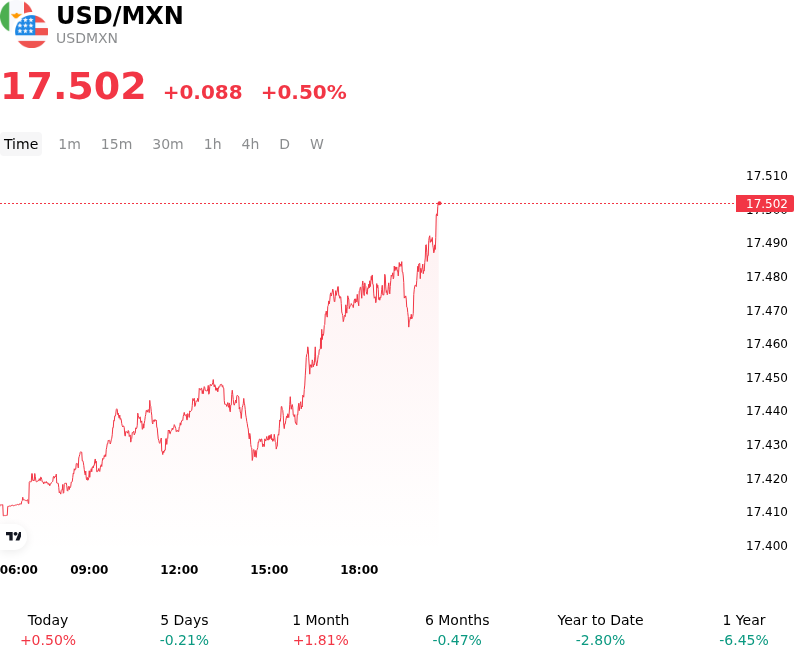
What is driving USD/MXN (USDMXN)’s stock price up today?
The USDMXN advance is primarily driven by a widening of the real interest rate differential and a shift in global risk appetite. Investors are reacting to a combination of resilient U.S. economic data and heightening trade-related uncertainty as the mandatory six-year joint review of the USMCA agreement approaches. The U.S. Dollar is gaining support from a repricing of the Federal Reserve’s terminal rate, with recent labor market strength suggesting that the central bank will maintain a restrictive policy stance for longer than previously anticipated. This has led to a notable move higher in U.S. Treasury yields, particularly at the front end of the curve, which is drawing capital away from high-yielding emerging market assets.
Simultaneously, the Mexican Peso is facing headwinds from domestic policy signals and external trade risks. Banco de Mexico appears to be transitioning toward a more accommodative stance as domestic headline inflation continues to converge toward the central bank's target range. This narrowing of the nominal yield spread between the U.S. and Mexico is eroding the attractiveness of the carry trade, which has historically been a significant pillar of support for the Peso. Institutional positioning is showing signs of a retreat from long-MXN exposures as traders hedge against potential volatility stemming from the ongoing trade negotiations and the structural implications of the 2026 USMCA review process.
Global risk sentiment is also playing a critical role in the pair’s upward momentum. Softness in global manufacturing data and fluctuations in crude oil prices have dampened the appeal of pro-cyclical currencies. Given Mexico's deep integration into North American supply chains and its sensitivity to U.S. industrial demand, signs of cooling in the U.S. manufacturing sector tend to disproportionately weigh on the Peso. As market participants recalibrate their portfolios in anticipation of a less favorable external environment, the U.S. Dollar’s role as a liquidity haven has been reinforced, further pressuring the MXN.
Looking forward, the trajectory of USDMXN remains contingent on the divergence between Fed and Banxico policy paths. While the Peso retains a carry advantage, the margin of safety for investors is shrinking. Markets are increasingly focused on whether the U.S. economy can sustain its restrictive interest rate regime without triggering a broader slowdown, alongside the potential for shifts in Mexican fiscal policy following the recent election cycle. These factors suggest that the current volatility reflects a fundamental reassessment of the risk-reward profile for the pair rather than a temporary technical correction.
Technical Analysis of USD/MXN (USDMXN)
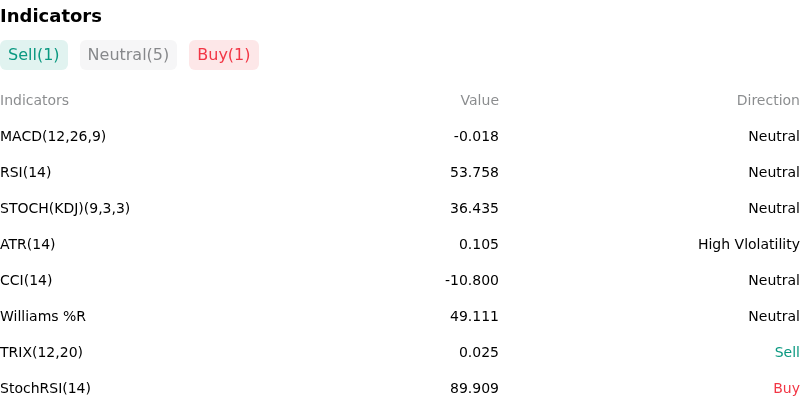
Technically, USD/MXN (USDMXN) shows a MACD (12,26,9) value of -0.018, indicating a neutral signal. The RSI at 53.758 suggests neutral condition and the Williams %R at 49.111 suggests neutral condition. Please monitor closely.
More details about USD/MXN (USDMXN)
Recent Events and Risks:
- Monetary Policy Decoupling: Recent communications from Banxico officials indicating a willingness to explore further rate cuts despite sticky domestic services inflation contrast sharply with the Federal Reserve's "higher for longer" narrative, threatening to narrow the yield spread and trigger an unwind of MXN carry trade positions.
- Constitutional Reform Concerns: Heightened market anxiety regarding the potential for a legislative supermajority in the upcoming June elections has increased the risk premium for Mexican assets, as investors fear structural changes to the judiciary and autonomous regulatory bodies could weaken institutional checks and balances.
- US Economic Resilience Volatility: Recent upside surprises in US labor market data and hawkish commentary from Fed officials have revitalized the USD, creating intraday pressure on the MXN as higher US Treasury yields reduce the relative attractiveness of emerging market high-yielders.
- Trade Policy and Geopolitical Friction: Escalating rhetoric regarding trade imbalances and border security in US election campaigning over the last 72 hours has heightened the risk of protectionist policy shifts, including potential tariffs, which directly impacts Mexico’s export-driven growth model.
This article may include AI-generated content that is human-reviewed, which is for reference and general information purposes only and does not constitute investment advice.
Recommended Articles








Comments (0)
Click the $ button, enter the symbol, and select to link a stock, ETF, or other ticker.