


WTI (USOIL) Is up 2.77% on Jun 17: Here Is Why



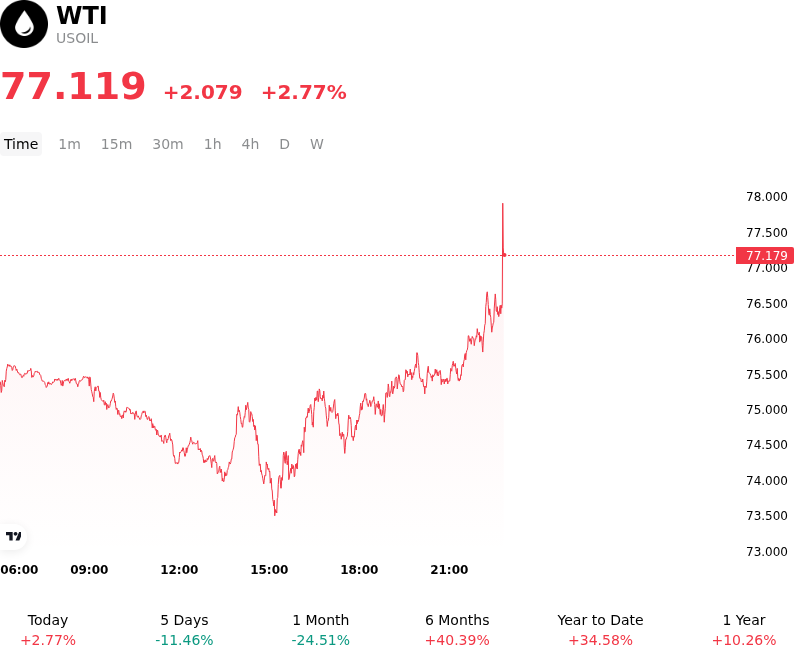
WTI (USOIL) is up 2.77% at Jun 17 10:50(ET), now at $77.119, with a 7-day down of 14.56%.
What is driving WTI (USOIL)’s stock price up today?
The primary catalyst behind the sharp intraday advance in WTI crude oil was a combination of exceptionally tight physical market data and a swift reassessment of geopolitical tail risks following days of heavy selling. Crucially, the Energy Information Administration reported a massive draw in domestic commercial crude inventories of 8.263 million barrels. This draw significantly outpaced consensus expectations of a 3.6 million-barrel decline, reinforcing a prolonged trend of depleting stockpiles that has drained over fifty million barrels from domestic storage over the past nine weeks. This tightening was exacerbated by continued liquidations from the Strategic Petroleum Reserve, pushing national reserves to their lowest levels since 1983 and demonstrating that despite broader macroeconomic headwinds, physical market balances remain highly constrained.
The recovery was also heavily supported by a partial clawback of the geopolitical risk premium that had been unwound earlier in the week. Prior sessions witnessed deep liquidations that pushed crude to a fifteen-week low on optimism surrounding a tentative U.S.-Iran peace agreement and the reopening of the critical Strait of Hormuz. However, the bearish momentum halted as traders weighed the execution risks of the deal. Statements from U.S. President Donald Trump warning of a return to military action and airstrikes if the upcoming memorandum of understanding is not successfully finalized reintroduced a necessary layer of caution. This rhetoric triggered substantial short-covering ahead of the scheduled diplomatic signing ceremony in Switzerland, as market participants recognized that restoring normal tanker flows could be a slow and highly fragile process.
Adding to the upward momentum were emerging supply-side threats in the Gulf of Mexico. Forecasters began tracking a developing tropical system, formerly a Pacific storm, which threatened to reform as a named storm as it approached the Texas coast. This raised the specter of precautionary offshore production shut-ins and coastal refinery disruptions. When combined with localized refinery outages in the Midwest and East Coast, these immediate operational threats further incentivized buyers to bid up near-month contracts. While investors also kept a close eye on the Federal Reserve’s impending interest rate decision, the combination of a massive inventory drawdown, geopolitical headline risk, and near-term weather threats ultimately powered the strong rebound in energy futures.
Technical Analysis of WTI (USOIL)
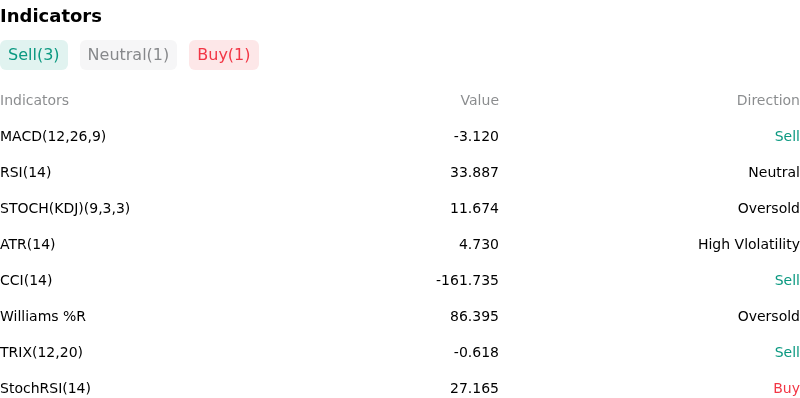
Technically, WTI (USOIL) shows a MACD (12,26,9) value of -3.120, indicating a sell signal. The RSI at 33.887 suggests neutral condition and the Williams %R at 86.395 suggests oversold condition. Please monitor closely.
More details about WTI (USOIL)
Recent Events and Risks:
- Unwinding of Geopolitical Premium on US-Iran Peace Deal: The signing of a preliminary peace memorandum between the U.S. and Iran on June 16, 2026, has triggered a massive liquidation of the conflict risk premium. This diplomatic breakthrough outlines a pathway to lift the naval blockade of Iran and reopen the Strait of Hormuz—which handles roughly 20% of global seaborne oil—causing WTI crude to plunge over 5% in the last 24–72 hours to a three-month low near $76.00 per barrel.
- Severe IEA Demand Downgrade and Impending 2027 Supply Glut: In its June 17, 2026, monthly oil market report, the International Energy Agency (IEA) slashed its 2026 global demand forecast by 700,000 bpd to an overall contraction of 1.1 million bpd. Concurrently, the agency warned of a massive supply surplus of over 5 million bpd looming in 2027 as Middle East exports recover and American production continues to expand.
- Weakening Chinese Demand and Macroeconomic Headwinds: Severe demand destruction is spreading beyond the immediate conflict zone. Forecasters are warning that Chinese apparent demand is on track for its first major annual contraction since the 1970s, which is further compounded by a second consecutive monthly downgrade to 2026 global demand growth by OPEC and risk-off sentiment ahead of the FOMC meeting.
- U.S. Gasoline Inventory Builds and High Domestic Production: Reflecting weak downstream product demand, American Petroleum Institute (API) data released on June 16, 2026, revealed a gasoline stockpile build of 2.47 million barrels. This rise in refined product inventories occurs alongside high U.S. crude production, which remains near record levels of approximately 13.8 million bpd, keeping pressure on physical refinery margins.
This article may include AI-generated content that is human-reviewed, which is for reference and general information purposes only and does not constitute investment advice.
Recommended Articles









Comments (0)
Click the $ button, enter the symbol, and select to link a stock, ETF, or other ticker.