


 Discount


Nvidia Halts AI Server Deliveries to Four Southeast Asian Countries: Three Earnings Risks Behind Thousands of B300 Chips Seeking New Buyers



AI Podcast


Nvidia has requested manufacturing partners to pause AI server deliveries to Malaysia, Singapore, Thailand, and Indonesia following tightened U.S. export rules on remote chip access, affecting thousands of B300 GPUs. This disruption presents three primary risks to Nvidia: potential revenue recognition delays from stalled shipments, future order reductions if alternative buyers merely substitute next-quarter procurement with spot inventory, and potential gross margin compression if abundant discounted spot chips force channel price concessions. While management expresses confidence in robust underlying demand, the resumption timeline and ultimate financial impact remain dependent on tenant retention and inventory absorption rates.
TradingKey - According to a Financial Times report on November 26, Nvidia (NVDA) has asked manufacturing partners to pause deliveries of AI servers powered by its chips to Malaysia, Singapore, Thailand, and Indonesia. Vendors including Dell (DELL) and Super Micro Computer (SMCI) have notified local buyers, with the timeline for resuming shipments remaining unclear. Meanwhile, following the tightening of U.S. rules on remote access to advanced chips, sellers have begun seeking new buyers for thousands of Nvidia B300 GPUs.
To assess the extent of the impact this shipment halt will have on Nvidia, one must first look at which stage the orders are stalled. The earliest risk to materialize is delivery delays. If Nvidia has already sold the GPUs to server manufacturers and recognized revenue, but the servers cannot be shipped, the initial impact falls on the manufacturers' inventories and cash collections. Only when inventory piles up and manufacturers delay their next round of procurement will the pressure transmit to Nvidia. For orders that have not yet met revenue recognition criteria, delivery delays could directly postpone the booking of related revenue.
Whether orders can resume also depends on whether overseas cloud service providers can retain their original computing tenants. The new regulations from the U.S. Department of Commerce that took effect on November 19, in addition to requiring licenses for deliveries of certain advanced chips to the four aforementioned countries and Brazil, also restrict overseas data centers from remotely providing large-scale computing power to specific clients. According to CNBC, some of the GPUs up for sale were originally slated for deployment in data centers that lease computing power to Chinese clients. If original tenants can no longer use this computing capacity, cloud providers will need to find new tenants or scale back planned procurement.
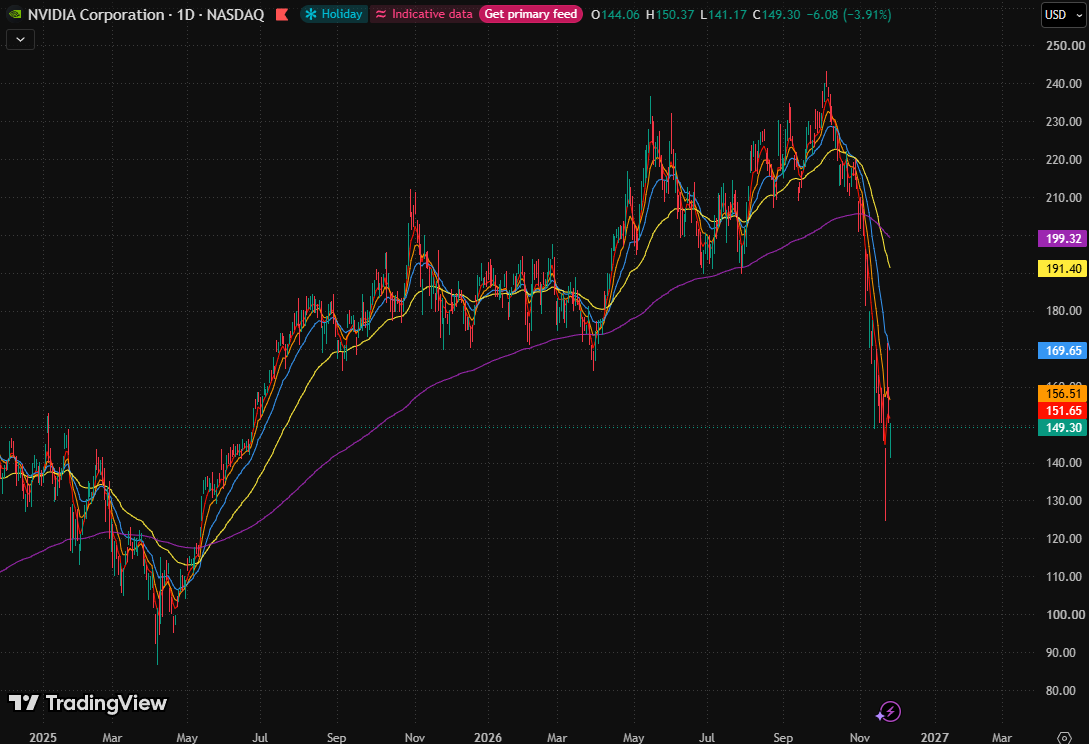
Nvidia stock chart, Source: TradingView
This also introduces a second, more critical risk to Nvidia's revenue: will new buyers reduce their existing orders after taking over the B300 chips? Nvidia management stated during the November 17 earnings call that chip demand far outstrips supply, expressing confidence in finding alternative buyers. If the buyer stepping in is a cloud provider that previously could not obtain enough GPUs, it could purchase these B300s while keeping its orders placed with Nvidia. Conversely, if buyers merely substitute GPUs originally scheduled for procurement next quarter with immediately available spot inventory, even if all of these chips are sold, Nvidia could still receive fewer orders next quarter.
Beyond who will buy them, the transaction price ties into a third risk: whether channel discounts will compress gross margins on Nvidia's new products. Currently, what has been disclosed is that sellers are looking for buyers, with actual transaction prices remaining unclear. Even if inventory holders cut prices on their own to recover cash, the discounts are initially absorbed by the holders themselves. Only when low-priced spot inventory is abundant enough and persists long enough—enabling customers to leverage it to demand lower quotes from Nvidia on new products, or requiring Nvidia to provide price subsidies to partners—will the pressure further transmit to gross margins. If unit costs do not decline in tandem, the gross profit generated per chip sold will decrease.
This content was translated using AI and reviewed for clarity. It is for informational purposes only.
Recommended Articles











Comments (0)
Click the $ button, enter the symbol, and select to link a stock, ETF, or other ticker.