


 Discount


S&P Plans to Downgrade Nvidia Credit Rating as Risk of Stock Testing $100 Mark Rises



AI Podcast


On November 25, Eastern Time, S&P Global Ratings placed Nvidia’s AA long-term credit rating on CreditWatch negative, citing governance weaknesses, management upheaval regarding CEO Jensen Huang, and a lack of succession planning. This potential downgrade could increase borrowing costs and hinder AI infrastructure expansion. Compounding these pressures are intensifying semiconductor competition, macroeconomic headwinds from sticky inflation, and weakening technical momentum, raising the risk that Nvidia’s stock could retest psychological support at $100. Conversely, Moody’s maintained its Aa1 rating and stable outlook. Investors must monitor upcoming congressional testimony and corporate governance developments.
TradingKey - S&P weighs Nvidia credit rating downgrade; stock faces rising risk of retesting psychological $100 support level amid multiple concerns.
On November 25, Eastern Time, S&P Global Ratings announced that it had placed Nvidia (NVDA)'s AA long-term credit rating on CreditWatch with negative implications, warning of a potential one-notch downgrade to AA- within the next 90 days. Impacted by the news, Nvidia's stock fell further by about 4%, breaking below the $150 mark to close at $149.30. As concerns over corporate governance and financing guarantees mount, the risk of Nvidia's stock retesting the psychological $100 round-number level has escalated sharply.
S&P's placement of Nvidia on CreditWatch negative was not driven by deterioration in its profitability or cash flow, but rather by the rare dominance of management and corporate governance risks in its credit assessment. S&P pointed out that CEO Jensen Huang underwent dramatic upheaval with an abrupt resignation and rapid reinstatement in less than two weeks, while the board's lack of clear public explanations and strategic rationale during the process revealed weaknesses in management oversight, explicitly stating that excessively long tenures of certain directors may have compromised board independence.
In addition, S&P emphasized key-person risk and a succession-planning void at Nvidia, noting that the company's operations and strategy are heavily reliant on Jensen Huang personally. However, the company has not yet established a clear succession plan or transition framework, which introduces substantial uncertainty for creditors in the event of senior leadership changes or unexpected developments in congressional inquiries.
What, then, does an S&P downgrade actually mean? If S&P officially lowers the rating, creditors could demand higher credit guarantees or asset collateral, driving up borrowing costs for Nvidia itself as well as for emerging cloud computing providers that rely on Nvidia's financing guarantees, thereby impacting the pace of AI computing infrastructure expansion and capital allocation efficiency.
For Nvidia equity investors, placing the credit rating on negative watch is often interpreted as a sign that corporate governance and regulatory uncertainties are far from over. Against a backdrop of high volatility in U.S. tech and AI semiconductor sectors, hawkish inflation data, and capital deleveraging, a governance discount can easily suppress price-to-earnings multiples and the magnitude of any rebound, or even further compress valuation multiples.
Furthermore, Nvidia faces headwinds from multiple other negative factors. Core AI model developers such as Anthropic continue to diversify their chip suppliers, while Amazon's in-house chips and M&A activities intensify competition in computing power, leading the market to scrutinize Nvidia's long-term pricing power and peak gross margins more rigorously. Meanwhile, the latest U.S. October core PCE inflation accelerated to 3.3% year over year, reinforcing expectations that the Federal Reserve will maintain high interest rates and putting deleveraging pressure on the high-valuation tech and semiconductor sectors as a whole.
From a technical analysis perspective, Nvidia has plunged from around $170 to $125 within just two weeks, surged over 30% in a single day back above $155 following Jensen Huang's return, and then fallen for two consecutive days to drop below $150, reflecting weakening upside momentum. Amid the confluence of multiple headwinds, there is a strong possibility that Nvidia's stock will retest its previous low of $125. If this support level fails to hold, the market could easily retest the psychological round-number threshold of $100.
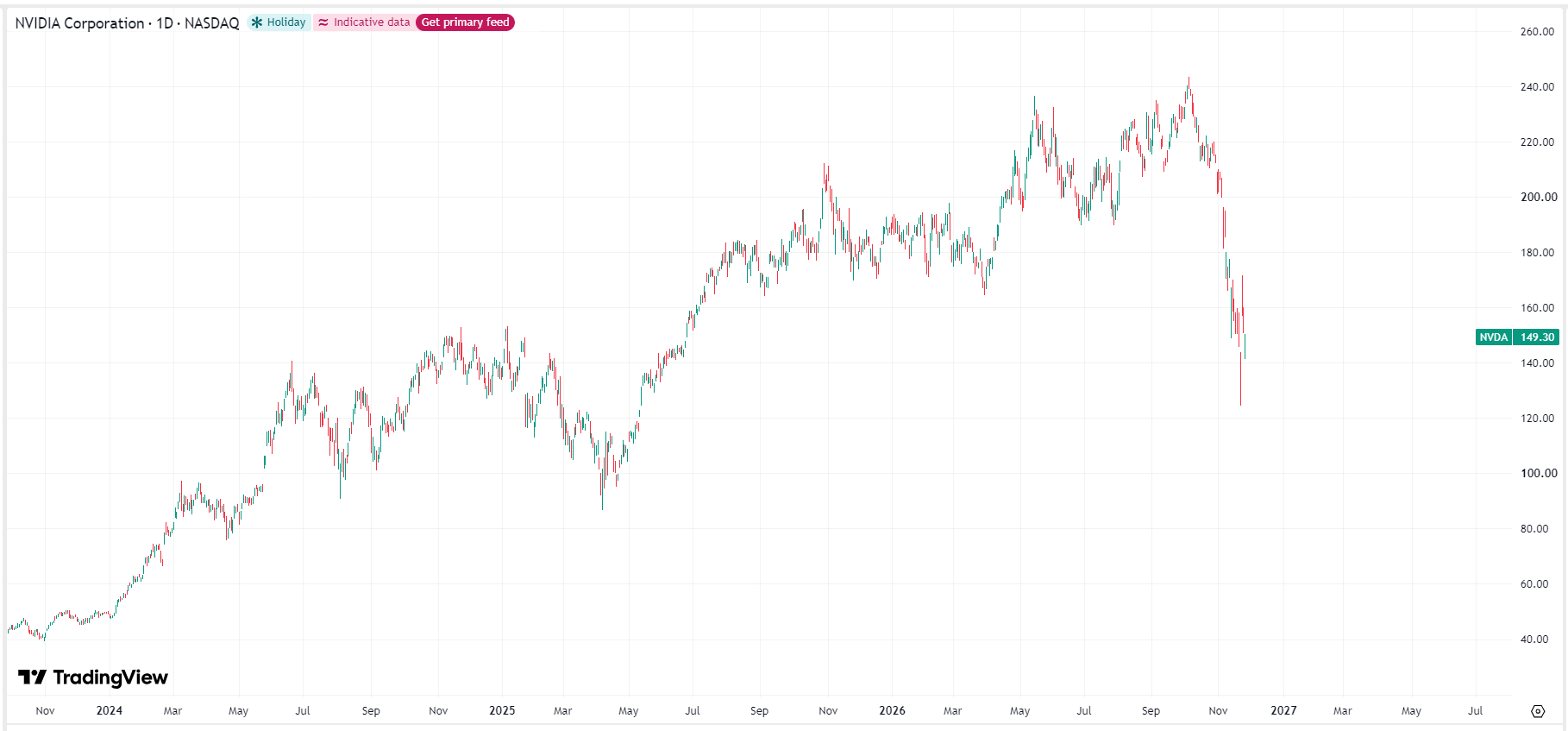 Nvidia stock chart, Source: TradingView
Fortunately, another major rating agency, Moody's, maintained Nvidia's Aa1 rating and stable outlook, arguing that Jensen Huang's return reduces near-term uncertainty. However, going forward, investors need to closely monitor Huang's testimony before the U.S. Congress and Nvidia's progress in strengthening its board governance.
This content was translated using AI and reviewed for clarity. It is for informational purposes only.
Recommended Articles








Comments (0)
Click the $ button, enter the symbol, and select to link a stock, ETF, or other ticker.