


 Discount


Japan, South Korea Stocks Pare Gains, Kospi Closes Up 0.29%; Kioxia Surges Over 12% With Nvidia



On November 26, Japanese and South Korean equities closed higher, though morning gains narrowed significantly. Japan's Nikkei 225 rose 0.86% to 57,499.16, driven by Kioxia’s 12.57% surge following a Nvidia collaboration for petabyte-level GPU memory. South Korea's KOSPI index gained 0.29% to 4,711.18, supported by semiconductor leaders like SK Hynix. Markets focused on South Korea’s impending stock stabilization fund deployment, while the Bank of Korea projected chipmakers' annual operating profits to reach 700 trillion won, reinforcing the sector's crucial economic role amid ongoing market volatility.
TradingKey - On November 26, Japanese and South Korean stocks both closed higher, though gains narrowed significantly from the morning session. South Korea's KOSPI closed up 0.29% at 4,711.18 points, while Japan's Nikkei 225 Index (N225) closed up 0.86% at 57,499.16 points. Both indices were up about 2% earlier in the day before surrendering most of their gains.
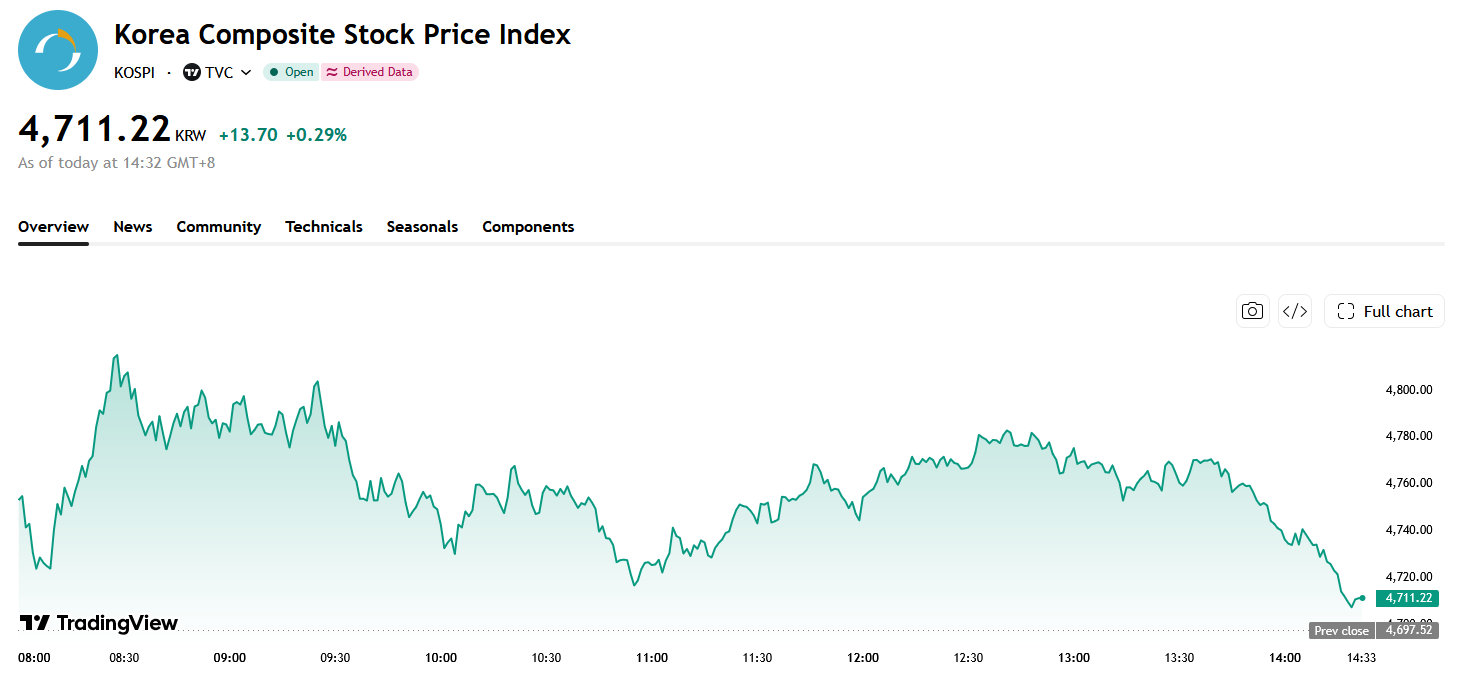
Source: TradingView
In the South Korean market, Samsung Electronics closed up 0.35% at 171,300 won (approximately $128), while SK Hynix closed up 2.23% at 1.053 million won. In the Japanese market, Kioxia jumped 12.57% to 7,762 yen (approximately $49), and SoftBank Group rose 7.32% to 2,894 yen.
Kioxia announced a partnership with Nvidia (NVDA) to combine Nvidia's SCADA software with Kioxia's high-performance SSDs to explore expanding effective GPU memory capacity to petabyte scale in support of Nvidia's Storage-Next initiative. This proof-of-concept utilized a GB200 NVL72 rack-scale system configured with 144 of Kioxia's 7.68TB XD8 series SSDs, totaling approximately 1.1 PB of raw storage capacity, and demonstrated the potential to process a database containing 2 trillion vectors.
South Korea will convene a meeting of its stock market stabilization fund's investment committee, with the market continuing to monitor the preparation and subsequent deployment of the capital. Meanwhile, Bank of Korea Governor Hyun Song Shin projected that operating profits for chipmakers will reach approximately 700 trillion won this year, demonstrating that the semiconductor industry remains a vital pillar of the South Korean economy.
This content was translated using AI and reviewed for clarity. It is for informational purposes only.
Recommended Articles






Comments (0)
Click the $ button, enter the symbol, and select to link a stock, ETF, or other ticker.