


 Discount


UnitedHealth Falls 5.4% on CMS's CRUSH Audit Plan, With $385.23 the Next Test



AI Podcast


UnitedHealth Group shares fell 5.42% to $389.68 on Tuesday, November 17, following the Centers for Medicare & Medicaid Services' proposed CRUSH rule, which introduces stricter Medicare Advantage audits and eliminates the fee-for-service adjuster. This regulatory development threatens potential past repayments dating back to 2018, injecting unquantifiable risk into the company's outlook despite a solid earnings recovery. Technically, the stock exhibits a short-term bearish bias below $399.37. Key support stands at $385.23, and a 4-hour close below this level could drive prices toward $373.77 and $362.74, whereas reclaiming $399.37 would neutralize downside pressure.
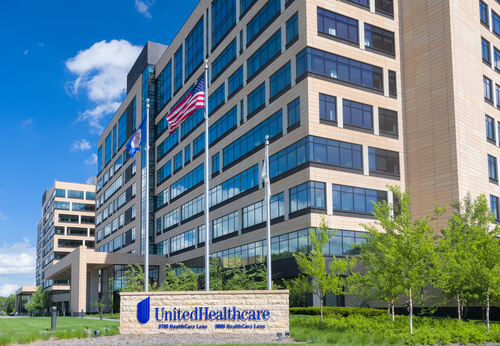
TradingKey - UnitedHealth Group (NYSE: UNH) fell 5.42% to $389.68 on Tuesday, November 17, from $412.02, on volume of about 8 million shares, well above its 5.2 million average. Premarket quotes are slightly lower at $387.91, and the stock is now about 16% below its 52-week high of $461.62.
The drop came a day after the Centers for Medicare & Medicaid Services, or CMS, the agency that runs Medicare, proposed a sweeping anti-fraud rule that would bring back tougher audits of Medicare Advantage insurers. Other insurers fell too, with Humana down 5.48% and CVS Health down 3.48%.
What the CRUSH Rule Would Change
On November 16, CMS proposed the Comprehensive Regulations to Uncover Suspicious Healthcare, or CRUSH, rule, which it says would save nearly $90 billion in federal spending over the next decade. The part that matters most for UnitedHealth covers risk adjustment data validation audits, known as RADV audits, which check whether insurers were overpaid based on how sick their members appeared in medical records.
Under the proposal, audit findings from a small sample of members would be extrapolated, meaning applied across an insurer's entire contract, starting with payment year 2018. CMS would also drop the fee-for-service adjuster, a discount that has protected insurers by allowing for coding errors that also happen in traditional Medicare. CMS estimates the change would recover an average of about $9 billion in Medicare Advantage overpayments per payment year across the industry.
The rule would also make fraud reporting mandatory. Only 46% of Medicare Advantage and drug plans voluntarily reported suspected fraud last year. Providers that bill Medicare Advantage plans would have to enroll in traditional Medicare two years after the final rule is published. Comments are due by January 19, 2027.
Why UnitedHealth Is Most Exposed
UnitedHealth is the largest Medicare Advantage insurer, so wider audits reaching back to 2018 could mean repayments for past years and tighter risk coding, the way insurers record how sick members are, which affects how much Medicare pays them. The company has not yet quantified any exposure, and GuruFocus said investors will watch whether it reserves for its 2018 to 2024 audit risk before the comment period closes.
The rule also has a legal history. CMS's 2023 audit rule allowed extrapolation and dropped the same adjuster, but a federal judge in Texas vacated it in September 2025 after a lawsuit by Humana, finding CMS had not given proper notice. HHS appealed in November 2025, and the Fifth Circuit heard arguments in October. CRUSH would effectively re-propose parts of that rule, so the final impact depends on both the appeal and the comment process.
The Recovery Story Was Going Well
The timing hurts because UnitedHealth's turnaround had been working. Third-quarter adjusted EPS rose to $4.69 from $2.92, against a $4.14 consensus, and UnitedHealthcare's operating margin improved to 3.3% from 2.1%. The company raised its 2026 adjusted EPS outlook to at least $20.50, from $19.50 to $20.00, its third raise of the year, and management targets 13% to 16% annual EPS growth over time.
For 2027, UnitedHealth is focusing on markets and products with more durable margins, including special needs plans for seniors with complex health needs, and about 390,000 members are in Medicare Advantage plans it is discontinuing. The Justice Department's criminal and civil probes into its Medicare Advantage billing also remain unresolved.
Analysts were still positive before the selloff. The average target is about $469.77, according to TradingKey data, about 21% above Tuesday's close, with Wells Fargo at $487 and JPMorgan at $524. At $389.68, the stock trades at about 19 times the $20.50 EPS floor, by my calculation. That multiple now has to absorb a new regulatory risk that the company cannot yet measure.
UnitedHealth Technical Analysis: 4-Hour Close Below $385.23 Could Open $373.77
That shift shows clearly on the 4-hour chart. The stock has just slipped below the rising trendline, a line drawn under its higher lows, that supported it since early October. Sellers stepped in again near $410.51, the 50% Fibonacci retracement of the July to October drop, which has capped rallies for most of November. The drop also pushed price below both moving averages, which track the average price over recent sessions, at $397.61 and $400.96, so the short-term picture now favors sellers.
RSI, a momentum gauge that runs from 0 to 100, has fallen to about 38, below its signal line. The MACD, another momentum indicator, has also turned slightly negative, which confirms that momentum is fading.
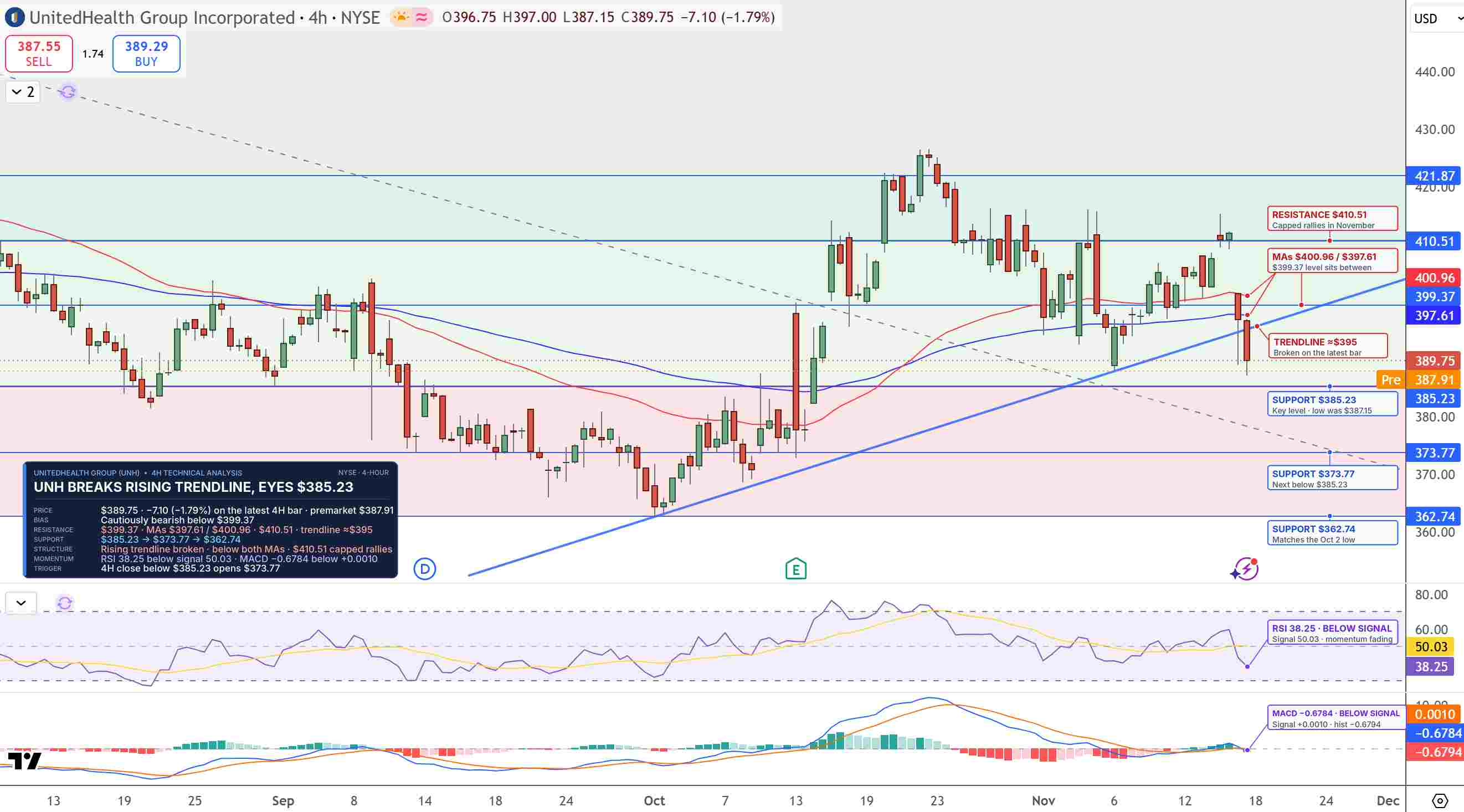
UNH Price Chart - Source: Tradingview
The key support is $385.23. A 4-hour close below it could send the stock toward $373.77, followed by $362.74, the October low. For buyers, reclaiming $399.37 would cancel the breakdown and could reopen $410.51.
I'm cautiously bearish while UnitedHealth stays below $399.37, with $385.23 as the next test.
Key Levels
- Last close: $389.68, down 5.42% on Tuesday, November 17 (premarket: $387.91)
- Support: $385.23, $373.77, $362.74
- Resistance: $397.61, $399.37, $410.51
- RSI: 38.25
- Bullish trigger: 4-hour close above $399.37
- Bearish trigger: 4-hour close below $385.23
FAQs
Why did UnitedHealth stock fall?
UnitedHealth fell 5.42% after CMS proposed the CRUSH rule, which would revive wider Medicare Advantage audits reaching back to 2018 without the fee-for-service adjuster, a change CMS estimates would recover about $9 billion a year industrywide.
What is the UnitedHealth stock forecast now?
The bias is cautiously bearish while UNH stays below $399.37. A 4-hour close below $385.23 could send the stock toward $373.77 and $362.74, while reclaiming $399.37 would cancel the breakdown and could reopen $410.51.
Bottom Line
UnitedHealth's earnings recovery is intact, but the CRUSH proposal adds a regulatory risk that investors cannot yet size. The level that matters is $385.23. In my view, a 4-hour close below it would open the way toward $373.77, while a move back above $399.37 would show the market sees the audit threat as manageable.
Recommended Articles








Comments (0)
Click the $ button, enter the symbol, and select to link a stock, ETF, or other ticker.