


 Discount


Nvidia Q3 Earnings Ease AI Chip Demand Concerns, but Still Faces Three Major Risks: Export Scrutiny, Customer Financing and CEO Succession



AI Podcast


On Eastern Time November 17, Nvidia reported strong quarterly revenue and raised its fiscal 2028 growth forecast to approximately 75%, easing AI demand concerns. However, the stock traded lower due to three key variables: export restrictions potentially impacting timely order delivery, emerging cloud providers facing potential financing hurdles for expensive GPUs, and ongoing leadership transition risks following Jensen Huang’s departure. While global demand remains robust, investors weighed these regulatory, financial, and operational uncertainties against the company's upgraded outlook, leading to a cautious market reaction.
TradingKey - On November 17, Eastern Time, Nvidia (NVDA) released its first earnings report following the departure of Jensen Huang. The company's quarterly revenue beat market expectations, and it raised its fiscal 2028 revenue growth forecast from about 70% to approximately 75%.
While the earnings report eased market concerns over insufficient AI chip demand, three key variables remain between customer purchase intentions and Nvidia's revenue recognition. Specifically, can the chips be approved for delivery, can buyers raise sufficient funds, and how will the new management support customer expansion?
Market concerns over these factors also led Nvidia's stock to open higher and trade lower today. As of press time, Nvidia was down about 1.5% at $153.
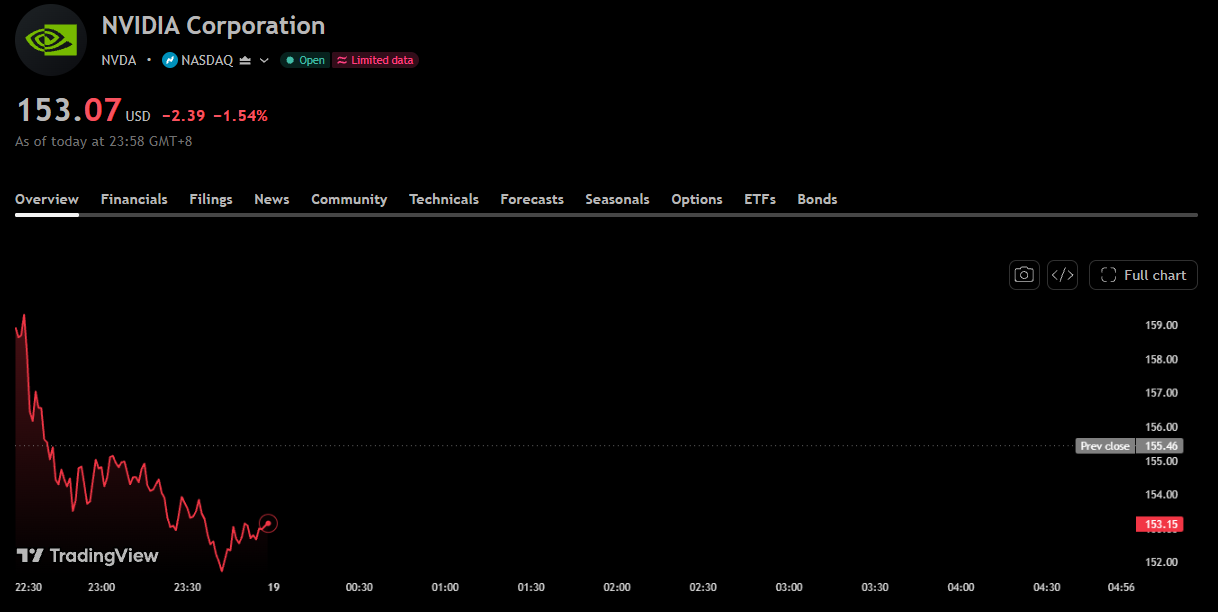
Nvidia stock price chart, Source: TradingView
Export Scrutiny Extends to Southeast Asia as Risk Lies in Timely Order Delivery
Nvidia's guidance does not include sales of licensed Hopper-architecture data center products to China. Barclays believes that, against this backdrop, the company's willingness to still raise its growth outlook indicates that demand from other markets is sufficient to support near-term sales.
However, Morningstar cautioned that direct sales to China represent only part of the risk. Some Southeast Asian data centers may also provide computing power to Chinese clients, and these operators' purchases of Nvidia chips could likewise be affected as the U.S. tightens export restrictions.
Singapore-based client Megaspeed is at the center of regulatory scrutiny. U.S. House Democrats have requested that financial firm Cantor Fitzgerald provide information on its Nvidia holdings to determine whether its commercial interests influenced the U.S. Department of Commerce's decisions regarding related chip exports. Cantor denied influencing government decisions, stating that the holdings were primarily used to hedge client trades; Megaspeed also denied any wrongdoing. To date, there has been no finding that the transactions violated regulations.
For Nvidia, even if other buyers are willing to absorb the shipments, rescheduling deliveries takes time. If orders from restricted customers cannot be redirected to other clients within the quarter, quarterly revenue could still fall short of expectations despite strong global demand.
Emerging Cloud Providers Still Need Funding as Compute Demand May Not Immediately Translate Into Purchases
Citi noted that the company is becoming more selective in financing AI infrastructure projects. This shift is particularly critical for emerging cloud service providers: they must procure expensive GPUs while also shouldering data center buildout and operational expenses, meaning capital often needs to be in place well ahead of compute-leasing revenues.
If Nvidia reduces financial support for certain projects and buyers cannot obtain alternative financing at acceptable costs, purchases originally planned in a single order may be split into multiple tranches. For Nvidia, being more prudent in selecting projects helps rein in its own risk exposure, but the trade-off could be a slower pace of expansion for some customers. At that point, chip sales will be affected not only by whether compute capacity is being utilized, but also by whether operators can pay and take delivery as scheduled.
Jensen Huang Return Discussions Conclude as Long-Term Succession Plan Remains Unsettled
Nvidia is currently led by Chief Financial Officer Colette Kress, who also serves as interim CEO, while the board has retained advisors to search for a permanent successor. Barclays endorsed the board's decision to no longer consider a return by Jensen Huang, viewing it as helpful in ending speculation over the founder's future, though who will lead the company over the long term remains unclear.
Succession risk ultimately boils down to operational decisions: which customers the new management will be willing to finance, who will receive priority allocation for export-restricted products, and whether these adjustments can be executed without delaying deliveries.
This also reflects a key post-earnings divergence: while robust demand is sufficient to underpin higher growth expectations, investors may not be willing to pay the same price as before for those expectations when regulations, financing, and the leadership transition are shifting simultaneously.
This content was translated using AI and reviewed for clarity. It is for informational purposes only.
Recommended Articles








Comments (0)
Click the $ button, enter the symbol, and select to link a stock, ETF, or other ticker.