


Coherent Surges 10%, Lumentum Rises 8% Pre-Market as US Plans to Restrict Chinese Optical Module Imports



AI Podcast


The U.S. government plans to restrict Chinese optical communications equipment over security concerns, boosting pre-market stocks for domestic suppliers like Coherent and Lumentum. Major tech firms oppose the policy, warning of up to a decade-long replacement timeline, equipment shortages, and rising costs due to China supplying roughly two-thirds of global optical transceivers. While U.S. suppliers currently lack the capacity to immediately absorb displaced orders, the policy may provide them with stable long-term demand. This potential restriction signals an extension of U.S. technology controls from advanced chips to critical data center networking infrastructure.

TradingKey - The U.S. government plans to further restrict Chinese optical communications equipment from entering the domestic market, a policy that could bring new market opportunities for domestic optical module suppliers. In pre-market U.S. trading Tuesday, optical communications supply-chain stocks broadly gained, with Coherent (COHR) up about 10%, Applied Optoelectronics (AAOI) rising 9%, Lumentum (LITE) gaining as much as 8%, and Corning (GLW) up about 3%.
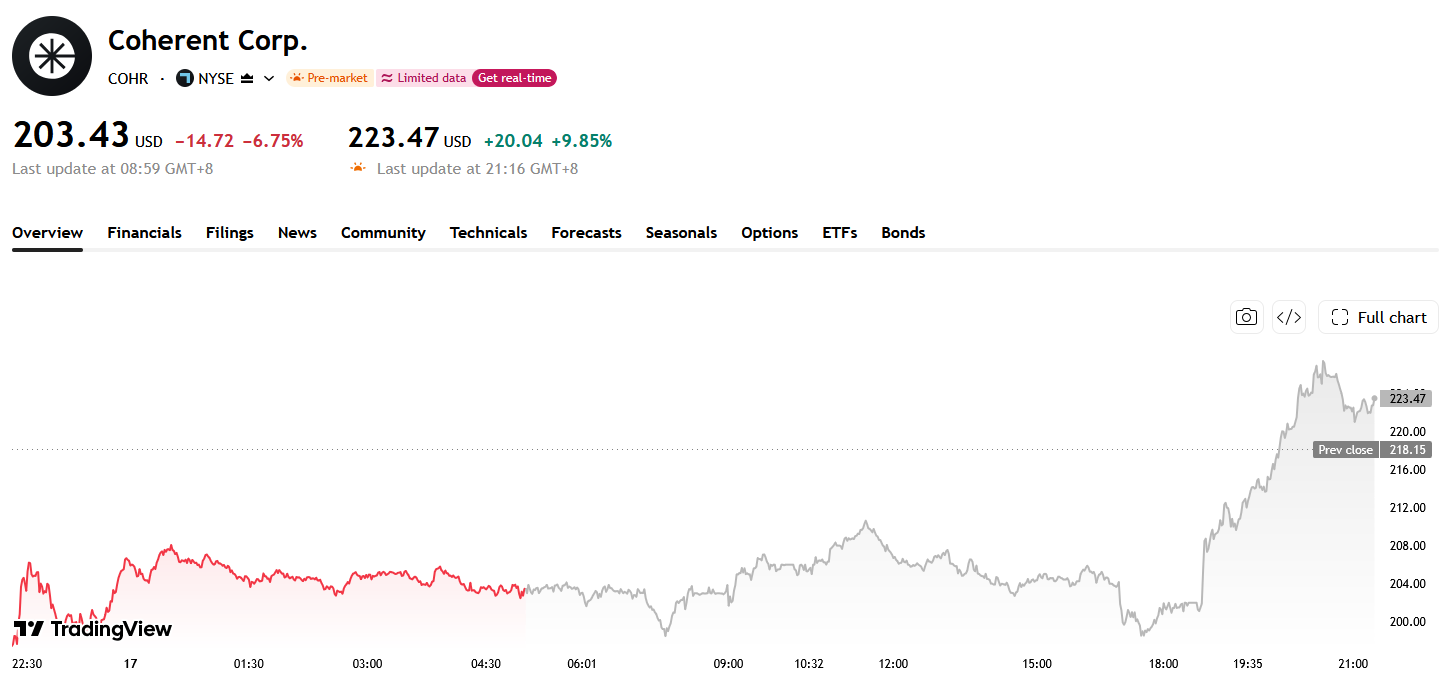
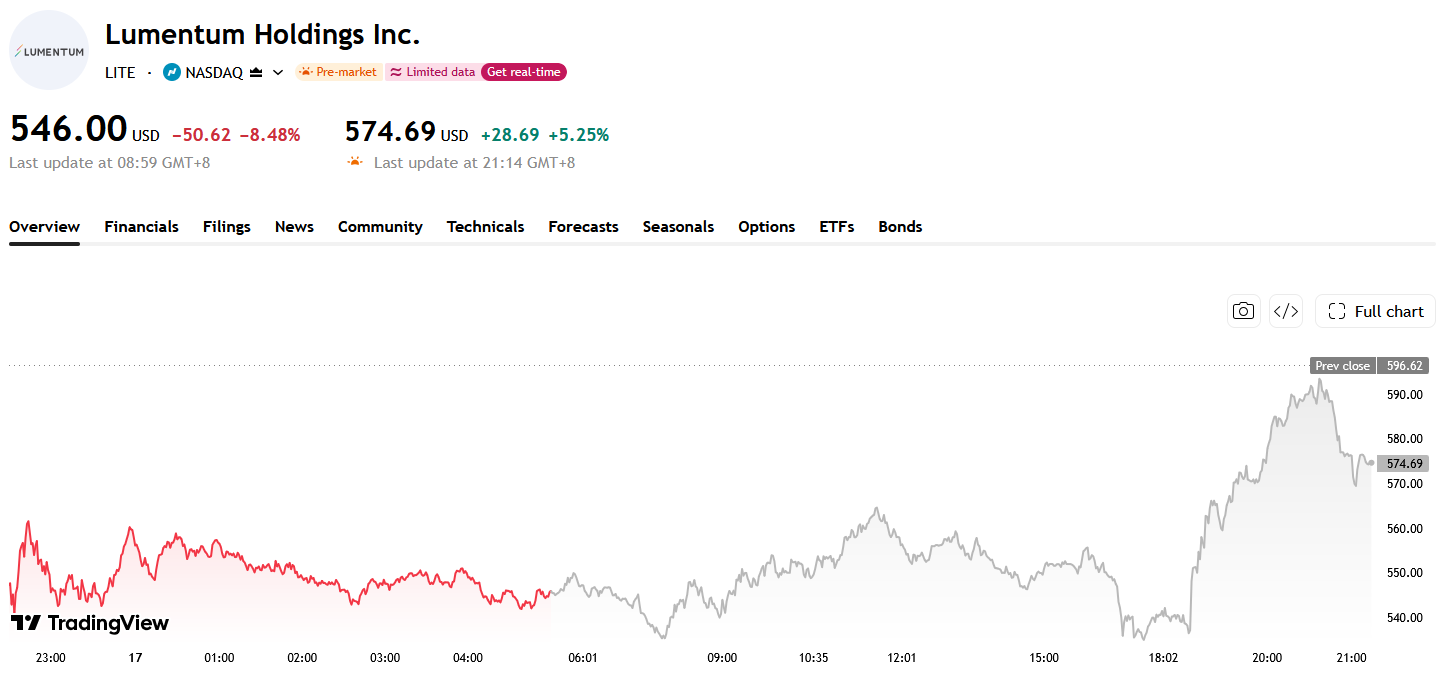
Source: TradingView
According to Reuters, citing people familiar with the matter, the Trump administration plans to press ahead with the restrictions, even though tech companies including Amazon (AMZN), Google (GOOGL), Meta (META), Microsoft (MSFT), CoreWeave (CRWV), and Cisco (CSCO) have voiced their opposition to the White House.
The U.S. Federal Communications Commission is studying restrictions on the import of new Chinese optical transceivers on the grounds that these devices sit at critical network junctions in artificial intelligence data centers and could theoretically be used to steal information, implant malware, or disrupt facility operations.
Optical transceivers transmit data at high speeds via optical fiber between GPUs, switches, servers, and storage devices, serving as critical interconnect components in large AI clusters. As data centers upgrade from 400G and 800G to 1.6T and higher speeds, optical modules not only affect network bandwidth but are also directly tied to the speed of cluster expansion and operational efficiency. Consequently, any supply restrictions could impact the construction costs and delivery timelines of U.S. artificial intelligence infrastructure.
Major tech companies oppose the policy primarily because Chinese suppliers are deeply embedded in the global data center supply chain. According to people familiar with the matter, corporate executives have warned White House officials that it could take U.S. companies up to a decade to fully meet replacement requirements. If the policy is implemented too quickly, cloud service providers such as Amazon, Microsoft, Google, and Meta could face equipment shortages, project delays, and rising procurement costs.
Counterpoint Research estimates that Chinese companies supply approximately two-thirds of the world's optical transceivers. Manufacturers such as Zhongji Innolight and Eoptolink hold key positions in the 800G and next-generation 1.6T product markets, with Zhongji Innolight accounting for about 27% of global revenue in the data center optical module market. While Coherent and Lumentum possess strong photonics technology and upstream laser capabilities, they currently lack the production capacity and packaging scale needed to fully absorb orders from Chinese vendors in the short term.
This also means that restricting Chinese optical modules will not necessarily allow U.S. suppliers to capture all orders immediately. If alternative capacity cannot be established in time, the pace of data center expansions by U.S. cloud providers could slow, and optical module prices could rise. Nevertheless, for Coherent, Lumentum, and Applied Optoelectronics, the policy could still encourage customers to sign long-term supply agreements and provide more stable demand expectations for expanding domestic production in the U.S.
Over the past year, the FCC has taken similar measures against new Chinese-made drones, robots, power inverters, and routers. If optical transceivers are ultimately included in the restrictions, it would signify that U.S. technology controls on China are extending further from advanced chips to data center networking and optical communications infrastructure.
This content was translated using AI and reviewed for clarity. It is for informational purposes only.
Recommended Articles











Comments (0)
Click the $ button, enter the symbol, and select to link a stock, ETF, or other ticker.