


Intel Falls Over 3% Pre-Market; Nvidia Slashes 25% Stake and Faces Shareholder Lawsuit



AI Podcast


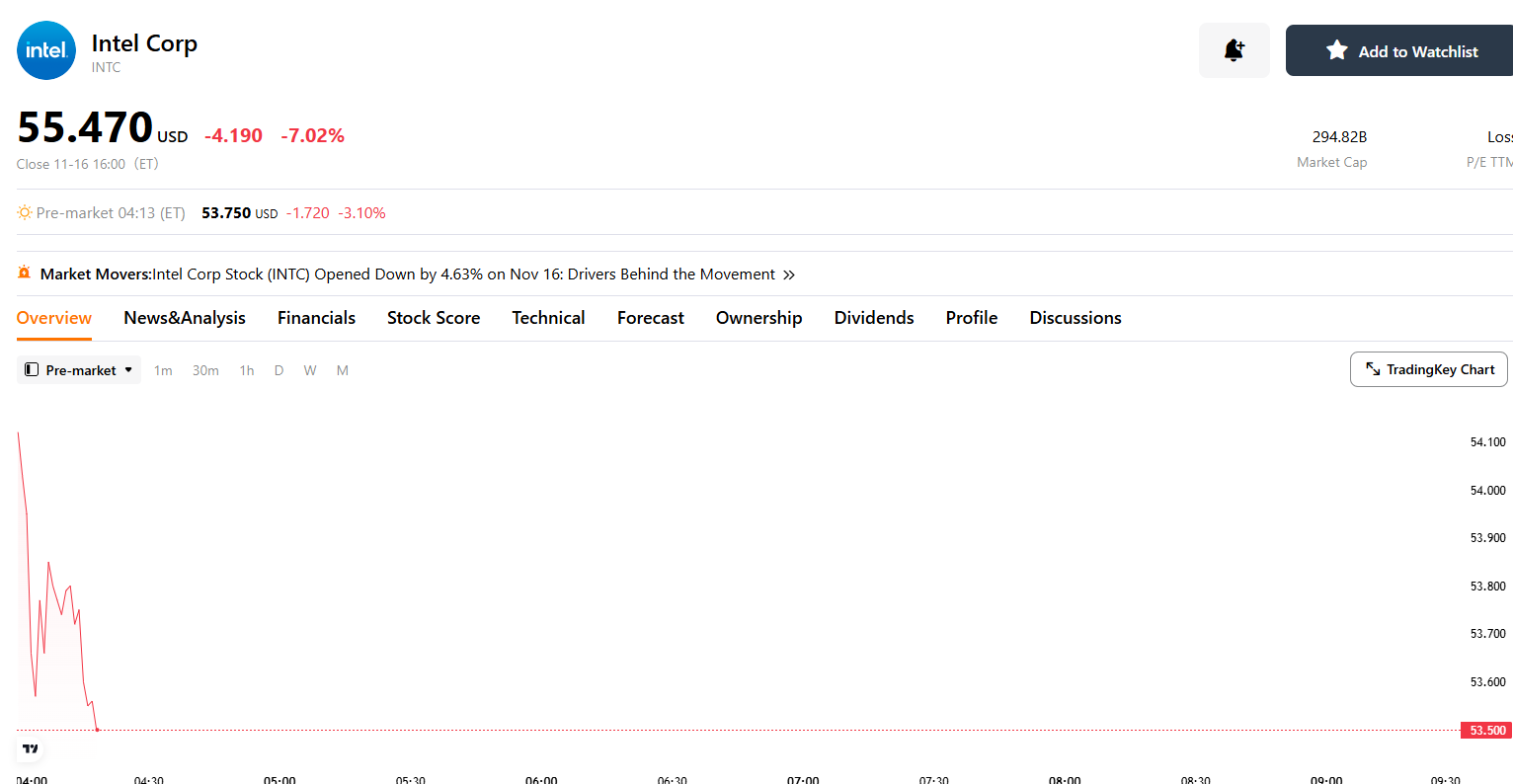
Intel shares fell over 3% in Tuesday's U.S. premarket trading, driven by Nvidia’s 25% reduction in holdings and a newly filed shareholder class-action lawsuit. Plaintiffs allege Intel failed to adequately disclose declining PC demand and inventory impacts. Compounding these governance and operational pressures, weak Q4 guidance, persistent PC market weakness projected into 2027, and critical component shortages continue to hinder the company's ability to capitalize on AI-driven data center demand.

TradingKey - Intel (INTC) extended its weakness from the previous trading day, falling more than 3% in Tuesday's U.S. premarket trading. Nvidia's sharp reduction in holdings, coupled with legal risks from a shareholder class-action lawsuit, further heightened market concerns over Intel's operating outlook and corporate governance.
Source: TradingKay
According to a Form 13F filed by Nvidia with the U.S. Securities and Exchange Commission, as of September 30, its holdings of Intel shares dropped from approximately 214.8 million shares at the end of the second quarter to 161.1 million shares, a reduction of about 53.69 million shares, or 25%. Based on prices at the end of the third quarter, the investment was valued at approximately $19.37 billion, accounting for 40.1% of Nvidia's disclosed equity portfolio, down from 47.3% in the prior quarter.
In addition to the reduction in holdings by a major shareholder, Intel also faces fresh legal pressure. Investors led by the City of Southfield Fire & Police Retirement System of Michigan recently filed a proposed securities class-action lawsuit in the San Jose Division of the U.S. District Court for the Northern District of California, naming Intel, Chief Executive Officer Lip-Bu Tan, and Chief Financial Officer David Zinsner as defendants.
The lawsuit seeks to represent investors who purchased Intel stock between July 23, 2026, and October 29, 2026. The plaintiffs allege that the company failed to timely and adequately disclose the impact of declining PC demand and channel inventory backlogs on revenue and margins, and contend that the negative impact outweighed the growth brought to its data center business by the artificial intelligence investment boom.
Intel previously issued fourth-quarter revenue and earnings guidance that fell short of market expectations, and projected that weakness in the PC market would persist into 2027. Meanwhile, tight supplies of critical components such as substrates and memory have also constrained the company's ability to ramp up data center processor production, making it difficult to fully capitalize on growing server chip demand.
This content was translated using AI and reviewed for clarity. It is for informational purposes only.
Recommended Articles








Comments (0)
Click the $ button, enter the symbol, and select to link a stock, ETF, or other ticker.