


Baidu's AI Cloud Nearly Doubles, but BIDU Still Leans on $76.33 Support



AI Podcast


Baidu reported third-quarter results with total revenue falling 1% year-over-year to RMB30.8 billion, as rapid AI cloud growth nearly offset a 22% decline in online marketing. Non-GAAP EPS reached $1.01, beating consensus. However, heavy AI infrastructure investments drove free cash flow into negative territory at approximately negative RMB4.6 billion. The stock remains under a bearish technical trend, trading below moving averages with key support at $76.33 and resistance at $79.82. While AI is successfully emerging as a new revenue engine, investors await proof that this growth can translate into positive cash flow and margin expansion.
TradingKey - Baidu (NASDAQ: BIDU) reported third-quarter results before the US open on Monday, November 16, and the early reaction is muted. The stock closed at $78.14 on Friday, November 13, and premarket quotes sit slightly lower at $77.81, with the earnings call set for 7:30 am ET.
The results come after a difficult year. The stock is down more than 40% in 2026, according to GuruFocus, and about 53% below its 52-week high of $165.30, by my calculation.
AI Is Growing Fast, but Search Is Shrinking
Total revenue fell 1% from a year earlier to RMB30.8 billion, or $4.60 billion, slightly above estimates. Baidu General Business, the core company excluding the iQIYI streaming service, grew 1% to RMB25.0 billion, because two very different trends almost cancelled each other out.
On one side, the AI-powered business rose 37% to RMB13.2 billion and now makes up 53% of General Business revenue, up from 39% a year earlier. AI cloud infrastructure, which rents computing power to other companies, nearly doubled, rising 94% to RMB8.2 billion, and GPU cloud revenue, from renting out AI chips, jumped 191%. Revenue from outside customers' token use on Baidu's Qianfan AI platform, which charges by the amount of text processed, rose 1,159%, though Baidu did not give the starting figure.
On the other side, online marketing revenue, mainly search ads, fell 22% to RMB11.9 billion. Startup Fortune estimates that AI revenue added about RMB3.6 billion from a year earlier, while search ads lost about RMB3.4 billion, so the new business is only just covering the decline in the old one. iQIYI revenue also fell 10% to RMB6.0 billion.
Profit Beat, but Cash Flow Turned Negative
Non-GAAP EPS, which excludes items such as stock-based pay, came in at $1.01 per ADS, beating the roughly $0.92 consensus tracked by GuruFocus. GAAP EPS was $0.65, and margins remain thin, with GAAP operating income of RMB626 million, a 2% margin, and non-GAAP operating income of RMB1.7 billion, a 6% margin.
Cash is the bigger concern. Operating cash flow was RMB2.8 billion, but heavy spending on AI data centers left free cash flow, the cash left after running the business and paying for new equipment, at about negative RMB4.6 billion, or about negative $682 million, by my calculation from the cash flow table. Renting out GPU capacity is also generally a lower-margin business than search advertising, so the shift toward cloud may weigh on margins even as revenue grows. Two AI lines also lagged, with AI applications flat at RMB2.6 billion and AI-native marketing down 15% to RMB2.4 billion.
A First Dividend and a Strong Balance Sheet
Baidu held RMB276.6 billion, or $41.25 billion, in cash and investments at the end of September, so it can fund the shift for some time. It has returned $373 million through buybacks since the start of 2026, and expects to declare its first-ever dividend before the end of 2026, subject to board approval and market conditions.
CEO Robin Li said, "Our long-term investments in full-stack AI are translating into meaningful growth at scale," and CFO Haijian He called AI cloud infrastructure "a new growth engine for Baidu." Other parts of the AI push are also moving. The Baidu App had 604 million monthly users in September, and Apollo Go, Baidu's robotaxi service, operated in 30 cities as of October, with more than 390 million cumulative autonomous kilometers. Its Kunlunxin M100 AI chip is expected to reach volume production by the end of 2026, and the chip unit is reportedly targeting a Hong Kong listing at a valuation of about $50 billion.
Why the Report Has Not Lifted the Stock Yet
AI cloud revenue nearly doubled and EPS beat estimates, yet premarket trading is almost unchanged. Total revenue is still shrinking, free cash flow is negative, and the fastest-growing business, GPU rental, is not the high-margin model investors paid for when search ads were growing. Analysts were still positive before the report, with a Buy consensus from 30 analysts and an average target of about $136, according to StockAnalysis, but the stock needs proof that the cloud growth can turn into cash.
Baidu Technical Analysis: 2-Hour Close Below $76.33 Could Open $74.42
That hesitation shows clearly on the 2-hour chart. Buyers have firmly defended the $76.33 support zone, which held at the end of October and again last week. Even so, the bigger trend remains bearish. The stock keeps making lower highs under a falling trendline from September, a line drawn across those lower highs, and trades below both of its moving averages, which track the average price over recent sessions, at $79.19 and $80.53. An earnings marker on the chart also points to volatility as US trading reacts to the results.
RSI, a momentum gauge that runs from 0 to 100, sits near 43, just below its signal line. The MACD, another momentum indicator, is slightly negative, so momentum still leans toward sellers.
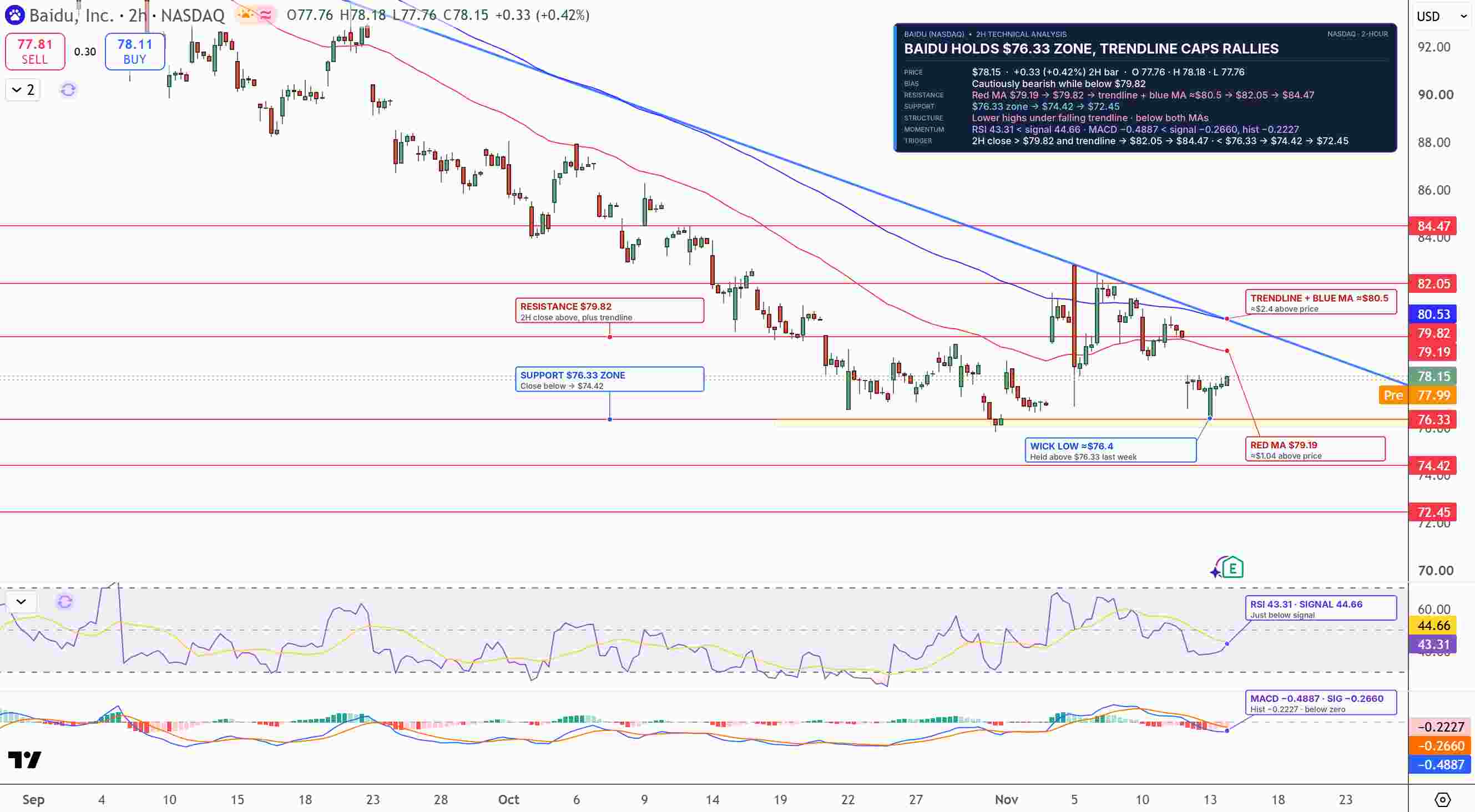
BIDU Price Chart - Source: Tradingview
A 2-hour close above $79.82 and the trendline could open $82.05, followed by $84.47. On the downside, a break below $76.33 could send Baidu toward $74.42, followed by $72.45.
I'm cautiously bearish while Baidu stays below $79.82, with $76.33 as the key floor.
Key Levels
- Last close: $78.14 on Friday, November 13 (premarket: $77.81)
- Support: $76.33, $74.42, $72.45
- Resistance: $79.82, $82.05, $84.47
- RSI: 43.31
- Bullish trigger: 2-hour close above $79.82
- Bearish trigger: 2-hour close below $76.33
FAQs
How did Baidu do in Q3 2026?
Baidu's revenue fell 1% to RMB30.8 billion as search ads dropped 22%, but AI cloud infrastructure revenue rose 94% and non-GAAP EPS of $1.01 per ADS beat the roughly $0.92 GuruFocus estimate. Free cash flow was negative because of heavy AI spending.
What is the Baidu stock forecast now?
The bias is cautiously bearish while BIDU stays below $79.82. A 2-hour close above $79.82 and the falling trendline could open $82.05 and $84.47, while a break below $76.33 could send the stock toward $74.42 and $72.45.
Bottom Line
Baidu's AI cloud is growing fast enough to offset falling search ads, but not yet fast enough to grow total revenue or cash flow. The level that matters is $76.33. In my view, a break below it would confirm the downtrend, while a 2-hour close above $79.82 would show buyers are finally rewarding the AI shift.
Recommended Articles






Comments (0)
Click the $ button, enter the symbol, and select to link a stock, ETF, or other ticker.