


Intel Drops Over 5% Pre-Market as Company, CEO and CFO Sued by Shareholders With Weak PC Demand in Focus



AI Podcast


Intel shares declined approximately 5% in premarket trading following a shareholder class-action lawsuit filed in the U.S. District Court for Northern California. The lawsuit alleges that Intel and key executives failed to timely disclose worsening PC market weakness and inventory buildup prior to its October equity financing, prior to a sharp post-earnings stock sell-off that erased significant market value. Plaintiffs claim management downplayed operational risks to complete fundraising, while ongoing component shortages and constrained data center production continue to challenge the company's turnaround strategy and financial outlook.
TradingKey - Intel (INTC) fell about 5% in US premarket trading on Monday. Following a historic sell-off in late October triggered by weaker-than-expected guidance, the company and two key executives now face a shareholder class-action lawsuit, further escalating market concerns over its disclosures, capital operations, and turnaround prospects.
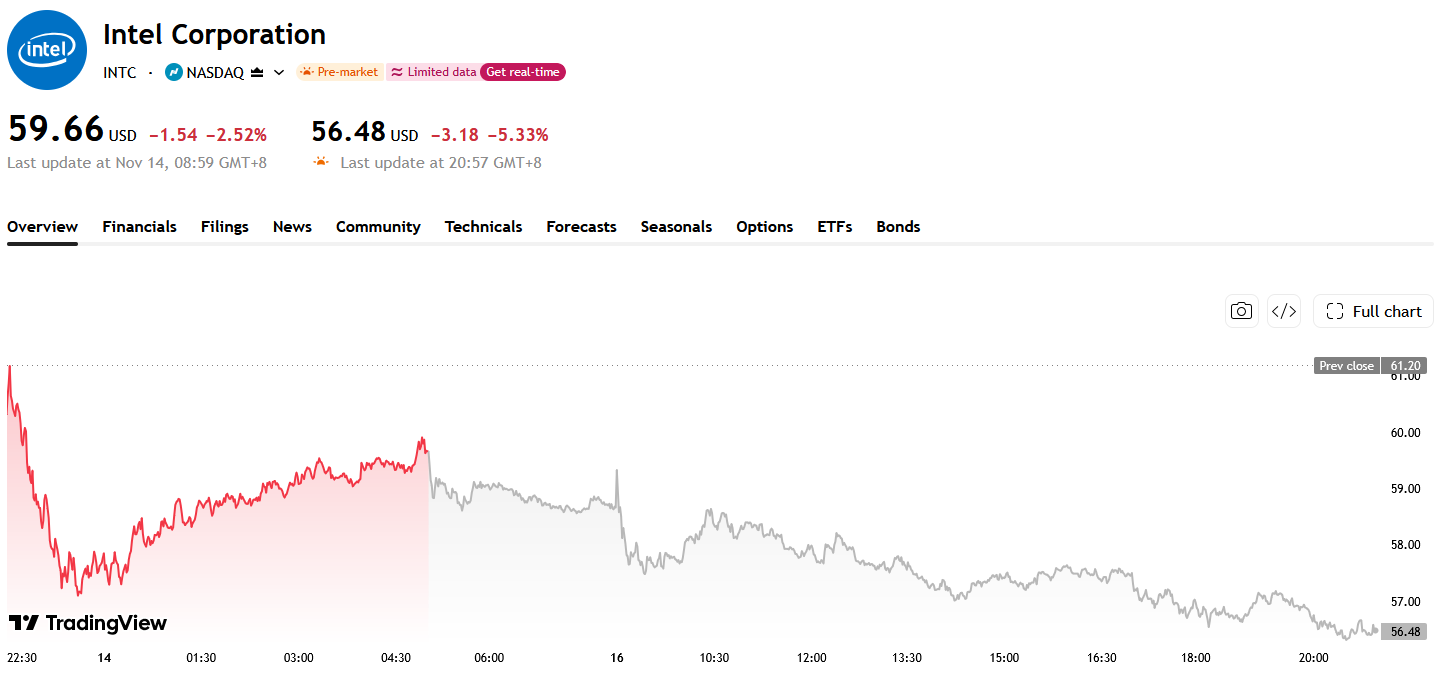
Source: TradingView
The proposed securities class action was filed on November 13 in the San Jose Division of the U.S. District Court for the Northern District of California, led by the City of Southfield Fire & Police Retirement System in Michigan. In addition to Intel, Chief Executive Officer Lip-Bu Tan and Chief Financial Officer David Zinsner were named as defendants. The plaintiffs seek to recover damages on behalf of investors who purchased Intel stock between July 23 and October 29, 2026, though no specific damages amount has been specified yet. At this stage, the claims remain allegations, and the court has not found Intel or its executives liable.
Shareholders allege that Intel failed to timely and adequately disclose the impact of the cooling PC market and channel inventory buildup on its operating performance. The complaint states that rising prices for components such as memory pushed up computer manufacturing costs, dampened end-user demand, and caused OEMs and distribution channels to accumulate large amounts of unabsorbed inventory. Under these conditions, the pressure on Intel's client business exceeded what the company had previously communicated to investors, with the negative impact even outweighing the growth brought to its data center business by the AI investment boom.
The lawsuit also targets Intel's August fundraising as a focal point of contention. The plaintiffs claim that midway through the third quarter, the company sold roughly $23 billion in stock at $95 per share, at a time when management may have already known that PC business and inventory issues were worsening. Consequently, shareholders argue that Intel had an incentive to downplay operational risks to complete the financing at a higher price. The proceeds were primarily used to support the expansion of its foundry and manufacturing operations, with the foundry transition being a key component of Lip-Bu Tan's strategy.
Intel shares plunged 28.6% on October 30, wiping out about $140 billion in market value in a single day. This followed the company's fourth-quarter revenue and earnings guidance that fell short of market expectations, alongside forecasts that PC market weakness would persist at least into 2027. Earnings results showed that third-quarter revenue from the Client Computing and Physical AI business dropped by approximately $800 million sequentially, as rising memory prices, tightening IT budgets, and customer inventory adjustments combined to depress processor demand.
The company's own regulatory filings also acknowledged that demand for PC products weakened in the third quarter compared with the first half of the year, projecting that this trend would worsen in the fourth quarter and persist into 2027. Meanwhile, tight supplies of substrates, memory, and other critical components also constrained Intel's ability to ramp up data center CPU production, preventing it from fully capitalizing on opportunities driven by growing server chip demand.
Intel has not yet officially responded to the lawsuit. Because the case was only recently filed, it will still proceed through subsequent stages, including the appointment of a lead plaintiff, the filing of an amended complaint, and motions to dismiss by the defendants.
This content was translated using AI and reviewed for clarity. It is for informational purposes only.
Recommended Articles








Comments (0)
Click the $ button, enter the symbol, and select to link a stock, ETF, or other ticker.