


SpaceX Rises Over 2% Pre-Market: Musk Says 100GW Annual Capacity Solar Cell Equipment Ordered to Support Starmind Satellite Project



AI Podcast


On November 11, Eastern Time, SpaceX partnered with Germany’s SINGULUS TECHNOLOGIES, signing an initial €60 million contract for heterojunction solar cell production lines to support the Starmind satellite project. Musk confirmed an eventual annual capacity procurement scale of 100 GW for the Bastrop, Texas facility, with the first delivery slated for the first half of 2027. This initiative aims to power orbital AI computing infrastructure, with deployment planned for as early as 2028. Investors must closely monitor equipment delivery timelines, installation progress, and the commercial realization of space-based computing services.
TradingKey - On November 11, Eastern Time, SpaceX (SPCX) rose more than 2% in pre-market trading. Earlier, German equipment manufacturer SINGULUS TECHNOLOGIES announced the signing of a supply contract with SpaceX for solar cell production equipment.
Subsequently, Musk stated on X that SpaceX had ordered heterojunction (HJT) solar cell manufacturing equipment with an annual capacity of 100 GW from SINGULUS to support the Starmind satellite project.
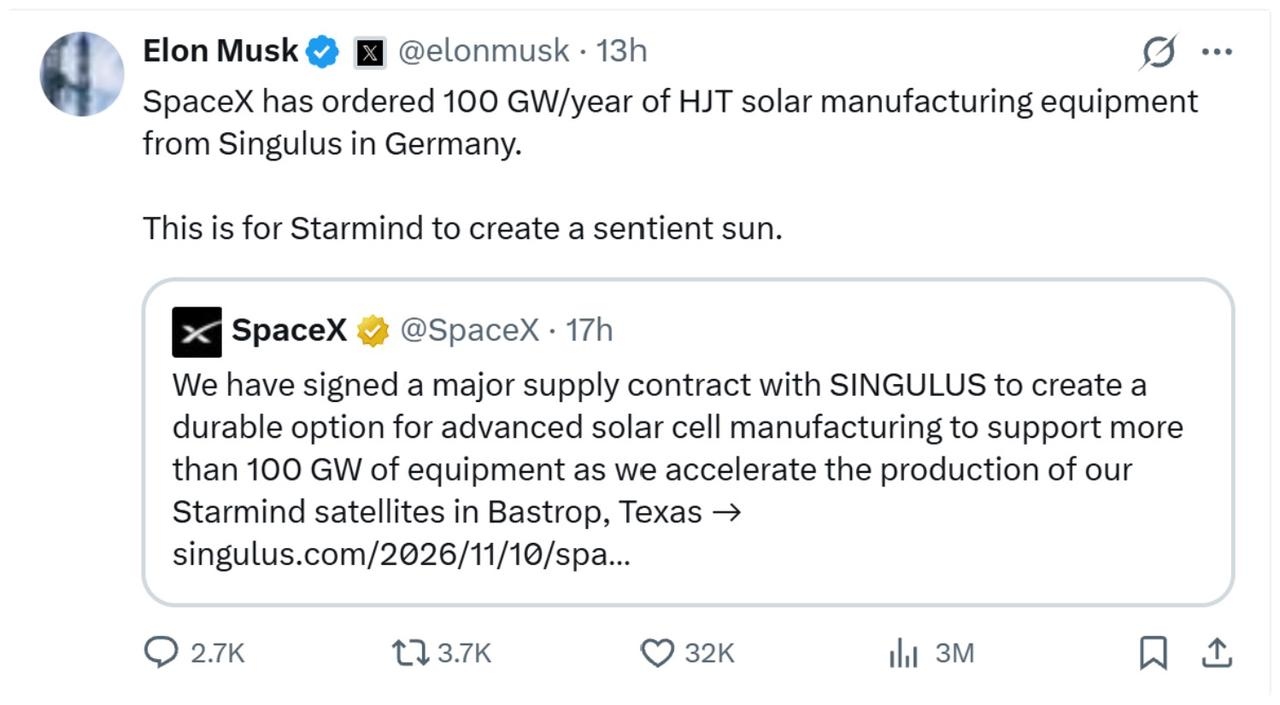
[Source: X]
This partnership indicates that SpaceX is accelerating its deployment of in-house solar cell production to provide power for Starmind satellites and to offer manufacturing capacity for expanding its space computing infrastructure in the future.
Boosted by news of the SpaceX partnership, shares of SINGULUS TECHNOLOGIES surged nearly 90% intraday on Germany's Xetra exchange on November 11, touching a high of 24 euros, up about 89% from the previous trading day's close.
SpaceX Signs Over €60 Million Contract With Singulus
According to an announcement released by SINGULUS on November 10, the company has signed a supply contract with SpaceX for HJT (heterojunction) solar cell production lines. The order value for the first turnkey production line exceeds 60 million euros, with delivery expected in the first half of 2027.
The contract is part of a strategic partnership between the two companies. SINGULUS plans to subsequently supply multiple production lines to SpaceX and develop high-performance solar cells and related manufacturing equipment.
Mike Nicolls, senior vice president of Starlink at SpaceX, stated that the collaboration will provide a manufacturing solution for producing the solar cells needed for Starmind satellites in Texas.
Regarding the overall procurement scale, SINGULUS announced that as SpaceX expands satellite manufacturing operations at its Bastrop, Texas facility, the scale of related production equipment will expand to support a level exceeding 100 GW. However, the company did not clarify whether this figure represents an annual or cumulative scale, nor did it disclose the specific number of production lines or the full delivery timeline.
Musk subsequently further clarified on X that SpaceX has ordered HJT solar cell manufacturing equipment with an annual capacity of 100 GW from Germany's SINGULUS.
It should be noted that 100 GW/year is the equipment procurement scale disclosed by Musk and does not mean that SpaceX has currently established the corresponding solar cell production capacity. The first production line is expected to be delivered in the first half of 2027, while the overall expansion schedule and actual commissioning timeline have yet to be disclosed.
Starmind Satellite Plan Drives Solar Manufacturing Expansion
The procurement is primarily intended to support SpaceX's Starmind space AI computing project. SpaceX is expanding its AI satellite production capacity in Bastrop, Texas, with plans to use orbital solar energy to power onboard AI computing equipment and transmit data via a laser communications network.
Compared with traditional communications satellites, AI computing satellites require higher power supply capacity, necessitating larger solar arrays.
Through its partnership with SINGULUS, SpaceX will acquire HJT solar cell production equipment and establish related manufacturing capabilities in Texas, enhancing its self-sufficiency in key components.
The two parties formed a strategic partnership in March 2026, with SpaceX subsequently providing financial support to SINGULUS in March and October.
SpaceX Investors Focus on Equipment Delivery and Satellite Deployment
According to IPO filings disclosed by SpaceX, the company plans to begin deploying orbital AI computing satellites as early as 2028.
Prior to that, the delivery, installation, and mass-production progress of production lines at the Bastrop plant will affect the expansion of SpaceX's solar cell supply capacity. Going forward, investors will also need to monitor the deployment scale of orbital AI satellites and whether related computing services can generate commercial revenue.
SpaceX is establishing in-house solar cell production to provide power support for space-based AI computing infrastructure. Whether equipment deliveries and satellite deployments proceed as planned will affect the project's subsequent commercialization progress.
This content was translated using AI and reviewed for clarity. It is for informational purposes only.
Recommended Articles






Comments (0)
Click the $ button, enter the symbol, and select to link a stock, ETF, or other ticker.