


SK Hynix’s $45 Billion New York Plant Investment Plan Faces Uncertainty as China Expansion Equipment Permit Unapproved



AI Podcast


SK Hynix’s planned $45 billion New York NAND investment faces uncertainty as the U.S. Department of Commerce delays export license approvals for its Dalian plant in China. The company intended to leverage Chinese capacity growth and revenue to fund its U.S. expansion. However, U.S. officials remain resistant to technology upgrades using American equipment in China, creating a policy contradiction that restricts foreign firms' ability to generate supporting capital. While the Dalian expansion is not officially rejected, persistent restrictions could force SK Hynix to adjust its funding sources, investment scale, or project timelines.
TradingKey - SK Hynix (SKHY)'s plans to build factories in the U.S. are being affected by the approval progress for equipment at its China plant. According to Reuters, citing people familiar with the matter, the U.S. Department of Commerce has not yet approved export licenses for U.S. chipmaking equipment required for the expansion of its Dalian plant in China, creating uncertainty over the company's arrangement to leverage Chinese capacity growth to support its U.S. investments.
People familiar with the matter said its subsidiary Solidigm plans to invest about $45 billion to build two NAND flash memory plants in Marcy, New York, with long-term investment potentially reaching $100 billion. Whether the Dalian expansion gets approved is a key condition for moving this investment plan forward.
Influenced by the news, gains in SK Hynix ADR narrowed from an early 4% to a low of 1.7%. As of press time, it was up 2.26% at $151.05.
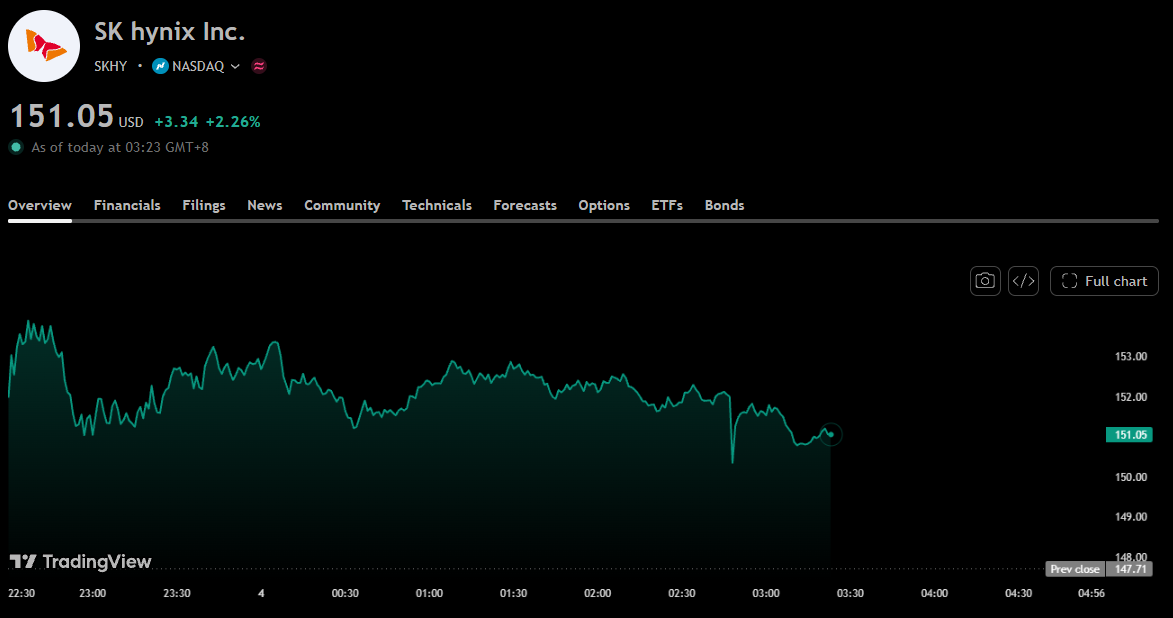
SK Hynix ADR stock price chart, Source: TradingView
China’s NAND Expansion Restricted, New Revenue and Tech Upgrades Face Delays
NAND is used for data storage in settings such as data centers. SK Hynix aims to install equipment in existing vacant cleanroom space at its Dalian plant while upgrading production technology to boost revenue, maintain competitiveness, and accumulate capital for a new U.S. plant. This arrangement was previously reported by Reuters. Reported by Reuters.
According to the latest reports, Solidigm executives have met nearly 10 times with U.S. Department of Commerce officials since late August. However, Under Secretary of Commerce Jeffrey Kessler maintained during talks last week that technology upgrades or capacity expansions through additional U.S. equipment would not be allowed.
Approval delays mean that even though factory space is available, new equipment cannot be put in place in a timely manner, potentially delaying revenue growth and production technology upgrades. This not only affects returns at the Dalian plant, but also disrupts the intended pace of capital accumulation for the U.S. project.
At present, the U.S. Department of Commerce has not officially rejected the expansion license. The two sides are also negotiating separately for the equipment licenses needed to maintain operations at the Dalian plant in 2027.
US Plant Investment Unfinalized as Equipment Permits Affect Capex Plans
This negotiation highlights the contradiction between US policy goals: attracting foreign companies to build chip plants in the US requires significant capital commitments from these firms; however, restricting equipment exports to China may constrain the existing business growth that these companies rely on to support those investments.
Solidigm remains cautious on the matter. The company stated that it is evaluating potential global locations for building NAND factories and has not yet decided on any specific proposal. As a result, both the $45 billion investment and the long-term $100 billion figure represent plans disclosed by people familiar with the matter rather than formally finalized capital expenditure commitments.
For SK Hynix, securing license approval would help boost NAND output and improve the feasibility of its US projects; however, if restrictions persist, the company may need to adjust its factory timeline, investment scale, or funding sources. What the market needs to evaluate is how much incremental earnings will be pushed back by approval delays, and whether the US expansion will consume more cash generated by other operations.
This content was translated using AI and reviewed for clarity. It is for informational purposes only.
Recommended Articles







Comments (0)
Click the $ button, enter the symbol, and select to link a stock, ETF, or other ticker.