


Oracle Stock Forecast: ORCL Breaks $123.47 Support as a $20 Billion Raise Puts Its Credit Rating in Focus



AI Podcast


Oracle shares dropped 8.76% to close at $119.22 on Monday, November 2, following a $20 billion equity and bond offering that exhausted its planned funding cap through fiscal 2030 in just five days. While robust AI demand and a massive backlog support long-term fundamentals, surging capital expenditures and negative free cash flow have heightened balance sheet and credit rating risks, bringing investment-grade status into question. Technicians indicate a bearish outlook while the stock remains below $123.47, with immediate support watched closely at $114.15 and potential downside risk toward $104.13.
TradingKey - Oracle (NYSE: ORCL) fell 8.76% to $119.22 on Monday, November 2, after announcing a $20 billion raise split evenly between new shares and bonds. Premarket trading points lower again at $117.76, just above the $116 price of the new shares.
The stock has now lost about 17.5% since its October 28 Investor Day close of $144.54 and sits about 66% below its September 2025 record of $345.72. The debate has moved from AI demand to Oracle's balance sheet, and whether it can keep its investment-grade credit rating.
A Four-Year Funding Cap Used in Five Days
At its Investor Day, Oracle said it would limit new capital-market funding to $20 billion through fiscal 2030, split evenly between equity and debt. The stock rose 10.7% that day. Five days later, Oracle used the entire amount.
It is selling 86.2 million shares at $116, an 11.2% discount to Friday's close of $130.67, raising about $10 billion and adding about 2.9% to its share count. It is also selling $10 billion of bonds in five parts, maturing from 2029 to 2046, with interest rates of 7% to 8.65%, above the roughly 6.5% its existing bonds yielded before the deal. Both offerings close on Wednesday, November 4.
The cap was meant to reassure investors, yet the stock has now given back the whole Investor Day jump and more.
Credit Rating Risk Moves to the Front
S&P cut Oracle to BBB-, its lowest investment-grade rating, on July 9. One more cut would make Oracle a "fallen angel," a company cut from investment grade to junk, the riskier tier, which can force some funds to sell its bonds. Morgan Stanley's Lindsay Tyler said, "There is a risk here that we might have two low BBB ratings for Oracle."
Credit default swaps, contracts that pay out if a company defaults, cost about 296 basis points, or 2.96% of the insured debt a year, to protect Oracle bonds on November 2, according to LSEG data. That was down from about 331 basis points on October 21, but far above Amazon's 80 and Microsoft's 56 on that date.
The Cash Gap Is Bigger Than the Raise
Oracle's capex, its spending on data centers and equipment, rose 162% to nearly $56 billion in fiscal 2026, and free cash flow, the cash left after capital spending, was negative $23.7 billion. S&P projects a shortfall of about $42 billion in fiscal 2027, roughly twice what Oracle just raised, and borrowings already stood at $125.34 billion at the end of August. Jefferies said the financing "buys time" but does not expect free cash flow to turn positive until fiscal 2029.
Fiscal Q1 revenue still rose 30% to $19.35 billion, and remaining performance obligations, signed contracts not yet booked as revenue, reached $664 billion, including a reported $300 billion contract with OpenAI, so demand is not the problem.
Stephens upgraded the stock to Buy with a $213 target, citing "improved visibility into Oracle's funding requirements and its free cash flow outlook," while Morgan Stanley's Sanjit Singh kept a Hold and $210 target, saying Oracle "still needs to demonstrate that it can expand its infrastructure on schedule while maintaining operating margins."
In my view, the backlog is real, but Oracle has to build the capacity before the revenue arrives. At about 14 times forward earnings, the stock is cheap on paper, but the market is now pricing funding risk, not demand.
Oracle Technical Analysis: 4-Hour Close Below $114.15 Could Open $104.13
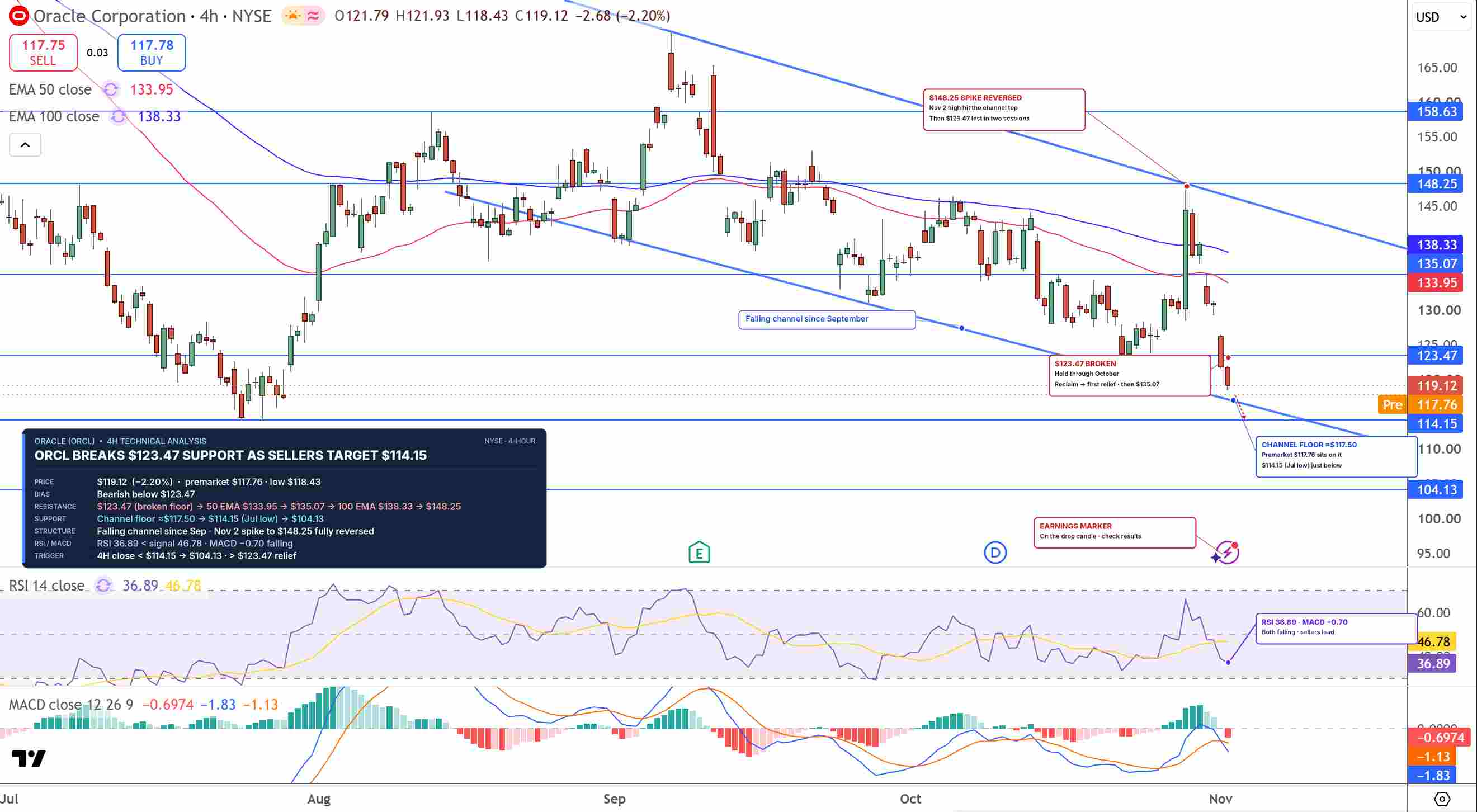
On the 4-hour chart, ORCL has broken below $123.47, a support level that held through October. That extends the falling channel, two parallel downward-sloping lines that have contained price since September. The stock also trades well below both moving averages, which track the average price over a set period, at $133.95 and $138.33, so sellers remain in control.
RSI, a momentum gauge that runs from 0 to 100, has dropped to about 37, and the MACD, a trend-following momentum indicator, has turned lower, confirming bearish momentum.
ORCL Price Chart - Source: Tradingview
On the downside, $114.15 is the next key support, near the lower edge of the channel and the July low, with the $116 offering price just above it. A 4-hour close below $114.15 could open $104.13. For buyers, a recovery above $123.47 would be the first sign of relief, with $135.07 as the next hurdle.
I'm bearish while ORCL stays below $123.47, with targets at $114.15 and $104.13.
Key Levels
- Last close: $119.22, down 8.76% on Monday, November 2 (premarket: $117.76)
- Support: $114.15, $104.13
- Resistance: $123.47, $133.95, $135.07
- RSI: 36.89 on the 4-hour chart, below the 50 midline
- Bullish trigger: 4-hour close above $123.47
- Bearish trigger: 4-hour close below $114.15
FAQs
Why is Oracle stock falling?
Oracle fell 8.76% on Monday after announcing a $20 billion stock and bond raise that used its full funding cap through fiscal 2030 just five days after Investor Day, raising concern about its cash needs and its BBB- credit rating.
What is the Oracle stock forecast now?
The bias is bearish below $123.47 on the 4-hour chart. A 4-hour close below $114.15 could open $104.13, while a recovery above $123.47 would be the first sign of relief, with $135.07 next.
Bottom Line
Oracle's AI backlog is huge, but the stock now trades on funding and credit risk. The next test is $114.15, just below the $116 offering price. I expect pressure toward that level while ORCL stays below $123.47, and a move back above it would show buyers are willing to look past the raise.
Recommended Articles






Comments (0)
Click the $ button, enter the symbol, and select to link a stock, ETF, or other ticker.