


Intel Falls Below $90 as Robotics Ban Hits Chipmaking, Stock Risks Falling Over 10% More



AI Podcast


Intel faces intense short-selling pressure and a sharp stock decline below the $90 threshold, driven by macro headwinds, rising Treasury yields, and BIS export bans on chips used in advanced robotics and automation. These restrictions threaten Intel’s foundry capacity recovery and 18A process returns, risking a further drop to the $80 technical support level, or potentially $40 if breached. Conversely, stronger-than-expected 18A customer progress in the upcoming October 29 earnings report could help reclaim the $100 psychological level and target previous highs of $130-$140.
TradingKey - Advanced Robotics Ban Hits Chip Manufacturing; Intel Stock May Fall Further to $80 Level.
Amid macro deleveraging, jumping U.S. Treasury yields, and a wave of valuation recalibration across the semiconductor sector, semiconductor and AI hardware giant Intel (INTC) has recently come under intense short-selling pressure. Its stock price has plunged continuously from its early-October highs, and after dropping below the $100 psychological level, it briefly fell below the key $90 threshold in pre-market trading today.
As the U.S. Bureau of Industry and Security (BIS) continues to expand export bans on chips used in robotics and automation, the focus of restrictions has extended beyond advanced AI computing chips to include advanced packaging, silicon photonics, and specific control chips and manufacturing equipment used in high-end industrial and humanoid robots.
For Intel, this undoubtedly directly interferes with order progress in its foundry business with certain Asia-Pacific and overseas industrial/robotics customers, raising market concerns that the recovery in its foundry capacity utilization will be prolonged. It is reported that Intel has applied to the Federal Communications Commission (FCC) for an exemption from the ban targeting foreign-made advanced robots.
Intel has poured massive capital expenditure (CapEx) into building out its 18A and future advanced processes. If export controls cause delays in foundry customer orders, it will depress returns on capital in the short term and trigger defensive deleveraging by quantitative funds, potentially driving its stock price down by more than 10%.
From a technical analysis perspective, Intel's next defensive line is around $80, which is not only an important psychological level, but also the lowest point of the pullback after reaching an all-time high—the starting point of the rebound in the second half of the year—offering strong support. It is particularly worth noting that if Intel fails to hold even this level, it means downside room will open up completely, with a high probability of falling to around $40.
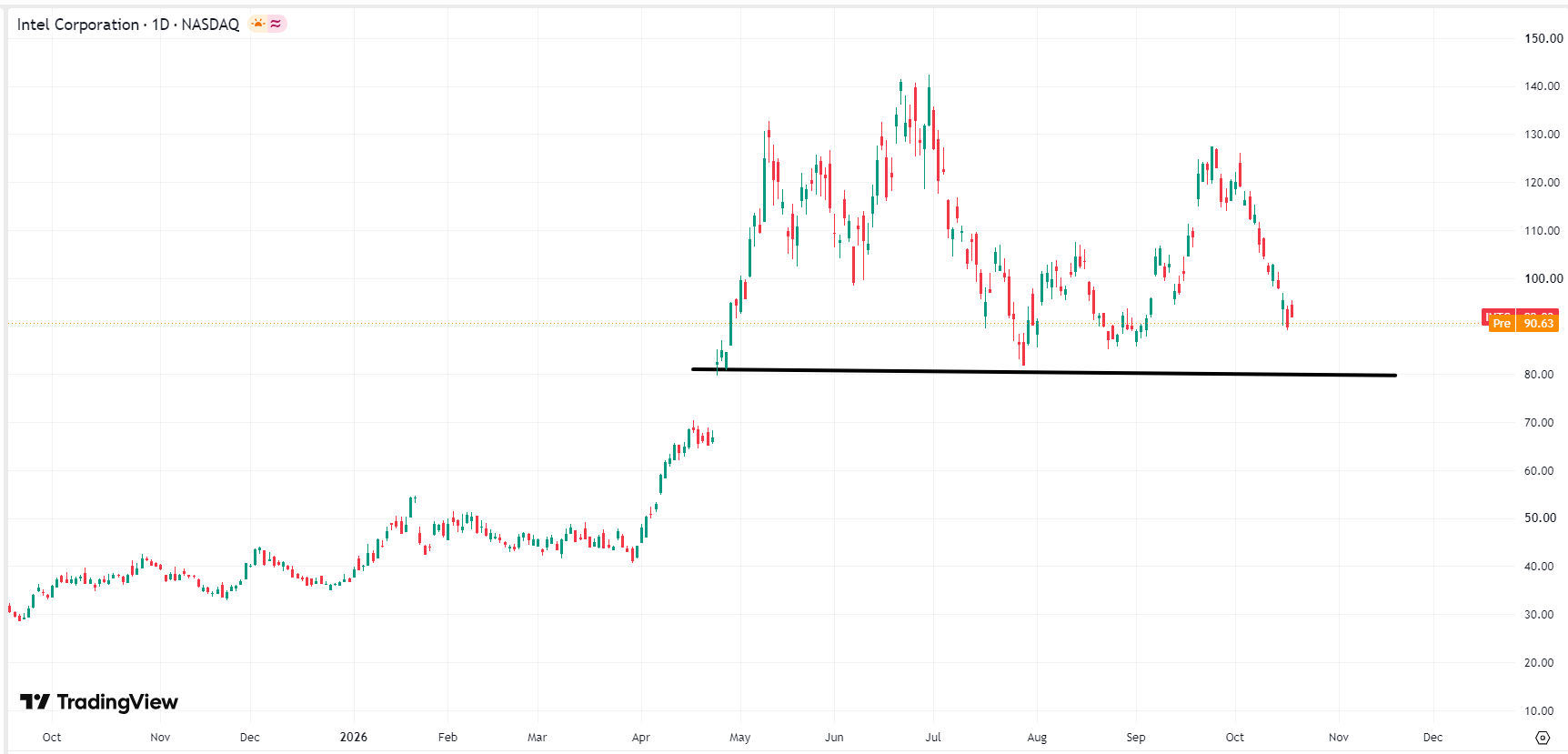 Intel stock price chart, Source: TradingView
If short-term sentiment digests the export ban headwinds, and the October 29 earnings report shows 18A customer progress exceeding expectations—driving the stock price to reclaim the $100 mark on heavy volume—it will not only signal an end to this round of shakeout, but also present a strong chance of mounting another push toward the highs of $130-$140.
This content was translated using AI and reviewed for clarity. It is for informational purposes only.
Recommended Articles










Comments (0)
Click the $ button, enter the symbol, and select to link a stock, ETF, or other ticker.