


SpaceX Fights Off European Bromo Attack as Shares Reclaim $150 and Eye $170 Short-Term Target



AI Podcast


On October 16, Eastern Time, SpaceX shares surged 2.56% in pre-market trading to reclaim the $150 level, overcoming macro inflation pressures and Europe’s newly accelerated "Project Bromo" satellite initiative. Despite long-term European competition, SpaceX maintains an insurmountable lead in launch costs, payload capacity, and over 10,000 operational Starlink satellites. Furthermore, the integration of SpaceX thrusters into Tesla’s Roadster 2.0 showcased high-margin consumer monetization potential beyond aerospace. Supported by institutional buying from major stakeholders like Morgan Stanley, this rebound bolsters market confidence, paving the way to challenge previous highs of $170–$175.
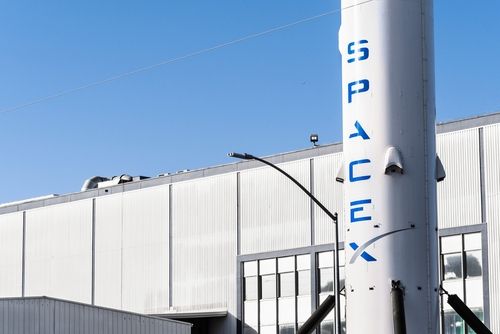
TradingKey - SpaceX Overcomes Bromo Headwinds as Stock Surges Back Above $150 Mark, Eyeing Previous High of $170.
On October 16, Eastern Time, SpaceX (SPCX) bucked the trend to surge past the $150 mark despite pressure from the $11.6 billion Project Bromo satellite mega-joint venture launched by European aerospace giants and market deleveraging pressure from macro inflation data such as CPI and PPI. In pre-market trading, SpaceX stock rose 2.56% to trade at $152.39.
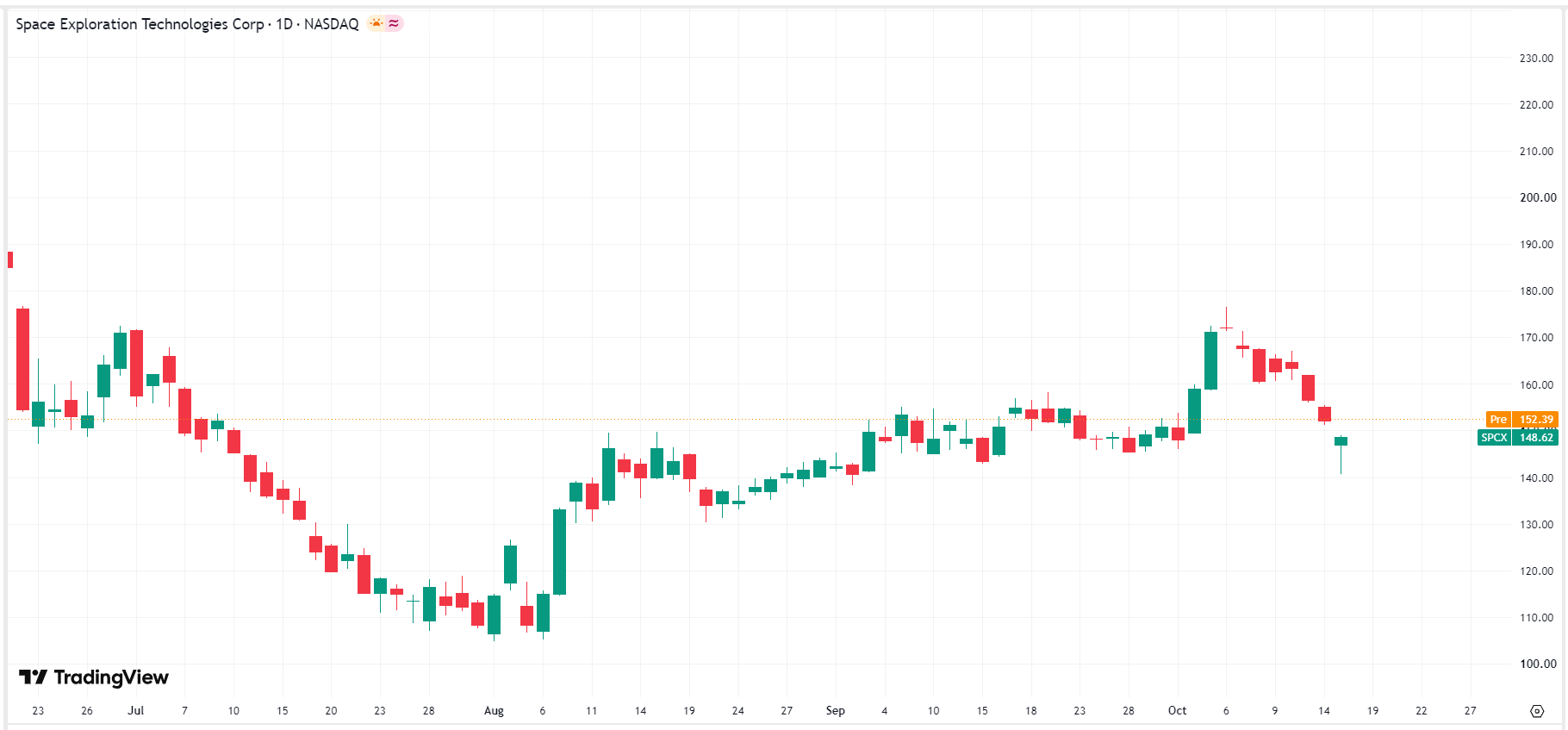 SpaceX stock price chart, Source: TradingView
Amid higher-than-expected US CPI and PPI data, the European Commission accelerated the advancement of "Project Bromo"—a project formed by Airbus, Leonardo, and Thales—aiming to build a native European satellite giant to reduce reliance on SpaceX's Starlink.
However, Project Bromo is unlikely to shake SpaceX's dominant position in the short to medium term. Currently, SpaceX relies on high-frequency reuse of Falcon 9 and the massive payload capacity of Starship to bring its per-kilogram orbital launch cost down to the lowest in the world, whereas Europe's Ariane 6 and the Bromo system still face a generational gap of several fold in launch costs and scheduling flexibility.
Furthermore, Starlink's satellites in orbit have surpassed the 10,000-unit threshold, serving millions of enterprise and individual users globally and creating strong network effects and free cash flow. Project Bromo will take at least 3 to 5 years from integration to actual deployment, making it impossible to capture its global market share in the short term. Therefore, the Project Bromo initiative will not weigh down SpaceX's stock price in the short run.
SpaceX's stock rebound was not only a recovery from an oversold condition after digesting negative CPI/PPI inflation news, but was driven even more by Tesla (TSLA) equipping its Roadster with SpaceX thrusters. Reportedly, the Roadster 2.0 features SpaceX thrusters, proving to capital markets that SpaceX does not rely solely on rocket launches and Starlink for profits, while demonstrating its derivative monetization capabilities in the consumer/high-end automotive market. As Tesla is a giant in this sector, this directly pushed SPCX stock higher in pre-market trading.
The $150 level represents a key institutional position base since SpaceX's June listing. This successful rebound confirms strong buying support from long-term institutional allocation capital such as Morgan Stanley and Wedbush near this level, while restoring bullish market confidence and paving the way for further gains to challenge the previous high range of $170–$175.
This content was translated using AI and reviewed for clarity. It is for informational purposes only.
Recommended Articles








Comments (0)
Click the $ button, enter the symbol, and select to link a stock, ETF, or other ticker.