


PTC Stock Forecast: $22.6 Billion Schneider Deal Resets the Investment Case



AI Podcast


Schneider Electric has agreed to acquire PTC for $205 per share in cash, representing a 42.3% premium over its October 2 close and valuing the equity at approximately $22.6 billion. This transaction fundamentally shifts PTC's investment thesis away from traditional metrics like Annual Run Rate growth and quarterly earnings toward deal-closing probabilities and the merger arbitrage spread. Supported by PTC's robust recurring software portfolio, strong free cash flow, and strategic AI capabilities, the acquisition is expected to close by Q3 2027, pending standard regulatory approvals and closing conditions.
PTC (NASDAQ:PTC) is due for a fundamentally new investment story on October 5, with Schneider Electric’s agreement to acquire the company for $205/share in cash. PTC’s equity value comes in at ~$22.6B and enterprise value at ~$23.7B. The offer price represents a 42.3% premium to the October 2 close of $144.03, which was the latest U.S. market close available before the October 5 regular session.
The acquisition is contingent on the standard closing conditions and regulatory approvals. This means that the main stock betas for the near-term will not be focused on growth in Annual Run Rate (ARR) or beating quarterly earnings expectations. The focus now shifts to closing probabilities, time value of money, and discount to the $205 cash offer.
Schneider Is Paying for Industrial Software Scale
Schneider’s acquisition of PTC’s Industrial Software portfolio encompassing Creo, Windchill, Codebeamer and ServiceMax is strategic. These software solutions sit alongside engineering and operational data that manufacturers require while digitizing their end-to-end workflows.
Schneider’s acquisition of PTC further implements Schneider’s vertical and horizontal software and industrial intelligence strategy. Schneider already owns AVEVA, and has been acquiring AI and data assets, including Cognite. Schneider already operated in these segments, but this acquisition allows further expansion throughout the product lifecycle and provides an additional large platform in industrial automation and engineering.
The $205 cash offer gives PTC shareholders a clear valuation. Prior to the announcement, the stock was trading down from its all time highs, and closed October 2 at $144.03. Schneider sees a 42.3% premium from PTC’s trading price, demonstrating that the market was not assigning PTC the strategic value that Schneider sees. Schneider already had a presence in these industries through AVEVA and other acquisitions, but saw an opportunity to gain an additional large platform through PTC.
The Deal Spread Becomes the Main Market Signal
The $205 offer price becomes the key short-term price level to watch, especially after PTC starts to trade. If PTC continues to trade near $205, the market believes the transaction is likely to complete with little perceived regulatory risk. Trade at a wider discount from $205 implies the market believes there is a longer time to complete the transaction, financing risk, and/or regulatory uncertainty and the transaction may not ultimately close.
This also impacts my interpretation of the stock. Prior to the announcement, I would have looked at likely technical support levels, revenue and ARR growth and free cash flow to estimate equity upside. With the agreement, the stock is likely to trade to $205 with little upside unless a competing offer is made, and potentially significant downside based on what PTC could trade for on a stand alone basis.
PTC’s Underlying ARR Was Already Improving
PTC’s ARR and revenue streams already improved, which made the deal more compelling. Additionally, the growth opportunities in PTC’s channel and system products made it an attractive target for acquisition.
PTC’s recurring software business is becoming stronger, and the company has been returning capital through share repurchases, including about $525 million of stock repurchased in Q3. Acknowledging this, let’s take a look at some of the numbers from their fiscal Q3. Constant currency ARR, excluding divested businesses, was $2.448 billion, an increase of 9.1% from the year prior, and above the management’s prior estimate of 8% to 9%. Reported ARR, excluding divested businesses, was $2.412 billion, an increase of 7% from the year prior.
ARR shows the recurring software base more cleanly than quarterly software revenues. Quarterly revenues can fluctuate based on when software licenses are recognized (ASC 606). For the full year 2026, management expects constant currency ARR growth, excluding divested businesses, to be in the range of 9.0% to 9.5%. ARR growth for Q4 2026 is also expected to be in the same range.
PTC’s strong recurring software base adds to Schneider’s strategic interest. PTC is not being acquired while its recurring business is deteriorating. Rather, the core software portfolio is improving after a portfolio simplification and sharper focus on Intelligent Product Lifecycle.
Revenue Looked Weaker Than ARR
PTC reported Q3 2026 total revenue of $600 million, down 7% from $644 million in Q3 2025. Non-GAAP operating margin dropped to 41% from 44% a year earlier. Reported EPS fell to $1.03 from $1.17 a year earlier. As reported, these numbers would indicate less strength in the quarter compared to Annual Run Rate (ARR).
PTC’s Q3 2026 results show more strength in ARR, as the reported results reflect PTC’sSubscription Accounting model as well as the effects of divestitures. PTC sold its Kepware and ThingWorx businesses to TPG earlier in 2026. Management described the divestitures as part of its sharper focus on the core CAD, PLM, ALM and SLM businesses under its Intelligent Product Lifecycle strategy. Management indicated ongoing strength in its core business, but restructuring makes period-to-period revenue comparisons less helpful than ARR and cash flow. As such, Management indicated ongoing strength in core business and that PTC was trading at an compressed valuation; therefore, the results would not impact valuation.
Cash Flow Remains a Fundamental Strength
Q3 2026 reported cash flow from operations of $261 million, an increase of 7% from $244 million in Q3 2025. Free cash flow of $249 million increased 3% from $242 million reported in Q3 2025. For the full year, cash flow from operations of $880 million was expected and free cash flow of $850 million was anticipated.
The cash flow profile of PTC is compelling. Recurring software businesses are very attractive as target investments because the predictable and stable nature of software cash flows can largely fund acquisition-related cash flows and support investment and leverage at the acquiring company. In addition, PTC’s cash flows also lessen the argument that Schneider is paying a premium to acquire a company that is still dependent on external funds to finance its growth.
Additionally, PTC had returned a significant amount of capital to shareholders prior to the acquisition. In Q3, the company repurchased about $525 million of its stock, and anticipate total buybacks for the year to be near $1.625 billion. After the acquisition agreement, those buybacks lose relevance. The $205 cash merger consideration provides the primary means for shareholders to realize value.
AI Adds Strategic Value to the Platform
PTC’s AI strategy complements where Schneider wants to go in the near term, as well. Neil Barua has underlined several times that for manufacturers to benefit from generative AI at scale, they need clean and trustworthy product data. PTC’s CAD, PLM, ALM and service systems already include a significant part of that mission critical engineering and product data.
The company has built what it calls an intelligence layer across those trusted systems, instead of developing an AI product that is disconnected from customer workflows. As a result, Schneider can build a combination of PTC’s product-lifecycle data and its own automation and industrial software. The strategic potential of this combination is more clear when considering PTC’s product-lifecycle data along with Schneider’s automation and industrial software and combining that with other data.
PTC Technical Analysis: $205 Offer Makes Merger Spread the Key Level
PTC’s close at $144.03 on October 2 is now a key level instead of a technical anchor. Before the announcement, the stock was trading above the $142.68 level, which was the breakout level, and has a rising trend of moving averages below price. In a normal setting, $149.69 would have been the key level, and $159.41 would have been the next target on the upside.
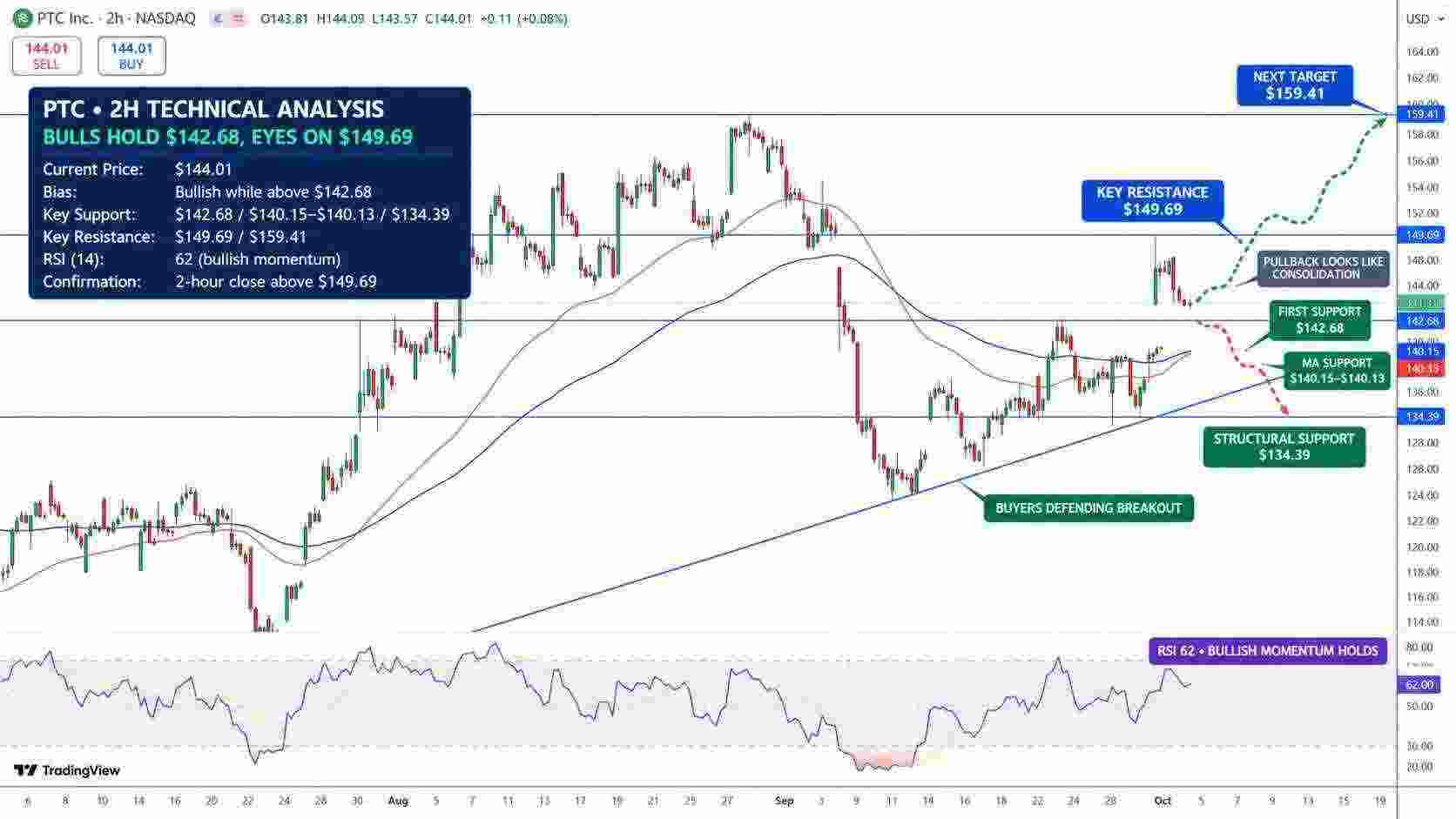
PTC Stock Price Chart - Source: Tradingview
The all cash $205 offer changes things. On Monday, once trading starts, $205 will be the key “resistance”. If PTC has a large gap up to $205, the discount to $205 will reflect how much time is left to wait to close the deal and how risky it is. Because of the offer, I think the historical technical levels of $142.68 to $149.69 are moot.
I think that after the first large move up after the deal, the market will focus more on the merger spread than on stop-loss levels. If the market is pricing in an unfavorable outcome, then the spread to $205 will give more insight into the outcome of the deal and Regulatory approval than moving averages and RSI.
Key Levels
- Unaffected October 2 Close: $144.03
- Cash Offer Price: $205.00
- Offer Premium to Unaffected Close: 42.3%
- Expected Closing Window: By Q3 2027
- Primary Near-Term Reference: Discount to $205 Market Price
- Standalone Technical Support Before the Deal: $142.68, then $140.15
- Standalone Technical Resistance Before the Deal: $149.69, then $159.41
Why is PTC stock in focus now?
PTC is in focus due to the going-private transaction announcement by Schneider Electric, which offered to acquire the company for $205 in cash, valuing the equity at approximately $22.6 billion. The announcement shifts the equity investment case from evaluating normal quarterly earnings to monitoring the completion of the transaction, the merger arbitrage spread, and related regulatory risk.
What matters most for PTC after the deal announcement?
The main focus is what happens to PTC’s equity price relative to the $205 offer price, which provides the first-order estimate of expected regulatory risk. A small discount to the $205 offer price indicates a strong expectation that the deal will be completed; however, a larger equity discount to the offer price indicates that the market is uncertain about regulatory risk, the timing of the transaction, or other deal-related concerns.
Bottom Line
PTC’s investment case has changed, primarily due to Schneider’s $205 cash offer on October 5. The $205 cash offer becomes the main valuation reference and should cap most upside unless another bidder emerges. If Schneider is the only suitor, PTC’s stock should move closer to the offer price, and PTC’s earnings multiples should become less important. The 42.3% premium is large enough that the new technical picture should dominate the previous one.
PTC’s fundamentals are sound. Cash flow is strong, AI is playing an increasing role in PTC’s products, and ARR is growing. From here, the deal has pushed the funding picture to the forefront. The main question is how much of the $205 consideration is baked into PTC’s share price? Most importantly, how much of the offer price is priced in before the deal closes? The main question is no longer can PTC break $149.69, the share price prior to Schneider’s offer.
Recommended Articles








Comments (0)
Click the $ button, enter the symbol, and select to link a stock, ETF, or other ticker.