


Levi Strauss Stock Forecast: Can DTC Growth Lift LEVI Ahead of Q3 Earnings?



AI Podcast


Levi Strauss enters its fiscal Q3 earnings following strong Q2 results, driven by 8% organic revenue growth, improved margins, and surging direct-to-consumer (DTC) sales, which prompted an upward revision of full-year guidance. The company appointed John Vandemore as CFO to advance its DTC-focused strategy. Financially, Levi boasts robust liquidity and increased free cash flow, supporting dividend hikes and share buybacks. Key risks include tariff pressures, currency volatility, and macroeconomic headwinds. Technically, the stock is attempting a rebound above $19.17 support, with a decisive breakout past $21.72 required to confirm a broader bullish trend reversal.
Levi Strauss & Co. (NYSE:LEVI) starts October with the street looking ahead to next week’s fiscal Q3 print and a recently announced change to the company’s financial leadership team. With the stock finishing October 1 at $19.92, up 1.12% on the day, and following a September largely spent trading around the $20 level, the stock remains well off its summer highs. The coming report will be an important catalyst to create a broader rerate on the stock if its growth in direct to consumer and stronger full year guide become bid.
In the interim, there has been progress on the operating front that has not been fully reflected in the stock. The company delivered broad-based revenue growth and improved margins in Q2, leading to better cash flow and continued strength in DTC. Additionally, management bumped up their full year guidance. The company needs to continue to follow that path into Q3 with the October report.
New CFO Appointment Supports the Next Growth Phase
Levi Strauss Appoints John Vandemore as EVP and CFO starting November 1. He most recently served as CFO of Skechers for nine years and previously held roles in operations. Levi’s CEO Michelle Gass stated Vandemore has the expertise to assist Levi in accomplishing its strategy in building a Direct to Consumer (DTC) model, as well as other next-stage growth initiatives.
The appointment occurs during the transition of current Chief Financial and Growth Officer Harmit Singh's retirement. As part of Singh's transition, he will remain in his current role until Vandemore joins, and work as a special adviser through November 30. For investors, the leadership changes signify Levi's push to increase its retail and digital offerings and protect its margins.
October 7 Earnings Are the Next Major Catalyst
Levi Strauss will release fiscal Q3 2026 results on Wednesday, October 7 for the quarter ended August 30. The results will be released after market close and management will host an earnings call at 5:00 p.m. ET. At the time of writing, results had not been released and this remains a true pre-earnings preview.
We will learn in this report if the positive first-half momentum continued into the third quarter. In this preview, I will analyze reported and organic revenue growth, DTC comparable sales, e-commerce and gross margin. I will also pay attention to management's full year guidance. An EPS beat would be less persuasive if DTC sales significantly slowed or tariff pressure caused EPS to contract more than expected.
Q2 Established a Strong Fundamental Base
Levi posted $1.562 billion in Q2 revenue, a 6% organic revenue growth and an 8% reported growth. Operating margin improved to 7.8% from 7.5% and adjusted EBIT margin improved to 9.0% from 8.3%. Adjusted diluted EPS improved 27% to $0.28 and net income from continuing operations improved to $95 million.
Geographic performance was broad-based. The Americas region reported 9% revenue growth, including a 5% increase in the U.S. The Asia region reported 10% revenue growth and 12% organic revenue growth. Beyond Yoga reported a 16% growth and provided additional revenue growth from Levi's core denim business. Europe reported negative organic revenue growth, but management attributed that to shipment timing from the prior year's distribution center transition.
DTC Is Becoming the Core Growth Engine
Levi's reported a 11% increase in DTC revenue for the second quarter, driven by 8% organic growth in DTC (direct-to-consumer) revenues. DTC channels recorded a 6% increase in comparable sales. The company's strategic shift to focus on digital and retail channels is paying off, and DTC sales accounted for 51% of the company’s total sales during the quarter.
This is important because traditionally, DTC channels have allowed Levi's to better control pricing and merchandising as well as build and develop direct-to-consumer relationships. Healthy wholesale channel growth of 5% reported and 3% organic also indicated the company's focus on DTC is paying off. I believe the stronger setup is one where DTC growth is faster while wholesale remains stable to support scale.
Margins Need to Hold as Tariff Pressure Builds
Levi's reported an improved gross margin for the quarter by 10 basis points to 62.7%. The company attributed the improvement to lower product costs and strategic price actions. Adjusted EBIT margin also improved to 9% from 8.3% for the same period last year. Management expects the full-year Adjusted EBIT margin to be about 12% (60 basis points above the prior year).
Lower product costs helped Q2 gross margin, while the risks are that foreign-exchange rate volatility and tariffs increase. The next earnings release is expected to give more clarity on if product costs and price actions are helping to protect margins, especially with ongoing inflationary pressure.
Cash Flow and Inventory Add Flexibility
At quarter end, Levi had $849 million in cash and about $1.8 billion in total liquidity. Cash and short-term investments totaled about $978 million, up about 33% from the same time last year. Adjusted free cash flow was $230.9 million, an increase of $84.9 million from the previous year. Management can allocate capital toward dividends, share buybacks, and further growth.
During the quarter, the board of directors approved a 14% increase in the quarterly dividend, giving shareholders a dividend of $0.16 per share. The company continued the $200 million accelerated share repurchase program launched in Q1, which was expected to settle in Q3. Management also has $240 million available to repurchase shares under the existing authorization.
Raised FY2026 Guidance Sets a Higher Bar
After the release of the second quarter report, Levi raised the expected growth of reported revenue for fiscal 2026 to 7.0% to 7.5% from 5.5% to 6.5%. Organic revenue growth expectations were also raised to 5.5% to 6.0%. Management also raised expected adjusted diluted EPS to $1.46 to $1.52. Gross margin expectations were also raised to slightly more than last year. Expected adjusted EBIT margin was also expected near 12%.
Management has more confidence in the future outlook, but it increases the expectations for Q3. Earnings released on October 7 will give insight into management's confidence and future expectations. Sustained or increased expectations for durable earnings growth will help justify its premium valuation.
Cyber Incident Did Not Disrupt Operations
Levi disclosed in August that an unauthorized third party gained access to three employees' company-issued computers through social engineering. They said certain corporate information was accessed and exfiltrated. They said that there was no consumer data on the computers, and said that there was no interruption to their business operations. Management said that they do not expect this to have a material impact on the company.
The incident does create some legal and compliance costs, and is worth monitoring. From their filing, this looks to be more of an administrative issue rather than an issue worth including in my earnings thesis.
Levi Strauss Technical Analysis: LEVI Defends $19.17 Trendline as RSI Recovers
Levi Strauss & Co. closed at $19.92 on October 1, 2026, rebounding from $19.17. I am watching the March lows rising trendline support which has been defended throughout the selloff since the August highs in the $25+ range. Levi's still trades below the major moving averages, therefore further recovery is required to confirm the trend.
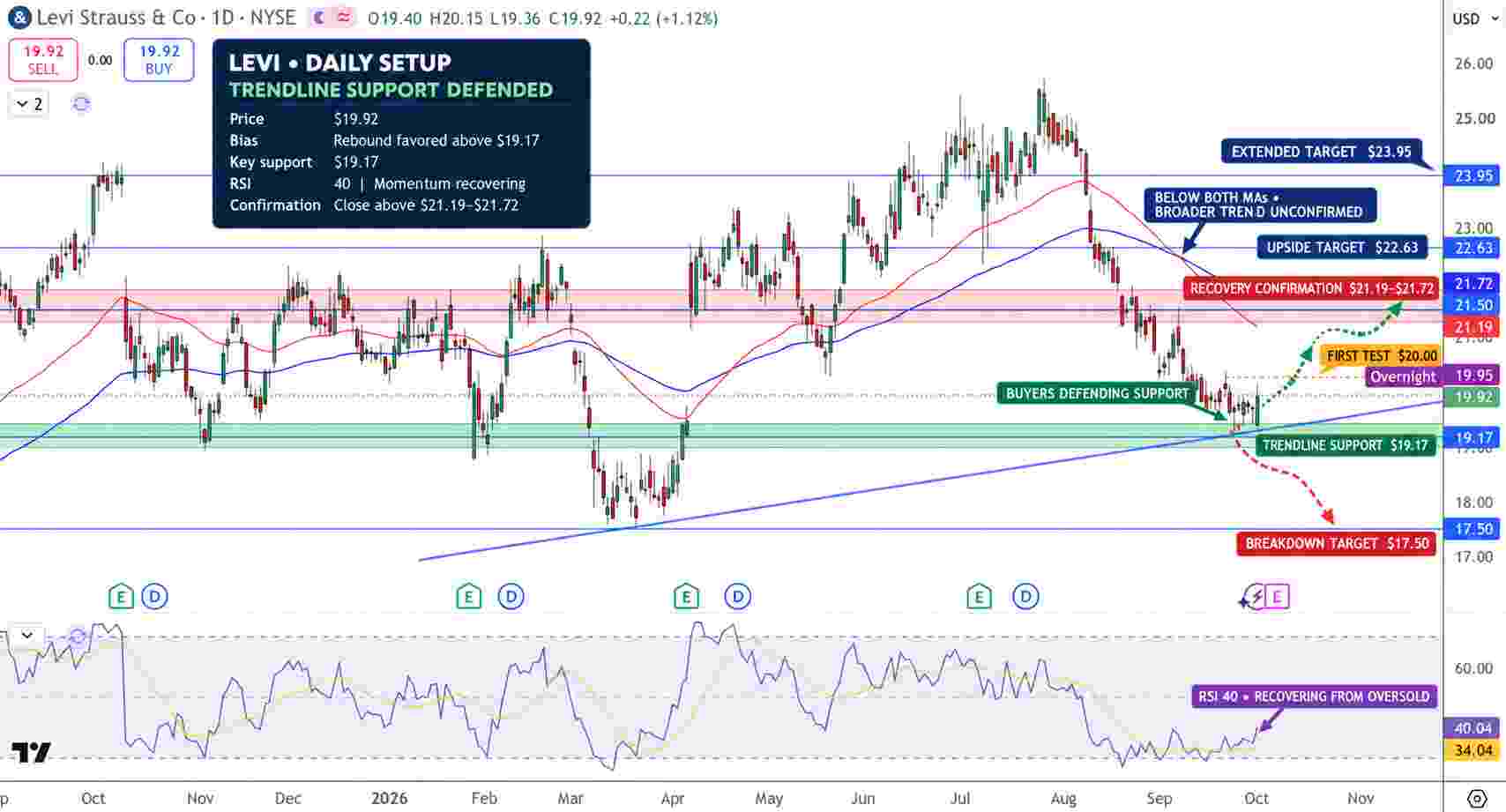
Levi Strauss Price Chart - Source: Tradingview
RSI has recovered from lows in the 30s and 40s and is above the signal line in the 30s, but is still below the neutral level of 50. The first major resistance levels are in the $20 range, with the 50 day MA in the mid $21 range and horizontal resistance in the $21.50-21.72 range.
A move above $21.72 would potentially confirm the rebound and target the $22.63 range above, with the next significant levels around $23.95. If the support at $19.17 and the rising trendline are breached, then the downside target would be $17.50.
I believe that as long as support at $19.17 is defended that the overall trend would favor a rebound, however, confirmation is needed by a move above the 21.19-21.72 range.
Why is Levi Strauss stock in focus now?
Levi is in the spotlight after it posted better-than-expected results in Q2; the results led to a surge in DTC revenue, improved margins and free cash flow, as well as an upgraded outlook for the rest of the year. The company has been transforming into a more DTC-focused company, appointing a new CFO in John Vandemore to oversee the company’s finances during the transition.
What level confirms a stronger LEVI recovery?
A daily close above $21.72 would confirm the reclaimed moving average and the horizontal resistance level and strengthen the bullish case for $22.63. A close below $19.17 would weaken the rebounding case and target $17.50.
Bottom Line
Levi enters Q3 with strong operating results, despite what the stock price reflects. Strong DTC results and a surge in revenues across all sectors of the business, as well as double-digit DTC revenue growth and free cash flow, drove the upgrade in management’s outlook for the year. Possible threats for the company remain tariff wars, and potential slower consumer demand.
In the short-term, LEVI is trying to build a rebound from $19.17. Until it breaks above the resistance level of $21.19-21.72, the overall rebound remains questionable. Maintaining the current support level keeps the overall rebounding view positive, and a break below $19.17 would bring the previous bearish view back.
Recommended Articles








Comments (0)
Click the $ button, enter the symbol, and select to link a stock, ETF, or other ticker.