


Constellation Brands Stock Forecast: Beer Demand Faces a Key Q2 Earnings Test



AI Podcast


Constellation Brands prepares to report fiscal Q2 2027 earnings on October 6 amid a 13.5% stock drop since August 31. Investors are closely monitoring beer depletions—particularly for key brands Modelo and Corona—alongside management’s ability to protect margins against logistics and marketing cost pressures. While the company projects strong operating cash flows of $2.4 to $2.5 billion and trades at an attractive forward P/E of 9.8, technical indicators show a persistent bearish trend with the RSI at 25. The upcoming earnings report will serve as a critical test for demand stability and full-year guidance validation.

Constellation Brands (NYSE: STZ) releases fiscal Q2 earnings on October 6. The stock closed at $112.99 on October 1, down 0.06%. It closed at $130.62 on August 31. That’s a 13.5% drop. The August 31 close came before management’s September 8 Barclays commentary highlighting a mixed consumer backdrop and expected gross-margin pressure in the second half of fiscal 2027. Management’s current fiscal 2027 guidance calls for beer net sales growth between a 1% decline and a 1% increase, with beer operating margin of 37% to 38%.
Tuesday’s Earnings Will Test Demand and Guidance
According to current company filings, Constellation’s 2025 Restructuring Initiative is expected to yield over $200 million in net annualized cost savings by fiscal 2028. Given these cost savings and its ongoing initiatives to improve its beer volume mix, prices, and its wholesaler channel, Constellation is focused on protecting its margin profile in fiscal 2027. We will get a clearer picture of Constellation’s effectiveness during its earnings call on Tuesday.
Constellation Brands will release fiscal Q2 2027 results on Tuesday, October 6, after U.S. market close. Management will hold a conference call on Wednesday, October 7 at 8:00 a.m. ET, or 12:00 p.m. GMT. The company ended its fiscal Q2 2027 on August 31, and results were not released when this article was written. Investors should watch for depletions, trends in shipments, operating margins, and cash flows and determine if management holds its full-year 2027 guidance.
According to estimates, the beer segment will only marginally improve earnings, and, as a result, the quality of the report may carry more weight than minor headline surprises. I will focus on depletions since they measure sales from distributors to retailers, which gives a more precise indication of demand than shipments. A report with beat expectations but with weaker depletions and/or negative guidance would provide very little evidence of a sustainable sales recovery.
September Commentary Highlighted Margin Pressure
At the September Barclays conference, management discussed factors that would negatively impact margins during the second half of fiscal 2027. This includes, inflationary pressures on logistics and commodities, as well as further investments in marketing which is expected to negatively impact operating margins. Despite these margin pressures, CFO Garth Hankinson, expressed confidence in the full year framework, including, gross margin framework.
This is important because it sets an earnings bar, and cost savings may help offset inflation. However, it becomes increasingly difficult to protect the bottom line with flat to declining top line. I am looking for Tuesday’s report to show management can guard margins by means other than discounting and cutting marketing investments. I have a significant amount of faith in management. However, current consumer demand is incongruent and unpredictable.
Q1 Showed Earnings Growth Despite Lower Reported Sales
In the latest reported quarter, fiscal Q1 2027, net sales decreased 3% to $2.433 billion. Comparable organic net sales increased 3% and reported operating income reached $845 million. Comparable operating income reached $834 million and comparable EPS was $3.43, an increase of 7%.
Differences between reported and organic numbers reflect the impact of portfolio divestitures. During the call, management attributed the difference to divestitures of some of the lower performing segments. I am looking for the next reported quarter to maintain growth and stability while the beer portfolio stabilizes.
Modelo and Corona Need a Broader Recovery
The first quarter of fiscal 2027 was a positive one for Constellation’s beer business, with 2% net sales growth, a 1.8% increase in shipments, and an average selling price growth of 2%. Total depletions were down 0.3%, with Modelo Especial down 2% and Corona Extra down 5%. Other models showed positive growth, with Pacifico up 21%, Modelo Chelada brands up 6%, and Victoria up 14%.
With Modelo and Corona still showing decreases, a broad recovery has not taken place, meaning the positive growth of some of STZ’s smaller brands has not made up for the large declines in Modelo and Corona. I would become more bullish if total depletions for the quarter for both Modelo and Corona started to increase, showing a broader recovery.
Wine and Spirits Needs to Turn Organic Growth Into Profit
Wine and Spirits reported a 47% decrease in net sales due to the sale of various brands. However, the company did report a 8% increase in organic sales and a 6.6% increase in total depletions. The remaining business showed underlying improvements in demand. The key issue is profitability, as the management team’s fiscal 2027 estimates project a segment level operating margin of only 5% to 6%.
Positive growth for Wine and Spirits has the potential to increase overall earnings quality for Constellation Brands. Tuesday’s report should offer additional information to support or refute this theory. Given the projected improvement in operating income, shareholders should be interested in growth more so than the positive organic sales growth reported this quarter.
Cash Flow and the Dividend Add Support
Constellation's 2027 outlook projects operating cash flow between $2.4 billion and $2.5 billion and free cash flow between $1.6 billion and $1.7 billion. The company also declared a Class A dividend of $1.03 per share in June, which comes to an annual rate of $4.12. At the October 1 price of $112.99, the annual dividend yield was approximately 3.65%.
Class A shares are currently yielding 3.65%, and the outlook on free cash flow is positive. Investors are waiting for demand to improve. Constellation returned more than $400 million to shareholders in the form of a dividend and share buybacks in the first quarter. The cash flow generation is strong despite higher costs and investments in capacity and marketing.
Valuation Has Become More Interesting
At the October 1 price of $112.99, Constellation's stock was trading at about 9.8 times expected fiscal 2027 earnings per share, using the midpoint of the company's guidance of $11.20 to $11.90. Stock Analysis also suggests a forward P/E ratio of 9.6, which is well below Constellation's historic valuation.
The stock's current valuation is 9.8 times expected fiscal 2027 earnings, and is trading below historic valuation. A decline in demand is always a risk. I believe the valuation is more favorable, and supported with stable margins and improving depletions, it would support the discounted valuation. A decline in demand, or a cut to fiscal 2027 guidance would undermine the view that the operating risk is already embedded in the valuation.
Constellation Brands Technical Analysis: STZ Tests $111.78 as RSI Signals Oversold Conditions
Closes as of October 1st showed Constellation at $112.99. STZ continues to trade below both major moving averages and continue to make new lows and keep the trend lower in place. What is interesting at the moment is how closely price is testing the $111.78 - $111.74 zone after an extended move down from the August recovery highs in the $135 area.
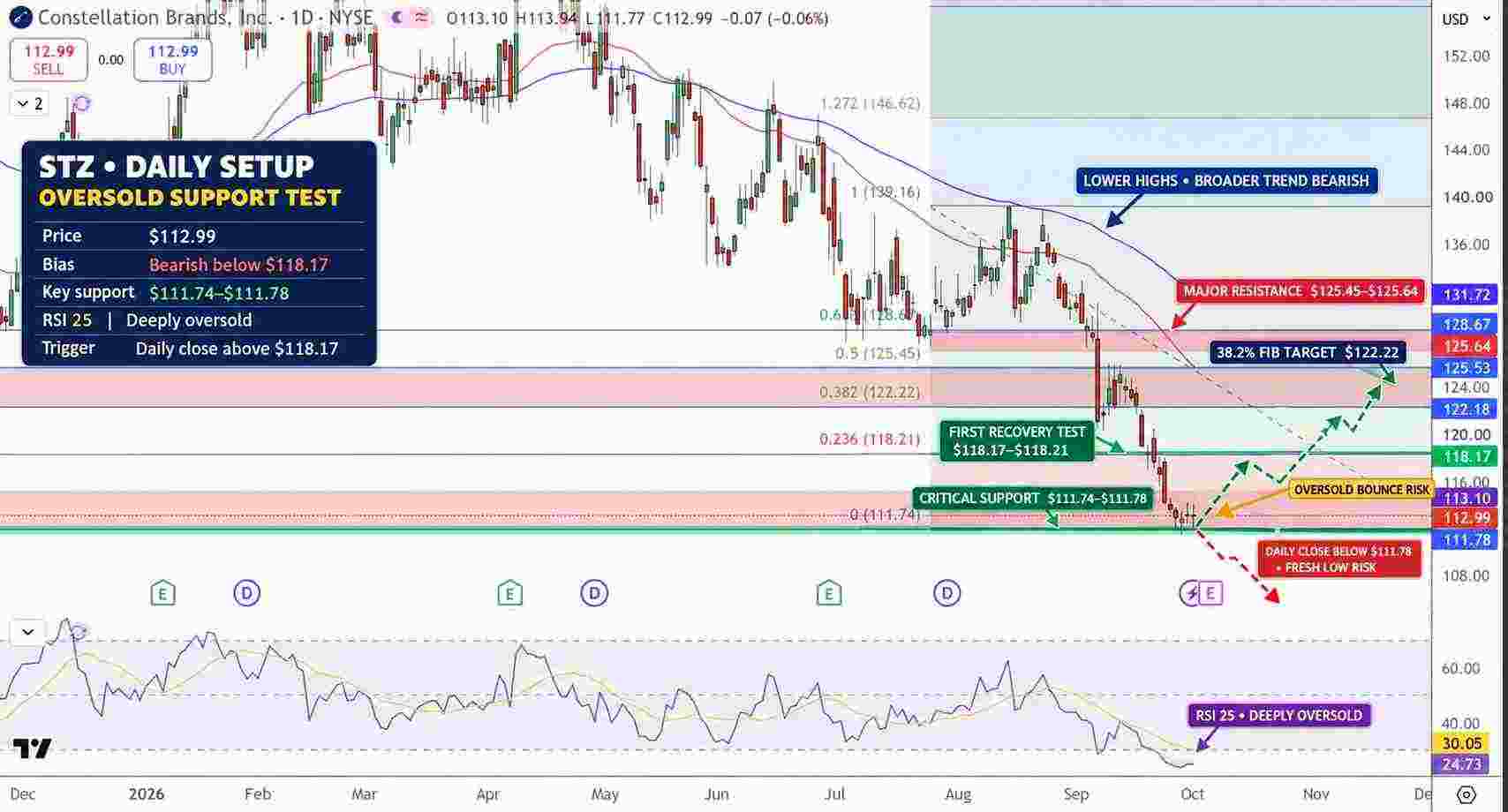
Constellation Brands Stock Price Chart - Source: Tradingview
Relative Strength Index (RSI) is sitting at 25, well below the signal line at 30 and in oversold territory. The signal line dip is a representation of the prevailing trend and with the decline still in force, a bounce from the support would only be a retrace and not a change in the longer term trend. Oversold condition do not necessarily always mean a bottom has been put in, so price action still remains the most important factor. A bounce from support is technically more relevant than the RSI line itself.
Immediate support is at $111.78. A close below this level would be bearish and open the door for new lows. For the buyers, immediate support is $111.78. Resistance is at $118.17 and $118.21. Next is the 38.2% Fibonacci level at $122.22, and the stronger resistance at $125.45 to $125.64.
My base case remains bearish as long as STZ trades below $118.17, but the extremely oversold condition of the RSI makes a rebound possible. A hold of $111.78 supports a rebound to $118.17 and $122.22, and a close below $111.78 makes a move to lower levels likely.
Key Levels
- Latest completed close: $112.99
- Major support levels: $111.78 to $111.74
- Major resistance levels: $118.17 to $118.21, $122.22, and $125.45 to $125.64
- RSI: approximately 25, extremely oversold
- Recovery trigger: Close above $118.17
- Breakdown trigger: Close below $111.78
Why is Constellation Brands stock in focus this weekend?
Constellation Brands is set to report fiscal Q2 results on Tuesday, 6 October after market close. The stock has declined and weakness in beer depletions have persisted. Eager investors will look to see if management is able to preserve their full-year guidance on margins and cash-flows and show progression with respect to demand with the Modelo and Corona portfolios and the overall beer business.
What level confirms a stronger STZ recovery?
A move and close above $118.17 would first show a minor change in the status quo. A close below $111.78 would confirm that the bearish trend is extending.
Bottom Line
Constellation Brands has a lower valuation, cash-flow and dividend business, but still needs to demonstrate that demand is stabilizing for their beer portfolio. Q1 showed better organic trends than reported sales, however pressure persisted for the Modelo and Corona brands and management expects cost pressures for the second half of the year.
Tuesday’s earnings report will be the main catalyst to provide demand data, support guidance and margins, and display depletions. A demand weakness would make the low valuation even less appealing. Technically STZ is bearish below $118.17, but is heavily oversold and could see a bounce to $118.17.
Recommended Articles








Comments (0)
Click the $ button, enter the symbol, and select to link a stock, ETF, or other ticker.