


Kioxia Stock Price Forecast: Can Japanese Memory Giant Keep Rising After Stock Split Amid Growing AI Storage Demand?



AI Podcast


Kioxia Holdings reported robust first fiscal quarter results, with revenue surging 415.5% year-over-year to 1.767 trillion yen and an operating margin of 71.9%, driven by strong generative AI data center demand and rising NAND prices. The company announced a 3-for-1 stock split effective October 1, lowering the capital required per lot. While upcoming second-quarter projections remain optimistic, future valuation depends heavily on sustained cloud procurement, potential supply expansions, and upcoming financial results. Risks include margin pressure from weakened product prices, pending litigation provisions, and unconfirmed mass production schedules for advanced technologies.
TradingKey - As of the Tokyo stock market close on September 24, Kioxia Holdings (285A) stood at 54,580 yen (approximately $345.62), up 0.02%, down about 51.6% from its year-to-date high of 112,700 yen set on June 22. NAND prices, data center SSD demand, and second-quarter financial results are the main factors influencing the company's subsequent valuation.
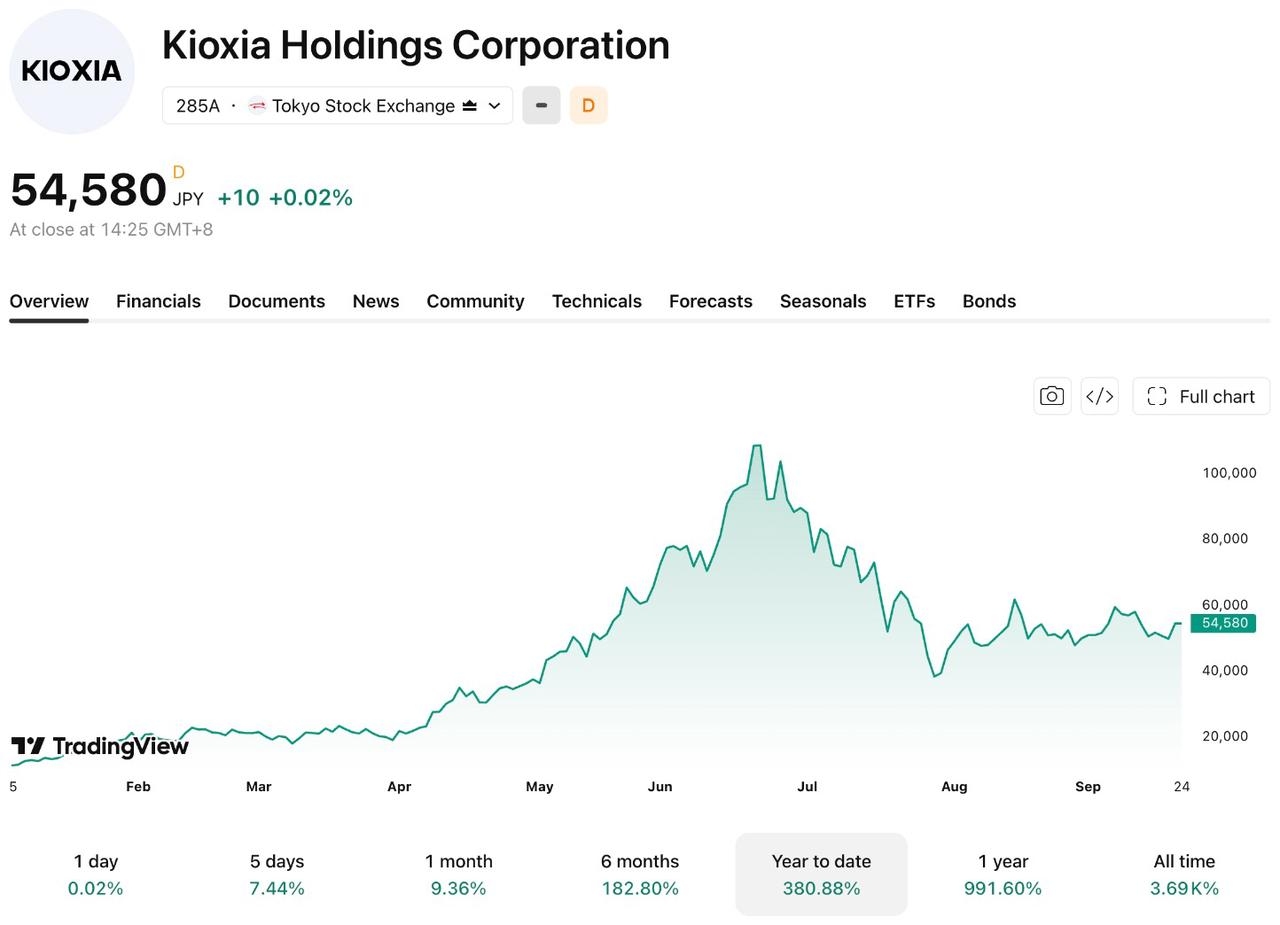
[Source: TradingView]
Kioxia will implement a 3-for-1 stock split with September 30 as the record date, taking effect on October 1, with split-adjusted shares trading from September 29.
Calculated statically based on the September 24 closing price, the post-split reference price per share is approximately 18,193 yen. The stock split will not directly alter the company's market capitalization or the theoretical value of shareholders' holdings; as the trading unit remains at 100 shares, the capital required per lot will be reduced to about one-third of the original amount.
NAND Price Increases Drive Kioxia Profit Growth
For the first fiscal quarter ended June 2026, Kioxia reported revenue of 1.767 trillion yen, up 415.5% year-over-year; operating profit was 1.270 trillion yen, net profit attributable to shareholders of the parent company reached 842.2 billion yen, and the operating margin reached 71.9%.
Earnings growth was mainly driven by rising demand from generative AI-related data centers, which boosted NAND average selling prices and shipment capacities, while the yen's depreciation also exerted a positive impact. Meanwhile, provisions for litigation losses and share-based compensation expenses offset part of the profit growth.
Kioxia expects second fiscal quarter revenue to be 2.39 trillion yen, up 35.2% quarter-over-quarter; operating profit is projected at 1.89 trillion yen, up 48.8% quarter-over-quarter. The company expects data center demand to remain strong, continuing to support revenue and profit growth.
The operating margin for the first fiscal quarter has reached a high level in the current memory cycle. If cloud service providers slow their procurement growth or major manufacturers expand NAND supply, product prices and profit margins could come under pressure.
Can AI Data Centers Deliver Sustainable Growth?
As AI applications expand from training to inference, the scale of model data and KV cache grows, driving up demand for enterprise SSDs. Kioxia plans to raise the sales share of data center and enterprise markets to over 60% in the medium to long term, but has not yet set a specific completion year.
Kioxia's 10th-generation BiCS FLASH adopts a 332-layer structure and utilizes CBA and OPS technologies, achieving a NAND interface speed of 4.8 Gbps and a bit density 59% higher than that of the 8th generation.
Sampling of the 1Tb TLC product has begun, which will primarily be used for enterprise and data center SSDs in the future and is planned for production at Fab2 of the Kitakami plant. The product remains in the sample validation stage, and mass production timing as well as final specifications have not yet been announced.
To expand long-term supply capacity, Kioxia and SanDisk (SNDK) plan to invest over $31 billion, or approximately 5 trillion yen, in Japan through 2032 for the Yokkaichi and Kitakami production bases as well as related infrastructure and technology. The plan is conditional on receiving support from the Japanese government, and specific investment details and production schedules have not yet been disclosed.
Can Kioxia Keep Rising After Stock Split?
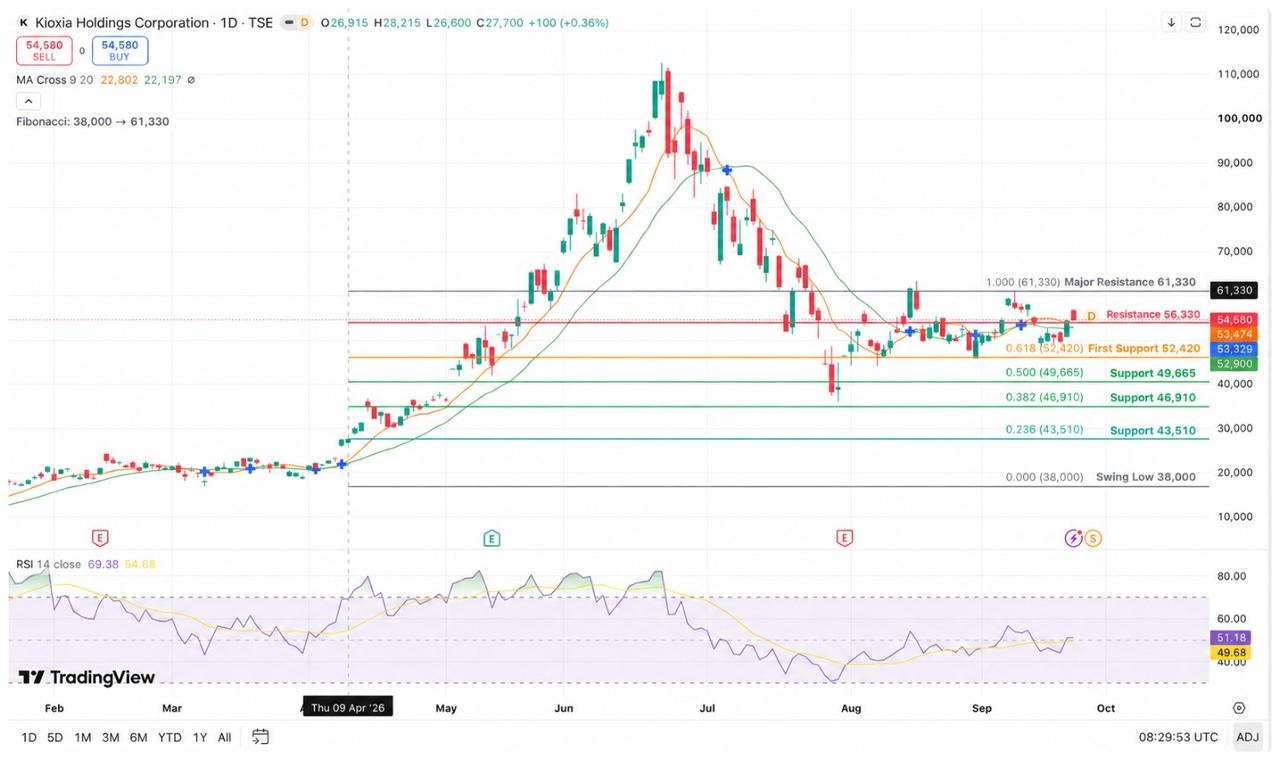 [Source: TradingView]
Drawing Fibonacci retracement levels from the recent low of 38,000 yen to the rebound high of 61,330 yen yields the following key levels:
- Overhead resistance: 56,330 yen, 61,330 yen
- Primary support: 52,420 yen
- Subsequent support: 49,665 yen, 46,910 yen, and 43,510 yen
- Key low: 38,000 yen
The current stock price stands at 54,580 yen, positioning it between the 0.618 and 0.786 retracement levels. If it breaks out and holds above 56,330 yen, the stock price may retest 61,330 yen; if it falls below 52,420 yen, it could retreat to around 49,665 yen.
From recent price action, around 54,000 yen serves as short-term support, while 56,330 yen is the primary resistance; on a heavy-volume breakout, the stock price could further test the 60,000 to 61,330 yen range.
Based on a 3-for-1 stock split, this corresponds to 18,000 yen and 19,000 to 20,000 yen post-split. Split-adjusted shares will begin trading on September 29, and historical stock prices and technical levels must be adjusted on the same basis for comparison.
The stock split will reduce the price per share and the minimum trading lot size, but will not alter Kioxia's revenue, profit, or cash flow. Whether the stock price can continue to rise still depends on second-quarter financial results, NAND prices, and data center SSD demand.
Kioxia is also preparing an offering of American Depositary Shares representing its common stock, though the listing timing, exchange, and structure have not yet been determined. If completed, it will provide overseas investors with a new trading channel.
If second-quarter results meet company guidance while NAND prices and data center demand remain strong, the stock price may find fundamental support. Conversely, if product prices weaken or earnings fall short of expectations, even the lower trading threshold from the split will do little to offset the pressure from downgraded earnings expectations.
This content was translated using AI and reviewed for clarity. It is for informational purposes only.
Recommended Articles











Comments (0)
Click the $ button, enter the symbol, and select to link a stock, ETF, or other ticker.