


Oracle Stock Reverses Earnings Spike as $150 Trendline Becomes the Key Test



AI Podcast


Oracle reported strong fiscal Q1 results, driven by 121% OCI growth and a record $664 billion backlog, showcasing robust AI demand. However, investor enthusiasm was tempered by negative free cash flow, high capital expenditures projected at $90 billion to $95 billion, and dilution risks from equity offerings. While customer-funded infrastructure helps mitigate upfront capital burdens, debt and execution remain key concerns. Technically, Oracle is testing a crucial support level at $150.12. Holding this threshold could prompt a recovery toward $157.09, whereas a breakdown risks exposing deeper downside targets at $146.98 and $143.89.
TradingKey - Oracle is set to open this Monday around its verified close of $150.28, which is exactly in line with the supplied $150.26 chart reference. The sell-the-news event is important, but not for the pullback. Since the earnings run to $166, ORCL has also reversed to the $150 area, as investors focused again on free cash flow, capex, and financing. Concerning the earnings, Q1 was an impressive quarter with 121% OCI growth and a $664 billion backlog, however, the market is more focused on the potential that this AI demand turns to actual cash and profit.
Q1 Strengthened the AI Growth Case
Oracle reported fiscal Q1 with $19.3 billion in revenues, growing 30% year over year with an adjusted EPS of $1.92. Cloud revenues increased 62% to $11.6 billion, and OCI revenues increased 121% to $7.4 billion.
All of the metrics from Oracle’s quarter show impressive numbers from an acceleration standpoint. Oracle also reported delivering 850 megawatts of additional data center capacity and more than 300,000 GPUs to AI cloud customers since the end of Q4.
This illustrates continued demand. The focus has now shifted from if the customers want Oracle’s infrastructure to if Oracle can adequately fulfill the demand with healthy returns on the capital expended.
$664 Billion Backlog Is the Core Bull Case
Remaining Performance Obligations reached a record $664 billion, which includes more than $30 billion in new AI cloud contracts.
Oracle anticipates roughly 50% of its backlog will convert to revenue within the next 36 months. This gives Oracle a strong advantage over competitors and makes the AI speculation less future-based.
Oracle’s Backlog
This part of the bull case still looks strong. Oracle has contracted demand. The issues are still execution and financing.
Free Cash Flow Is Still the Main Bearish Issue
In Q1, Oracle reported record operating cash flow at about $23 billion. However, negative free cash flow remained at about $5.4 billion due to high spending on infrastructure.
Capital expenditure reached $28.499 billion in this quarter. Oracle still expects full year capital expenditure at $90 billion to $95 billion.
So, the importance of the post-earnings rally on Friday is clear. Investors want Oracle to show improvement on free cash flow instead of needing constant capital raises and new debt. The high revenue growth was not enough to justify the post-earnings rally.
Customer-Funded Infrastructure Helps the Risk Equation
One of the main arguments against the cash-burn concern is the revised financing structure that Oracle's competing AI contracts include. Specifically, Oracle says many recent AI contracts use customer prepayments or customer-supplied hardware, reducing Oracle’s upfront capital burden.
Oracle reported that $11.363 billion of Q1 capital expenditures was offset by customer prepayments with a significant financing component. Oracle’s claim is that the structure of the new AI contracts does not create an incremental impact on its existing capital-raising plan.
This helps improve the economics of Oracle's $664 billion backlog. Should customer funding of infrastructure continue to accelerate, Oracle can grow even faster while having less of the AI buildout on Oracle's balance sheet.
Dilution and Debt Remain Important Risks
Oracle’s reliance on debt and large equity offerings during Q1 increase the importance of dilution and balance sheet risk for ORCL shareholders. Oracle completed a $20 billion at-the-market common-stock offering in Q1 as part of its broader debt-and-equity funding plan.
Oracle already has credit-rating concerns and with a more volatile credit environment, funding infrastructure via cash will continue to erode Oracle's market valuation. Should free cash flows continue to be negative, the market will continue to price Oracle stock appropriately and likely cause a discount even with extremely positive OCI.
Ellison Cancels $7.5 Billion Stock-Sale Plan
Larry Ellison made a last minute announcement to cancel his $7.5 billion stock sale over the weekend. The plan would have allowed Ellison to sell up to 50 million Oracle shares, but no shares were sold under it before cancellation.
No shares were sold using the plan. Oracle stated that Ellison has no intention of selling shares anytime soon. Oracle said Ellison currently has no other plans to sell Oracle stock. While I wouldn’t consider that a valuation signal, there is some reduction of selling pressure.
Restructuring Costs Add Another Near-Term Expense
Oracle increased expected restructuring costs by roughly $700 million, bringing the total cost to an estimated $2.8 billion.
This still increases near-term costs, but management has been using AI to reduce costs in the company. Non-GAAP operating income increased 31% in the first quarter, thus the efficiency is still present.
Today’s AI-Safety Debate Adds Sentiment Pressure
Stocks relating to AI fell on September 14 after some important AI executives questioned the rush to build the next generation of AI models, citing safety issues.
For Oracle, this is mostly about sentiment and valuation for now. A slowdown in training the next generation of models might affect demand for some of the bigger clusters, but the broad deployment of current models might offset this.
As of now, this news article creates a sentiment risk for Oracle, but it isn't evidence that the $664 billion pipeline is under threat.
Oracle Technical Analysis: $150.12 Is the Immediate Decision Level
The chart indicates that $150.26 is the level to watch, and Oracle closed at $150.28 on September 11 after making an intraday high of $166.00. Oracle's price has dropped from its moving average ($152.30) and is now testing the rising trendline which comes in at $150.12.
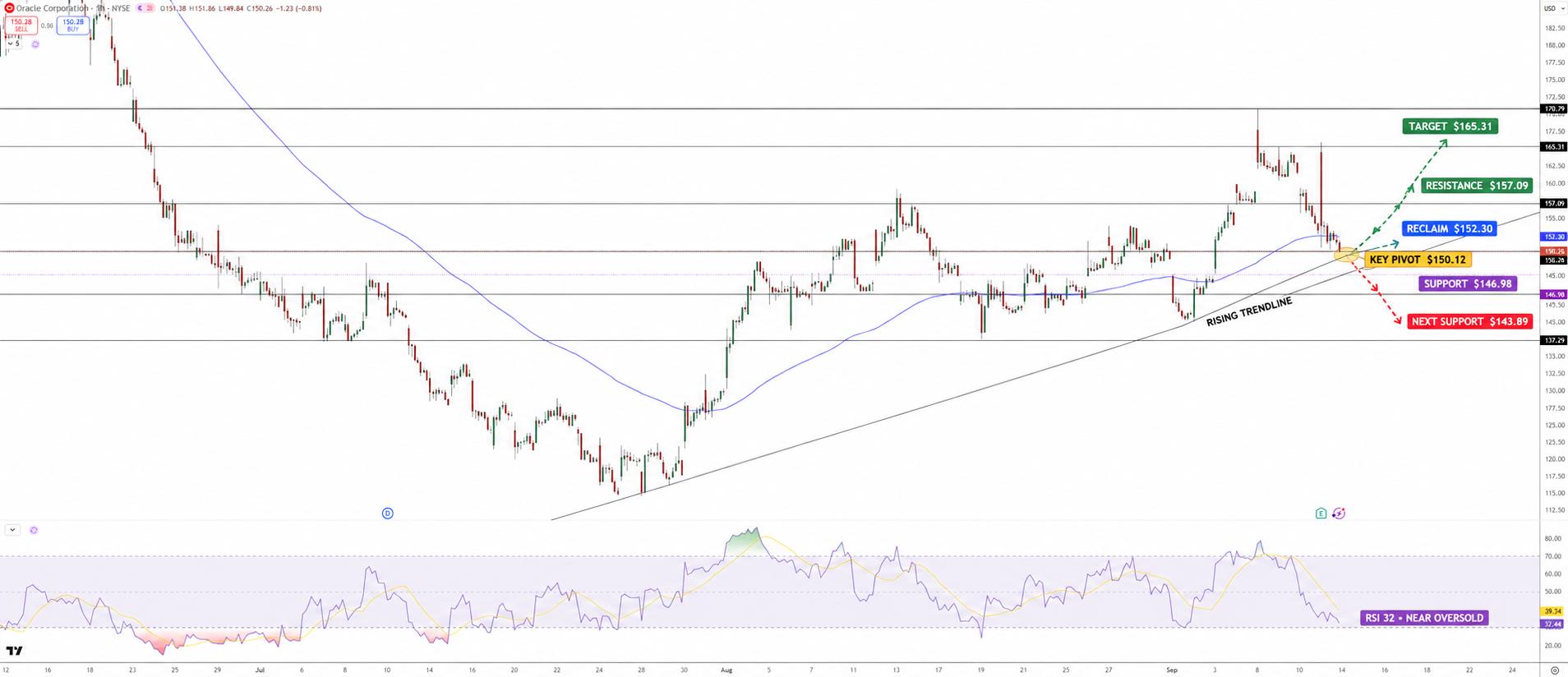
Oracle Stock Price Chart - Source: Tradingview
The RSI is around 32 with the signal line sitting near 39, so the market is close to becoming oversold, and selling pressure is present. However, enough of a stretch in the price has been achieved to warrant a possible technical correction if the price holds and buyers step in to defend support.
Defending $150.12 would be the goal to achieve the first of multiple recovery levels, with $152.30 and $157.09 being the next levels to reclaim as resistance.
A break below $150.12 weakens the support of the rising trendline and exposes $146.98 and eventually $143.89. Further price erosion would eventually bring $137.29 into focus
Key Levels
· Latest completed close: $150.28
· Immediate support: $150.12
· First recovery level: $152.30
· Breakout confirmation: $157.09
· Major resistance: $165.31
· First downside target: $146.98
· Secondary support: $143.89
· Deeper support: $137.29
· RSI: Around 32, near oversold
Why is Oracle stock in focus now?
The positive signal of AI demand during Oracle’s first quarter was overshadowed by other factors. Of particular interest to investors are negative free cash flow, planned capital expenditure $90 billion-$95 billion, dilution, and financing risk. The cancellation of Ellison’s sale and the recent AI-safety argument have drawn additional interest.
What level confirms an ORCL rebound?
A rebound would be supported by $157.09, and would be stronger at $165.31. Below $150.12, focus would shift to $146.98 and then to $143.89.
Bottom Line
AI growth will determine whether Oracle will overcome investor concerns of high capital that Oracle will address through OCI growth at 121% and RPO at $664 billion. Customer-funded infrastructure improves the economics. However, negative free cash, capex and debt remain outstanding concerns. Fragile levels are between $152.30 and $150.12. Falling below $150.12 sets focus to $146.98 and $143.89.
Recommended Articles






Comments (0)
Click the $ button, enter the symbol, and select to link a stock, ETF, or other ticker.