


Corning Surges Over 8% on Multi-Billion Dollar Fiber Deal With Verizon as AI Infrastructure Expansion Accelerates



AI Podcast


Verizon and Corning have signed a multi-year, multi-billion-dollar fiber optic supply agreement spanning 2027 through 2032, providing over 80 million miles of high-density fiber to expand U.S. broadband and support generative AI infrastructure. This partnership highlights a structural shift where optical fiber demand extends from traditional access networks to AI data center interconnections and cloud services. While the alliance enhances order visibility for Corning and supports Verizon’s AI Connect strategy, investors should monitor execution timelines, profit margins, capacity utilization, and broader telecom capital expenditure cycles.

TradingKey - On September 8 ET, Verizon (VZ) and Corning (GLW) announced the signing of a multi-year, multi-billion-dollar fiber optic supply agreement covering 2027 through 2032, involving over 80 million miles of high-density fiber to expand U.S. broadband access and build a high-density backbone network supporting generative AI computing demands.
Following the announcement of the agreement, Corning shares rose over 8% at one point to $166.75.
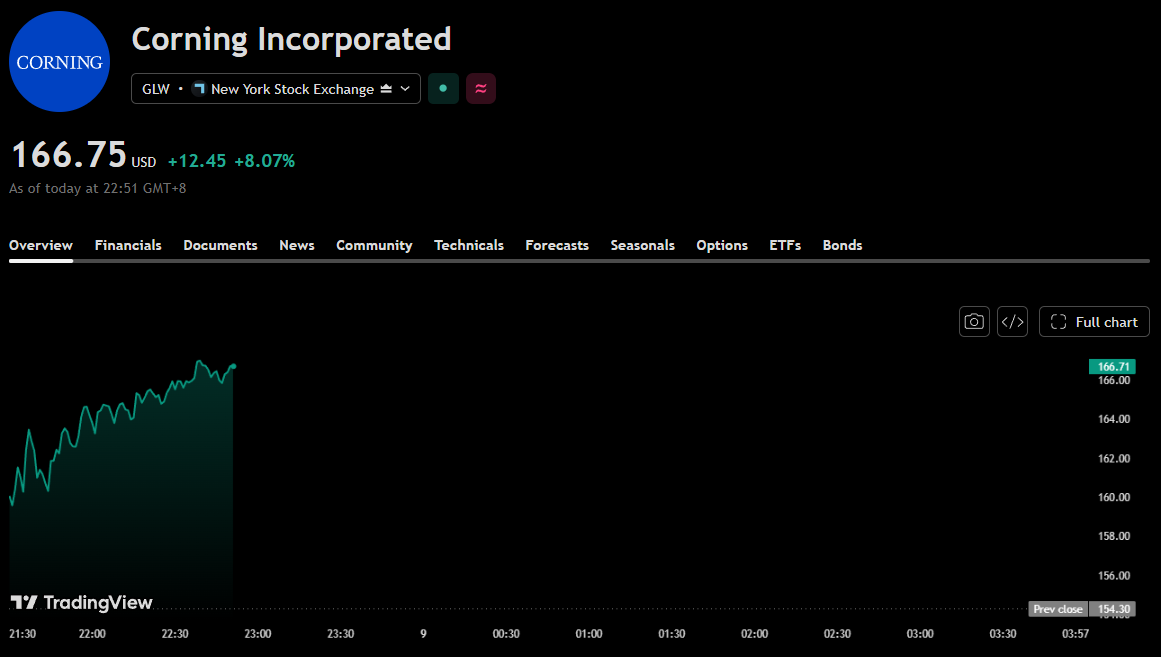
Source: TradingView
What the Verizon and Corning Agreement Includes
The focus of this agreement is not a one-time purchase, but a continuous supply arrangement centered on multi-year network construction. According to announcements from both parties, Corning will provide Verizon with over 80 million miles of high-density optical fiber solutions between 2027 and 2032, with a contract value reaching billions of dollars, although the exact amount was not disclosed.
Optical fiber is the infrastructure for fixed broadband, mobile backhaul, and data center interconnection. As video traffic, cloud services, and artificial intelligence applications continue to grow, carriers require higher-capacity, easier-to-deploy optical fiber systems to reduce the time and cost of network expansion. This agreement ties the supply cycle to Verizon's medium- to long-term network construction plans, demonstrating that fiber optic demand has extended from traditional access networks to AI infrastructure.
Kyle Malady, CEO of Verizon Business, stated that the partnership will help the company expand broadband coverage and meet customer demand for higher speeds and lower-latency connectivity. Meanwhile, Mike O'Day, Senior Vice President and General Manager of Corning Optical Communications, said that the collaboration will utilize optical fiber technology to connect homes, businesses, mobile networks, and data centers.
AI Infrastructure Becomes New Engine for Optical Fiber Demand
Training and inference for generative AI require massive amounts of data to be transmitted at high speeds among servers, storage systems, and data centers. If traditional network architectures fail to continuously boost bandwidth and reduce latency, they could become bottlenecks for computing power utilization and cloud service expansion. Consequently, investment in AI infrastructure encompasses not only GPUs, servers, and data centers, but also the high-capacity fiber-optic backbone networks that connect these facilities.
In its announcement, Verizon mentioned its "AI Connect" strategy, planning to directly connect data centers via ultra-high-density cables, targeting use cases for hyperscale cloud customers such as AWS. For such customers, network stability, scalability, and deployment efficiency are just as critical as bandwidth itself. High-density fiber can provide greater transmission capacity within limited conduit space, making it well-suited for the continuous expansion of data center clusters and metropolitan networks.
This means that the partnership between operators and fiber-optic suppliers is changing. In the past, fiber demand was mainly driven by residential broadband penetration and generational upgrades in mobile communications; now, cloud computing, AI computing power, and data center interconnections are becoming new sources of growth. The agreement between Verizon and Corning is a case in point of this shift in demand.
What It Means for the Industry and Investors
From an industry perspective, this agreement reinforces the logic of "connectivity as infrastructure." While investment focus in the AI value chain often centers on chips and data centers, data exchange between computing centers and cloud service delivery remain difficult to achieve without sufficient fiber-optic connections. The capital expenditure linkage among broadband operators, fiber-optic manufacturers, and cloud service providers could become a key variable to monitor in the telecom infrastructure industry.
For Verizon, the agreement supports expanding its broadband coverage, enhancing enterprise connectivity capabilities, and advancing its AI Connect strategy. Potential benefits include new broadband subscribers, enterprise network revenue, and demand for data center interconnections, though these gains will need to be realized gradually through subsequent network construction and customer contracts.
For Corning, long-term and large-scale orders enhance order visibility for its optical communications business and expand the application scope for its high-density fiber-optic products. Investors should continue to monitor the timeline of converting orders into revenue, optical communications profit margins, capacity utilization rates, and shifts in telecom operators' capital expenditure cycles.
This content was translated using AI and reviewed for clarity. It is for informational purposes only.
Recommended Articles








Comments (0)
Click the $ button, enter the symbol, and select to link a stock, ETF, or other ticker.