


Micron’s Taiwan Labor Dispute Continues to Escalate: What Does It Mean for MU and HBM Supply?



AI Podcast


Micron Technology faces escalating labor disputes in Taiwan, where unions representing two-thirds of its workforce demand increased performance bonuses and profit-sharing mechanisms amid record earnings. With over 60% of Micron's global capacity concentrated in Taiwan, a potential strike threatens DRAM and HBM shipments to major AI clients like Nvidia and Microsoft. Although the first round of mediation on September 4 failed, a second round is scheduled for September 21. If negotiations break down, production disruptions could severely impact the global HBM supply chain and squeeze future operating margins, making the mediation outcome a critical risk factor for investors.
TradingKey - In early September, global memory chip giant Micron Technology (MU)'s labor dispute in Taiwan continued to escalate. Two major unions, the "Micron Wafer Union" and "Micron Memory Union," are moving forward with strike procedures, with the main points of contention centered on performance bonuses and profit-sharing mechanisms.
On September 4, Asia-Pacific time, Micron completed the first round of formal mediation with the Taoyuan union. The two sides have not yet reached a consensus, but a second round of mediation has already been scheduled.
Why Is Micron's Taiwan Union Going on Strike?
Micron currently has approximately 15,000 employees in Taiwan, China, mainly across its two major production sites in Taoyuan and Taichung. The two unions combined have around 10,000 members, accounting for roughly two-thirds of the total workforce. An internal survey conducted by the unions in August showed that over 80% of participating members supported a strike.
For the third quarter of fiscal year 2026, Micron reported revenue of $41.46 billion, up 346% year-over-year, GAAP net income of $28.24 billion, and a Non-GAAP gross margin of 84.9%.
The unions contend that Micron's current personal performance bonus system lacks calculation transparency and caps bonuses, resulting in employee bonuses that fail to match the company's profit growth.
In response, the unions presented two key demands:
First, a one-time retroactive bonus, demanding an additional one-time bonus for fiscal year 2026, with each employee in Taiwan receiving an amount equivalent to 83 months of salary;
Second, institutionalized profit sharing, abolishing the current Incentive Pay Plan (IPP) system starting in fiscal year 2027 and instead allocating 15% of the company's operating profit into an employee bonus pool, with payout frequency changed from annual to quarterly.
Micron responded that performance bonuses for 2026 will reach an all-time high. Following the conclusion of the first round of mediation on September 4, the company stated that it will announce more details on incentives in the coming weeks, with the relevant IPP plan expected to be formally disclosed in October.
What a Strike Means for Micron and HBM
Taiwan, China is one of Micron's largest production bases globally. As of early 2026, Micron has cumulatively invested approximately NT$1.4 trillion (about $43.9 billion) in Taiwan, with more than 60% of its global capacity concentrated in Taiwan.
If a strike ultimately occurs and causes production disruptions, Micron's DRAM and HBM shipments in Taiwan will be directly impacted, potentially delaying capacity deliveries to AI server customers such as Nvidia (NVDA), Google (GOOGL), and Microsoft (MSFT). Given the current tight supply of HBM, a prolonged strike could also lead some customers to shift orders to Samsung or SK Hynix (SKHY).
In addition, Micron is building an advanced HBM packaging facility in Singapore and has acquired PSMC's Tongluo plant to expand its capacity in Taiwan. However, the Tongluo plant is not expected to enter mass production until 2028 and cannot replace existing capacity in the short term. Taiwan's production status remains unchanged for now.
If Micron ultimately compromises by significantly increasing performance bonuses or setting aside a portion of operating profit for a bonus pool, it will directly drive up labor costs and squeeze future operating margins.
How Will Micron Stock React?
[Source: TradingView]
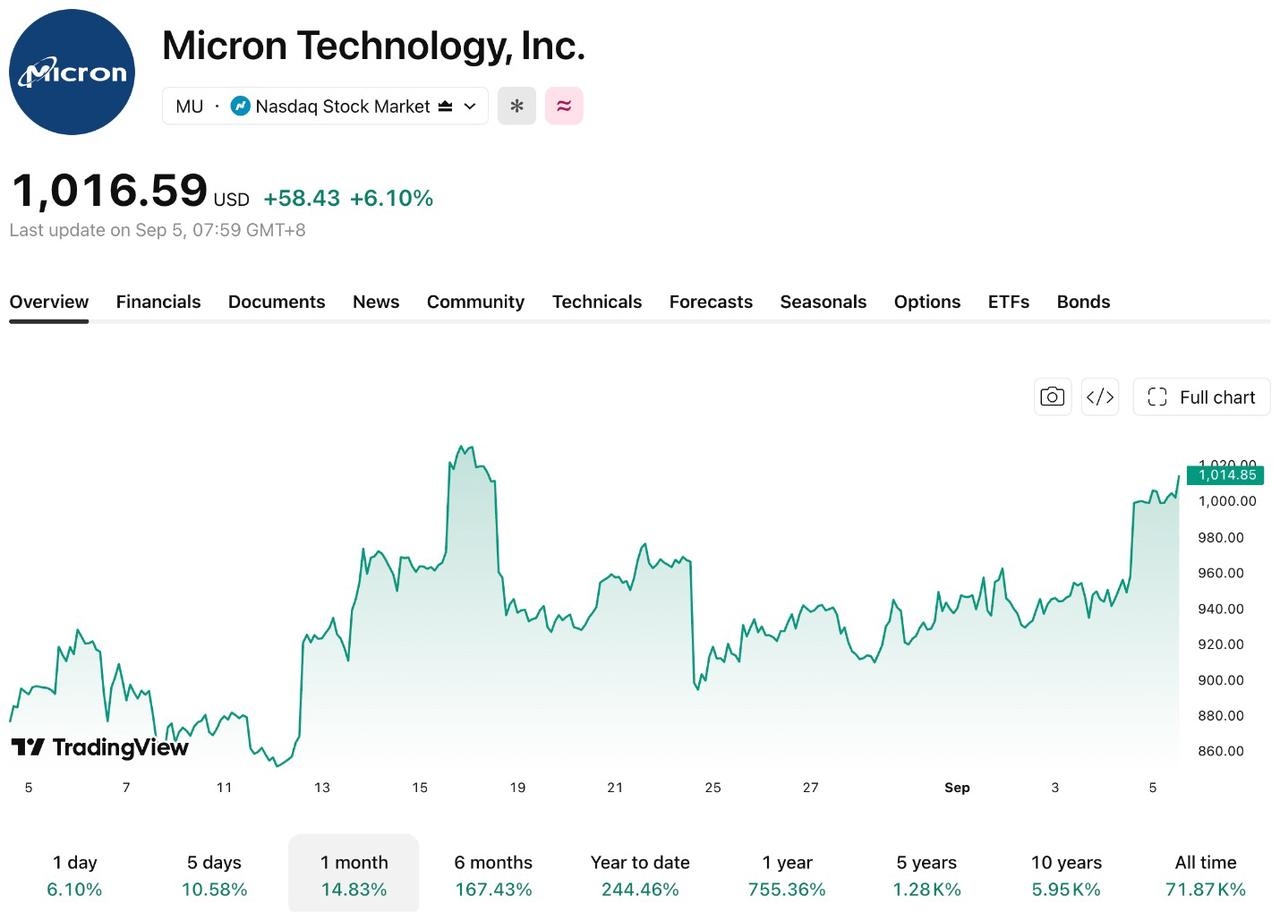
Following news of a strike on September 1, Micron shares closed down 2.64% for the day at $933.44.
On September 4, Micron shares rose 6.1% to close at $1016.59. While the three major U.S. stock indices weakened overall that day, the memory chip sector rebounded across the board, with SK Hynix ADR gaining 8.1% and SanDisk jumping 11.9%.
Reports from research firms indicate that demand for AI servers is keeping DRAM and memory product prices at elevated levels. The rise in Micron's stock price was driven more by industry fundamentals than by isolated labor news.
For investors, whether subsequent labor mediation can avert a strike remains the key. If mediation fails and leads to a strike, the market will re-evaluate Micron's production and supply risks; if the two sides reach an agreement, the easing of short-term overhangs could also serve as a marginal positive for the stock price.
How Are Samsung and SK Hynix Doing It?
In the current negotiations, the union at Micron Taiwan is also using the employee profit-sharing systems of Samsung Electronics and SK Hynix as benchmarks.
Samsung Electronics faced the threat of a general strike by its union in May 2026, originally scheduled from May 21 to June 7, before labor and management ultimately reached a tentative agreement prior to the walkout. The agreement included an average wage increase of 6.2% for 2026 and established a special performance bonus mechanism for the semiconductor business, with bonus payouts tied to operating performance. The union subsequently ratified the agreement with a 73.7% vote in favor.
Meanwhile, labor negotiations at SK Hynix lasted for about two months. On August 20, the two sides reached a preliminary agreement on the 2026 compensation and performance bonus package. Building on the previous system of allocating 10% of annual operating profit to employee profit-sharing, the payout structure was adjusted to 40% in cash and 60% in company stock, alongside a 6.3% wage increase. A portion of the stock bonuses included a lockup period. However, the agreement was subsequently rejected by employees; in an August 25 vote, 50.08% of voters opposed it, falling short of passage by a narrow margin of just 25 votes, sending both parties back to the negotiating table.
Because the profit scale, compensation structure, and payout benchmarks differ across the three companies, the union's benchmarking focuses on the profit-sharing mechanism rather than a direct comparison of employees' take-home pay.
What Happens Next?
Under Taiwan's Act in Settlement of Labor-Management Disputes, a labor union must first undergo mediation with management, and a strike vote can only be held if mediation fails. The Micron Taiwan union is currently still in the mediation phase.
The first round of mediation on September 4 failed to reach an agreement, and both sides have scheduled a second round for September 21. If negotiations break down again, the union will initiate the strike vote procedure, which requires approval from a majority of all members to legally strike. While over 80% of survey participants previously supported a strike, this was merely an internal intent survey and not a formal vote.
Micron stated that it will pay record-high performance bonuses this year and will disclose more incentive details in the coming weeks, with the related IPP plan expected to be officially released in October.
Micron needs to strike a balance among employee incentives, production stability, and shareholder returns. In the short term, the market should watch whether upcoming mediation can avert a strike. In the medium term, key factors to monitor include whether changes to the bonus structure will drive up costs and if the Taiwan production site will suffer actual operational impacts. An impact on the global HBM supply chain will only materialize if a strike actually occurs and continues to disrupt production.
At its core, the dispute centers on how employees and corporate management divide excess profits during a booming AI cycle. The outcome of negotiations at Micron Taiwan is not only an internal matter for the company, but could also serve as a reference point for tracking compensation and reward trends across the global memory industry.
This content was translated using AI and reviewed for clarity. It is for informational purposes only.
Recommended Articles











Comments (0)
Click the $ button, enter the symbol, and select to link a stock, ETF, or other ticker.