


Semiconductor Stocks Buck Trend as Micron Rises Over 4%; Trump Demands Big Fed Rate Cut



AI Podcast


On September 4 Eastern Time, stronger-than-expected August non-farm payrolls increased by 162,000, signaling economic resilience and diminishing recession fears while fueling Fed rate-hike expectations and sending Treasury yields higher. Despite macroeconomic rate pressures typically weighing on high-valuation growth sectors, U.S. semiconductors and memory stocks rallied sharply. This outperformance was driven by intact AI capital expenditure demand, supply tightness, and an industry expansion cycle. Furthermore, political calls for monetary easing and potential policy pivots helped offset rising interest rate concerns, allowing the semiconductor sector to temporarily outweigh broader valuation headwinds.

TradingKey - On September 4 Eastern Time, US August non-farm payrolls significantly exceeded expectations, fueling expectations of a Fed rate hike. Subsequently, US Treasury yields moved higher, with the 2-year Treasury yield hitting its highest level since January 2025.
The market expects the Federal Reserve may hike interest rates within a few weeks. According to the Chicago Mercantile Exchange (CME) FedWatch Tool, federal funds futures traders currently price in a 58% probability of a rate hike.
This better-than-expected jobs report was supposed to weigh on high-valuation growth stocks, but the US semiconductor sector rallied sharply in early trading today.
As of press time, the Dow Jones Industrial Average, the Nasdaq Composite Index, and the S&P 500 Index all fell slightly. However, the Philadelphia Semiconductor Index rose over 3%, with ASML (ASML) up 4.24%, Marvell Technology (MRVL) up 4.21%, Intel (INTC) up 3.71%, AMD (AMD) up 2.91%, and Nvidia (NVDA) up 2.68%.
Memory stocks strengthened across the board, with SanDisk (SNDK) up 6.74%, Seagate Technology (STX) up 5.12%, Western Digital (WDC) up 4.34%, Micron Technology (MU) up 4.09%, and SK Hynix (SKHY) up 3.86%.
What Signal Did Nonfarm Payrolls Data Send?
U.S. nonfarm payrolls increased by 162,000 in August, significantly higher than market expectations of around 53,000; the unemployment rate remained at 4.1%, in line with expectations. Meanwhile, employment data for June and July were revised upward. This suggests that previous market concerns regarding a rapid deterioration in the U.S. labor market may have been overdone, and the U.S. economy still demonstrates a degree of resilience.
From an asset pricing perspective, this report carries two implications: first, the risks of an economic recession and sharp corporate capital expenditure cuts have diminished; second, the Federal Reserve lacks urgency in the short term to rapidly cut interest rates due to labor market weakness. The latter implication dominated the initial reaction following the data release: the U.S. dollar strengthened, Treasury yields rose, and market bets on the Fed maintaining a tight policy stance or even raising rates in September intensified.
Semiconductor and AI stocks typically feature higher valuations and longer duration, making their share prices sensitive to real interest rates, Treasury yields, and liquidity expectations. Therefore, strictly from the perspective of macro rate transmission, strong nonfarm payrolls are closer to a "negative" than a "positive". This explains why U.S. stock index futures came under pressure following the release, while reactions in the bond and gold markets were distinctly hawkish.
How Trump’s Call for Rate Cuts Could Change the Market Narrative
Trump posted on social media platform Truth Social that strong employment data shattered market expectations, and cited the improvement in U.S. credit conditions to demand that the Federal Reserve cut interest rates. He also stated that the U.S. should have the lowest interest rates in the world, viewing high interest rates as a burden on U.S. competitiveness and financing conditions.
While Trump's statements cannot directly determine Fed interest rates, they influence market perceptions of policy dynamics. Their core role is not to turn strong non-farm payrolls into evidence for rate cuts, but to convey a clear policy direction to the market: the White House will continue to push for monetary easing. On the day employment data fueled rate-hike expectations, these statements served to partially offset the upward pressure on interest rates.
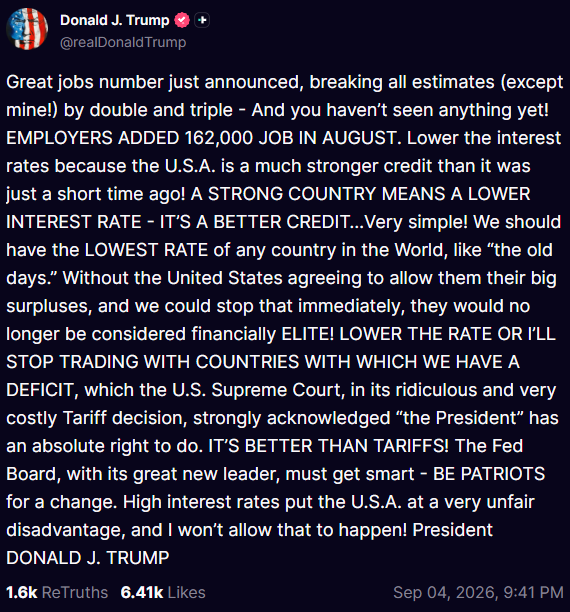
[Source: Truth Social]
What Is the Real Reason Semiconductor Stocks Are Rising?
First, the economy has not stalled, and the thesis behind AI capex remains intact.
Nonfarm payrolls significantly beating expectations shows that, at least for now, the US economy is not undergoing the rapid deceleration that the market had previously feared. For semiconductors, this means investment plans from cloud providers, enterprise clients, and data centers have not been broadly cut due to recession expectations. The tailwind of strong employment for chip stocks stems more from demand-side resilience than from interest rate easing.
In addition, the AI hardware boom remains strong enough to outweigh macroeconomic interest rate disruptions.
Currently, capital remains focused on segments such as AI servers, advanced computing, memory, and optical communications. If the market believes that AI infrastructure investment is still in an expansion cycle, then earnings expectations driven by industry orders, supply tightness, and rising product prices could temporarily outweigh valuation pressures from rising yields.
Finally, Trump's statements provided a "policy hedge."
Following the nonfarm payrolls release, if the market were left with only the single narrative of "strong data leads to higher rates," sustaining the semiconductor rally would be more difficult. Trump's call for rate cuts allowed the market to continue trading the possibility of a policy pivot; combined with relatively dovish remarks from some Fed officials, growth stocks gained some breathing room.
This content was translated using AI and reviewed for clarity. It is for informational purposes only.
Recommended Articles









Comments (0)
Click the $ button, enter the symbol, and select to link a stock, ETF, or other ticker.