


Micron Stock Price Forecast: Will MU Retest $740 Low Amid Looming Strike?



AI Podcast


On September 1 ET, Micron Technology shares dropped over 2% premarket due to strike threats from labor unions representing nearly 10,000 workers at its Taoyuan and Taichung plants in Taiwan. Driven by opaque bonus systems and Korean peer benchmarks, workers demand massive bonuses and profit shares. A strike threatens critical HBM and advanced DRAM supplies for AI customers, risking operational delays, margin compression, and global labor domino effects. Consequently, Micron's stock faces downside risks toward $740 or $450 if mediation fails, while a successful settlement could catalyze a rebound toward the $1,000 threshold.
TradingKey - On September 1 ET, Micron Technology (MU) shares fell more than 2% in premarket trading due to threats of a strike wave by labor unions at its Taoyuan and Taichung plants in Taiwan. Reportedly, out of approximately 15,000 employees at the Taoyuan and Taichung facilities, the two major unions represent nearly 10,000 workers, and an internal survey shows that over 80% of members support strike action. However, why are the unions initiating a strike, and what impact will it have on Micron's production capacity and stock price?
Why Is Micron's Taiwan Union Striking?
The core reason why the unions at Micron's Taoyuan and Taichung plants in Taiwan prepared and voted in favor of a strike intent lies in the huge discrepancy between record operational profits fueled by the AI boom and the actual profit-sharing and bonus system for frontline employees. Benefiting from surging demand for HBM3e/HBM4 and high-end DRAM in AI servers, Micron's gross margin and net profit recently reached record highs. Frontline employees believe that while they bear high-intensity capacity pressure on the front lines, their actual earnings do not reflect the company's prosperity.
In addition, Micron's bonus system lacks transparency. The incentive compensation plan currently used by Micron is determined by company and individual performance. The union alleges that the calculation metric formulas are extremely opaque and overly tied to revenue growth rather than actual profit, resulting in employees failing to receive corresponding profit sharing when the company's profits surge.
While these may be long-standing issues at Micron, the trigger was likely benchmarking against South Korean peers. Among them, Samsung's semiconductor division and SK Hynix (SKHY) both have explicit operating profit-sharing mechanisms, leading Micron's Taiwan employees to feel that their compensation significantly lags behind their South Korean peers. Ultimately, the Micron union put forward three core demands:
- One-time retroactive bonus: Demanding a one-time performance bonus equivalent to 83 months of salary for fiscal year 2026 in line with high profits.
- Institutionalized profit sharing: Demanding a fixed allocation of 15% of operating profit starting from fiscal year 2027 to form an employee bonus pool, with payouts changed from annual to quarterly.
- Reform of bonus calculation methods: Demanding open and transparent financial profit-sharing metrics to prevent arbitrary adjustments by the company.
What Impact Will Taiwan Strike Have on Micron?
Taiwan is Micron's core global memory manufacturing and packaging base. If mediation fails and escalates into an actual strike, it will directly impact Micron's operations. The Taiwan facilities host the vast majority of Micron's High Bandwidth Memory (HBM3e/HBM4) and advanced DRAM production lines. Any capacity reduction or work stoppage on these lines would directly delay capacity deliveries to AI server customers such as Nvidia (NVDA), Google (GOOG), and Microsoft (MSFT), potentially exposing Micron to customer compensation claims and even prompting some AI customers to shift orders to competitors like SK Hynix or Samsung Electronics.
Conversely, if Micron's management ultimately compromises and satisfies the demands of the Taiwan union—such as setting aside a portion of operating profits as a bonus pool or significantly raising performance bonuses—it will directly push up personnel and operating costs, thereby squeezing future operating margins. Even more critically, this is highly likely to trigger a domino effect, prompting facilities such as the Woodlands site, Hiroshima plant, Sanand plant in Gujarat, Penang plant, and Muar plant to follow suit with similar demands.
How Is Micron's Stock Price Trending?
Since surging to $1,255.00 in late June this year, Micron's stock price has continued to fall, dropping to around $740 in late July. Subsequently, Micron's stock price staged an oversold rebound, briefly rising above $1,000, but failed to hold above that threshold. It is currently fluctuating in a narrow range below the $1,000 level, forming a descending channel, a classic bearish pattern.
In mid-September, if Micron fails to prevent a strike wave led by its union in Taiwan, its stock price could move downward to retest the $740 bottom. If Micron's factories worldwide follow suit with strikes demanding higher bonuses, the stock price could break below this support level, with the next line of defense at $450. Of course, once a mediation agreement is reached, the short-term negative sentiment weighing on the stock price will turn into a catalyst for a rebound, driving another push toward the $1,000 mark.
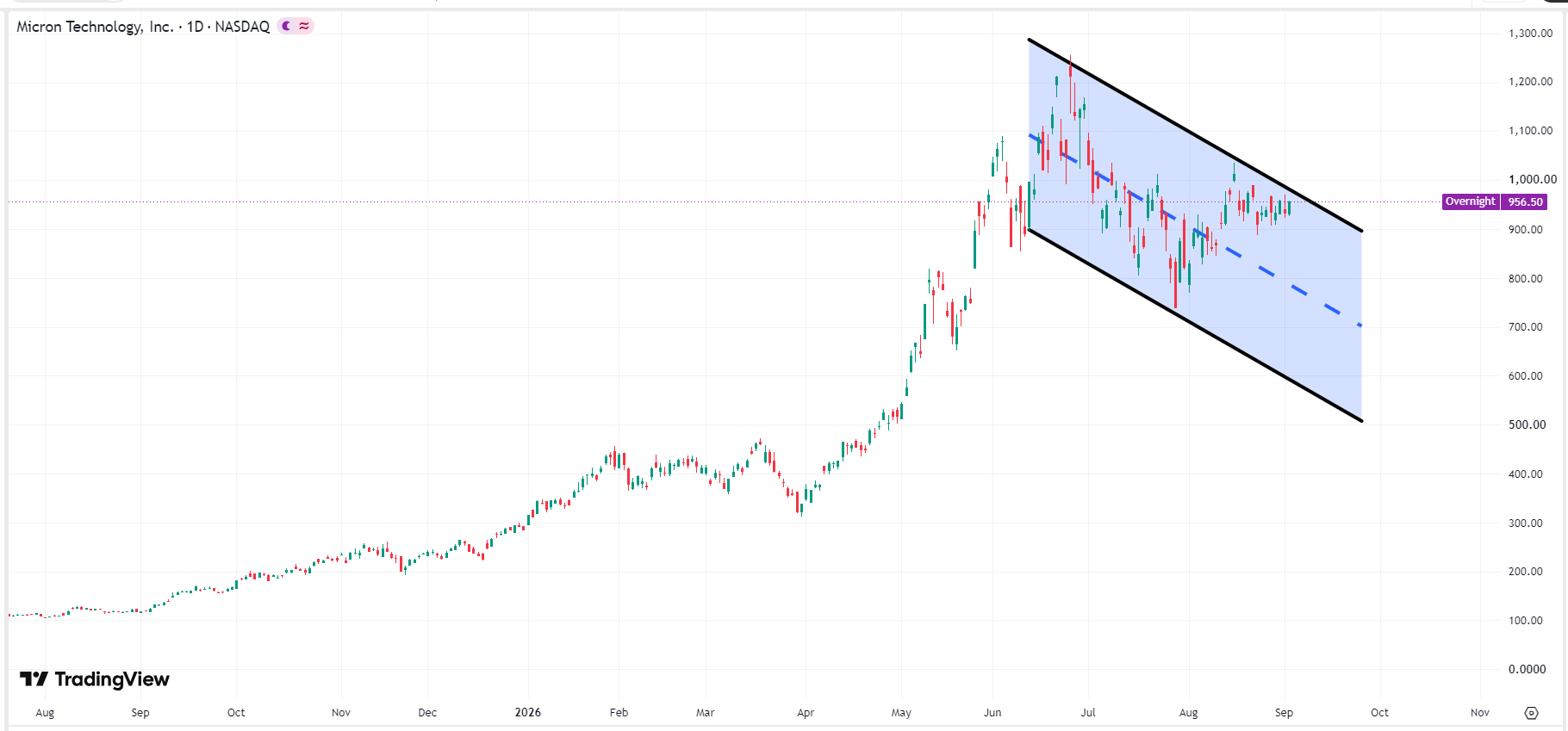 Micron stock price chart, Source: TradingView
Conclusion
Micron's Taiwan union voted in favor of a strike mandate due to an opaque bonus system and benchmarking against South Korean peers, demanding an 83-month lump-sum bonus and a 15% share of operating profits. A strike could impact HBM and DRAM capacity as well as profit margins; if mediation fails, MU's stock price could retest $740 or even $450; if a settlement is reached, it could rebound toward $1,000.
This content was translated using AI and reviewed for clarity. It is for informational purposes only.
Recommended Articles










Comments (0)
Click the $ button, enter the symbol, and select to link a stock, ETF, or other ticker.